

Everyone agrees that a lot of new American buildings are ugly. Scan any neighborhood forum, any city council hearing, any urbanist Twitter thread, and you will find near-universal consensus on this point: the blocky five-over-ones, the black-and-white “gentrification buildings,” the unornamented apartment blocks that have colonized commercial corridors from Seattle to Charlotte. Nobody likes them. The “ugly is fine” YIMBYs concede the premise when they tweet “I don’t care if it’s ugly, people need homes.” The NIMBYs concede it when they invoke design review boards as the last line of defense against aesthetic ruin. Both sides agree on the diagnosis. Both sides are wrong about the cause.
The standard explanation for the ugliness of contemporary American development points to developer greed, architectural laziness, or the inevitable tradeoffs of building at scale. The more important answer is regulatory: zoning codes, parking mandates, setback requirements, use separations, and the discretionary design review process have collectively created a narrow corridor of permissible building forms, and most developers are rationally optimizing within it.
If the ugliness is a product of regulation, then the remedy runs in the opposite direction from what NIMBYs propose: abolish the zoning codes and design review processes that constrain form, invest in the urban systems that produce collective beauty, and let the emergent intelligence of thousands of small actors do what committees cannot.
I should be clear about my commitments. I want to abolishing zoning and discretionary design review, to the point that it makes some YIMBYs uncomfortable on that front. I also want to stress that we urbanists and YIMBYs, part of a tradition that stretches from Jane Jacobs through New Urbanism through Strong Towns, a tradition that has always cared deeply about what cities look like. The “I don’t care if it’s ugly” posture adopted by a vocal faction within the movement is a deviation from that tradition, and it is both empirically unsupported and strategically counterproductive.
I should be precise about what I am criticizing. YIMBYism is an internet-native movement, and that is one of its great strengths. As a commenter said before, the internet is what allowed people who experience the diffuse benefits of new housing, future residents, priced-out renters, to find each other and organize in a way that previous generations of social scientists assumed was impossible. The Minneapolis YIMBYs made memes. Online discourse built the coalition.
What I am objecting to is not online advocacy but a specific annoying rhetorical concession: the claim that aesthetics do not matter, that ugliness is an acceptable price for units. That concession is loud but not representative of the broader movement. Ryan M Allen , a professor at Soka University of America who writes the newsletter College Towns , offered us a better frame for the common enemy in our conversation with him: not “NIMBYs” as people, but “freezing our towns in amber and endless sprawl.” The aesthetics question is central to both halves of that formulation.

If you care about building more housing, you should care about what it looks like. Not because beauty is more important than shelter (it isn’t) but because the evidence suggests you don’t have to choose.
The tools designed to produce beauty are producing ugliness
Since 1994, Seattle has subjected most new apartment construction to “design review,” in which building proposals must win approval from a volunteer citizen board. Dan Bertolet of the Sightline Institute undertook an exhaustive analysis of how this process actually functions. What he found should trouble anyone who believes that committee oversight produces better buildings.
Seattle’s design review board postponed approval of a 400-unit, transit-oriented development with 168 subsidized homes, objecting to the color, the presence of a ground-floor daycare, and the shape of the building. The East Design Review Board delayed 110 affordable homes and a daycare above Capitol Hill Station because they considered the design “really good” but not “great.” An ECONorthwest analysis found that projects in 2018 took 84 percent longer to move through the permitting process than comparable projects in 2010.
These are not isolated anecdotes. Architects in Seattle report that developers routinely choose worse designs to avoid triggering the design review threshold. As one architect told Sightline: developers’ first question is whether they can avoid design review, and firms regularly see “good clients building indifferent projects because the ‘better’ idea that we are pitching triggers a requirement for design review.” The process does not merely delay good buildings. It actively incentivizes bad ones.
In New York, the Landmarks Preservation Commission rejected a proposal to replace a crumbling two-story brick building with a superior design featuring a glass-and-metal storefront and a delicate brick screen. The original building, the commission determined, was “reflective of the period of significance.” Housing that survives this pageant arrives in a diminished state: delayed, downsized, and bearing rents that reflect months or years of regulatory compliance rather than the cost of beauty.
Design review was built in good faith. The intuition behind it (that aesthetic quality matters to communities, that citizen input should shape the built environment) is not unreasonable. We take that intuition seriously. The problem is that the process does not deliver on its own premises. Jack Nasar’s research on urban design aesthetics identifies the formal variables that drive positive aesthetic responses: order, moderate complexity, and elements of familiar styles. But design review boards optimize for consensus, not for any coherent aesthetic principle. The result is architecture designed to offend no one, which is to say architecture that delights no one. As of the early 1990s, 83 percent of surveyed American cities had adopted some form of design review. We could not locate a single peer-reviewed study demonstrating that these boards produce measurably better aesthetic outcomes than unreviewed construction.
Mark R. Brown, AICP, CNU , an urban planner and the writer of Car Free America , showed us what the alternative to committee review looks like. In our interview, he described Giralda Avenue in Coral Gables, Florida, a formerly struggling two-lane street with parallel parking that was pedestrianized through a design-driven process. “Each component of the project was considered a piece of art, from the planters to the pavers to the color of the tiles,” Brown told us. The street is now the most vibrant row of restaurants in the city. After construction, a rezoning allowed residential uses and balconies, further activating the space. The aesthetic success was not incidental to the project’s political success. It was the engine of it.

But Giralda Avenue was not produced by a volunteer design review board evaluating whether a building was sufficiently “great.” It was produced by a Business Improvement District and City Commission with a specific design vision and the professional capacity to execute it. Design vision works. Design-by-committee does not.
The zoning trap
The design review problem sits atop a deeper structural issue: the underlying zoning codes that constrain architectural form in ways that make individual buildings worse and urban systems ugly.
Parking minimums alone distort form dramatically: ground-floor parking podiums, setback requirements for surface lots, and the sheer volume of building dedicated to car storage rather than human habitation. Use separations prevent the mixed-use ground floors that give streets their vitality. Height limits in residential zones force density into narrow commercial corridors, creating the abrupt transitions between single-family homes and mid-rise apartment blocks that generate the most visceral opposition.
Adrian Pietrzak and Tali Mendelberg of Princeton have shown through survey experiments that people react negatively to buildings that are architecturally “out of place” relative to the height or style of surrounding buildings. They call these “contextual development preferences,” and they are real and consequential. But zoning itself creates the mismatches. By restricting height in some areas and concentrating density in narrow corridors, zoning forces the very contextual mismatches that generate opposition. The system produces the disease it claims to cure. Exclusionary zoning created the built form, the built form created aesthetic expectations, and those expectations now drive opposition to anything that departs from them.
Allen’s work on college towns confirms this at the ground level. He observed that the best urbanism in many American cities survived around universities, not because of design review, but because campuses accidentally preserved the pre-war built environment. “A lot of the best urbanism that we can see in some of the small towns comes from university towns,” he told us, “because they sort of act as a natural city.” Students don’t have cars. The campus maintained walkable density. Pre-war structures that were demolished elsewhere survived near universities because there were always people walking there, because you couldn’t easily sprawl students out.
The aesthetic quality that people love in college towns like Ann Arbor, Chapel Hill, and Madison was not produced by design review. It was produced by walkable density, mixed use, and the absence of parking-driven sprawl, and it survived despite the zoning regime that destroyed the same quality everywhere else.
Allen crystallized the absurdity with a single observation about Disneyland. Walt Disney, he told us, was “inspired by his hometown and his wife’s hometown, sort of these ideas of an idyllic version of a city or a town that was no longer existing.” So Disney built a replica. “What’s funny is it costs $120, $130, whatever it costs now... to go in and walk down this town. And that feeling used to be in every town across the country.” We regulated away the beauty. Now we pay to visit a facsimile.
Ugly buildings, beautiful city
Tokyo is filled with plain, unremarkable, even ugly individual buildings. The concrete is often bare. The facades are often flat. The signage is often cacophonous. And yet Tokyo is, by wide consensus among urbanists, architects, and ordinary visitors, one of the most beautiful and livable urban environments on earth. This paradox contains the most important lesson in the entire aesthetics debate: beauty in cities is an emergent property of urban systems, not a feature stamped onto individual buildings by review committees.
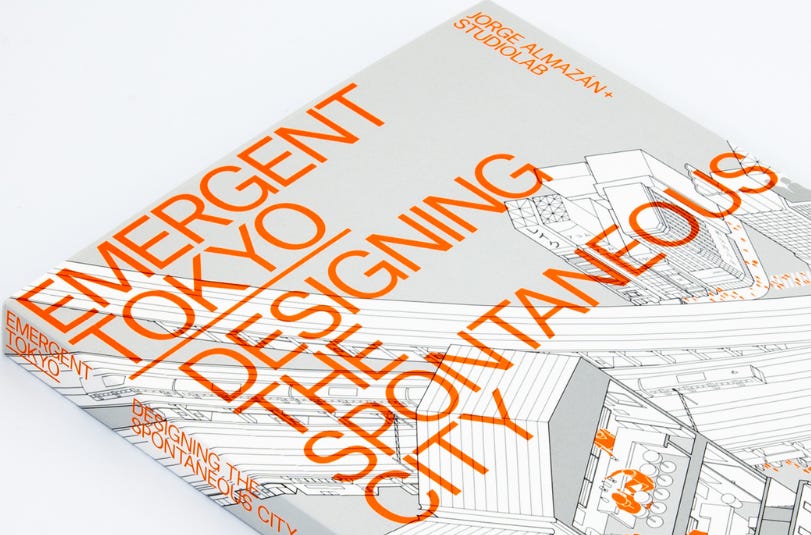
Jorge Almazán, a Tokyo-based architect and professor at Keio University, spent years studying what makes Tokyo work. His book Emergent Tokyo: Designing the Spontaneous City, written with Joe McReynolds and his Studiolab research team, identifies five distinctive urban typologies that produce Tokyo’s collective beauty from individually unremarkable parts. Yokochō alleyways: narrow lanes of micro-bars and restaurants, chaotic and cramped, that are among Tokyo’s most beloved spaces. Zakkyo buildings: mixed-use vertical structures stacking small businesses on upper floors in combinations that would be illegal under virtually every American zoning code. Dense low-rise neighborhoods of small wood-frame houses on tiny lots, where residents create micro-gardens on their doorsteps that beautify the streetscape emergently. The beauty arises not from any of these typologies in isolation but from the system that connects them.
In an interview on the Compounding Podcast, Almazán described how Tokyo’s street network creates what he calls “pocket neighborhoods.” Efficient arterial roads form the exterior boundary; inside is a dense maze of small streets that cars avoid because they are inefficient to navigate. “Without forcing people,” Almazán explained, “just because of the structure of the city itself, what you have is that basically people or cars crossing those areas tend to go slowly.” The result is naturally walkable, car-light neighborhoods, without any explicit pedestrianization or design mandate.
And the walkability generates beauty. When you walk slowly through a neighborhood, you notice: the micro-gardens, the shop fronts, the varied building forms, the textures and asymmetries that would be invisible from a car at 45 miles per hour. Almazán described residents contributing “a little bit to the community by putting small pots, even cultivating small trees... When you walk through many of these neighborhoods... you see the personality of everyone.” No committee mandated it. It emerged from thousands of individual decisions within a permissive regulatory environment.
Almazán himself cautions that the emergent urban spaces he documents cannot simply be dropped into other cities. Some of what makes Tokyo’s plain-building beauty work is culturally specific: the micro-garden behavior reflects norms of collective public stewardship that are not easily legislated, and the jijikai (neighborhood self-governance associations) operate through social consensus mechanisms that are not how Americans resolve land-use conflicts.
But the culturalist explanation can be taken too far. What is replicable is structural: Japan’s national zoning framework with 12 cumulative use categories, which constrains nuisance without constraining form; the small-lot structure that allows individual landowners to build at varied scales; the mixed-use permissions that make zakkyo buildings legal; the transit investment that creates walkable catchment areas; and the absence of mandated aesthetic review. No design review board evaluates whether Tokyo’s buildings are beautiful. The beauty emerges from the system.
The American comparison, and the Houston objection
The contrast that should trouble us is not between Tokyo and Kyoto, or Tokyo and Singapore. It is between Tokyo and American cities that have individually more beautiful buildings but collectively uglier urban environments, precisely because they police individual facades through design review while neglecting the urban systems that produce collective beauty.
San Francisco has some of the most individually beautiful residential architecture in the United States: the Painted Ladies, the Victorians, the Edwardian rowhouses. It also has one of the most aggressive design review and historic preservation regimes in the country. The result: a housing crisis so severe that median rent exceeds $3,000, tent encampments within sight of million-dollar homes, a city that has frozen its beauty in amber while the human cost mounts. San Francisco has beautiful buildings. It does not have a beautiful city, because beauty at the system level requires dynamism, affordability, and the presence of actual people, not just facades.
Santa Fe, New Mexico, mandates a Pueblo Revival aesthetic: every building in the historic district must conform to a specific adobe style. The result is not beauty but uniformity, a theme-park homogeneity that visitors find charming and residents find stifling. Meanwhile, outside the mandated zone, the city sprawls in the standard American pattern. The distinction between mandated local style (Santa Fe) and organic local style is crucial. The former produces uniformity. The latter produces genuine beauty.
Georgetown, in Washington, D.C., enforces historic preservation so strict that individual window replacements require commission approval. Meanwhile, the District’s housing affordability crisis deepens. The aesthetic preferences of existing homeowners have been codified into law, at the direct expense of people who need homes.
In every case, the pattern is the same: beautiful buildings in a small preserved zone, surrounded by sprawl, car dependency, and housing scarcity. Tokyo inverts this entirely. It prioritizes systemic qualities (walkability, mixed use, density, architectural freedom) and produces a city that is collectively beautiful even though most individual buildings are plain.
At this point a skeptical reader will raise the obvious question: What about Houston? Houston has no zoning ordinance, the closest thing to what we are proposing that exists in a major American city. And Houston’s aesthetic reputation is not Tokyo’s.
Houston eliminated the wrong half of the equation. The city removed use restrictions but did not invest in the system-level qualities that produce collective beauty. Houston has no comprehensive transit network creating walkable catchment areas. Its streets are engineered for automobile throughput, not pedestrian experience. And Houston retains extensive private deed restrictions that function, in many neighborhoods, as de facto zoning.
But Houston’s failure is not simply a matter of neglect. It is structural. The same fragmented governance that prevented Houston from adopting restrictive zoning also prevents it from building coherent systems: coordinated transit, competent water management, walkable infrastructure. And the Texas Department of Transportation operates as a parallel authority that widens highways regardless of what local residents want, actively degrading the walkability that our argument identifies as the aesthetic precondition. Houston didn’t just choose not to build the system. Houston’s governance makes system-level investment structurally difficult, and the state highway authority works against it.
This does not mean Houston’s freedom produced nothing beautiful. It did. The Beer Can House, the Orange Show, the folk-art vernacular that could never survive a design review board: these are exactly the kind of individual creative acts that architectural freedom enables. But they remain isolated curiosities you drive to, not part of a collective streetscape you walk through. Freedom produced the beauty. The missing system is what would have connected it.
The Houston case does not disprove the thesis. Eliminating restrictions on what you build is necessary but insufficient. You must also invest in the system around what you build, and you need governance capable of doing so: the walkable streets, the transit, the human-scale infrastructure that enables the emergent beauty we find in Tokyo, in college towns, in the pre-war American main streets that Disney had to replicate. Houston removed the zoning without building the system.
The beauty of working with what exists
The Tokyo case demonstrates this pattern at the city scale. But the evidence extends further, into adaptive reuse, local design revival, and the uncurated spaces that fragmented ownership produces.
Adaptive reuse, the repurposing of existing buildings for new functions, is one of the most reliable pathways to aesthetically successful development. It is also 15 to 30 percent less expensive than new construction and can be completed up to 30 percent faster. The World Economic Forum reported in 2025 that reusing built assets emits 50 to 75 percent less carbon. And multiple projections estimate that 90 percent of real estate growth within the next decade will involve adaptive reuse rather than new construction.
The aesthetic case is equally strong, though less often articulated. Reused buildings retain proportions, materials, structural details, and spatial relationships that took decades to develop, what we might call accumulated aesthetic capital. Older buildings predate modern climate control and were designed with thick walls, awnings, high ceilings, and large windows for functional reasons: temperature control and natural light. These features are also precisely the qualities people find beautiful.
Calvin Chua, an architect whose Singapore-based firm Spatial Anatomy works across challenging contexts in Asia, showed us how adaptive reuse operates in practice. In our interview, Chua drew a sharp distinction between high-capital “landmark” reuse (converting a power plant into a museum) and the community-focused reuse that he finds more compelling. An example that was brought up was Karl Bengs, a German architect who has spent years renovating abandoned kominka (traditional Japanese houses) in dying rural villages. Bengs is not building tourist attractions. He what he wants to do is building actual homes, based on local designs. He applies modern techniques to preserve traditional forms, embracing local design vocabulary honestly, not through committee mandate (the Santa Fe model) but through an architect responding to place, materials, and community need. The aesthetic quality is central to the project’s success: people move to these renovated villages partly because the buildings are beautiful, and partly because they are real.
Chua’s own research on Singapore’s strata malls revealed a different dimension of uncurated beauty. Strata-titled malls let individuals own shops outright, not rent them. Any building change requires 80 percent owner approval. “Because the ownership structure is so fragmented,” Chua explained, “it’s very hard to curate what shops get to exist in there. But at the same time, because of the lack of curation, this subculture or unique shops start to emerge in these strata malls.”
The uncurated interiors are among Singapore’s most culturally vibrant spaces. Some owners refuse million-dollar buyout offers because the malls function as what Chua describes as “retirement villages,” places with their own ecosystems, where the sense of purpose and community is embedded in the fragmented, unmanaged structure of the space. The spirit emerged because the space was uncurated. No property management company dictated what went where.
A comparison that you can draw between Singapore’s strata malls and American strip malls, both of which have fragmented ownership and eclectic tenants. But American strip malls are car-oriented and surrounded by parking lots, while strata malls are embedded in walkable, transit-rich neighborhoods. Same ownership structure. Radically different aesthetic outcomes. The variable, once again, is the urban system.
Why urban systems produces beauty
We have now surveyed the evidence across multiple contexts: Seattle’s design review failures, Tokyo’s emergent beauty, Japanese rural revival through adaptive reuse, Singapore’s uncurated strata malls, American college towns, and American cities that froze individual beauty in amber while their collective systems decayed. The pattern is consistent. The mechanism operates through five channels.
First, diversity of form. When thousands of individual actors build on small lots with minimal regulatory constraint, the result is a varied streetscape with different heights, materials, setbacks, and uses. Nasar’s research identifies moderate complexity as a key driver of positive aesthetic evaluation. Zoning and design review suppress complexity by mandating uniformity.
Second, walkability as aesthetic enabler. The aesthetic experience of a city requires pedestrian-speed movement. Walkability is not merely a transportation policy. It is an aesthetic precondition. Almazán’s pocket neighborhoods, Allen’s college towns, and Brown’s Giralda Avenue are all places where people walk, and therefore where people see.
Third, temporal dynamism. Tokyo rebuilds its average building every 30 years. The built environment constantly adapts to current needs and tastes; unsuccessful buildings get replaced, successful ones get imitated. A regulatory regime organized around preventing change is an aesthetic straitjacket.
Fourth, bottom-up curation. The most beloved urban spaces (Tokyo’s yokochō, Singapore’s strata malls, the pre-war American main streets) were not designed by committees. They were curated from below: individual shop owners, residents, and small builders making independent decisions that accumulated into coherent streetscapes. This is the process that Cozzolino (2021) describes as “the joint yet individual action of numerous actors on various scales” producing “rich, coherent and harmonious built environments.”
Fifth, existing structures as aesthetic capital. Adaptive reuse preserves proportions, materials, and spatial relationships that took decades to develop. Each generation builds on what the last created, rather than starting from zero under new regulatory constraints.
We can already hear the objection from the “ugly is fine” faction: that we are romanticizing Japanese farmhouses, backyard cottages, and micro-gardens over the thing that actually matters, which is units. The strongest test of this framework comes from the most unlikely source: Soviet commie blocks. Nobody romanticizes them. Gray prefabricated concrete panels, assembled like industrial Lego, repeated across thousands of sites from Budapest to Vladivostok. And yet, as urbanist Adam Something has documented, the residential areas built around these buildings routinely outperform brand-new private housing developments in livability. The reason is the system. Soviet-era planning placed kindergartens, schools, doctors’ offices, parks, supermarkets, and public transit within walking distance of every apartment. Street plans excluded through traffic. The buildings were ugly. The neighborhoods were livable. New luxury developments built nearby, with individually superior architecture but no investment in surrounding services, cannot match them.
If the system-level argument holds even for commie blocks, the ugliest mass-produced buildings on earth, it holds everywhere. Get the system right and even ugly buildings produce good neighborhoods. Get the system wrong and even beautiful buildings produce broken cities.
We are not arguing against units. We are arguing that the system around the units determines whether those units produce neighborhoods people actually want to live in. The commie blocks delivered massive quantities of housing, fast and cheap. But the achievement endured because the surrounding system was good. Units matter. The system around them matters more.
To be clear: we are not endorsing the political system that produced commie blocks. But the urban planning insight, that neighborhoods need services, walkability, green space, and transit within reach of every front door, was correct. The Soviets achieved it through authoritarian mandate. Our proposal achieves it through architectural freedom and capital incentives.
The political science: why this is urgent
Everything we have argued so far could be dismissed as an aesthetic preference. A wave of recent political science research makes that dismissal untenable. Aesthetic judgments causally determine whether people support housing development.
David Broockman, Christopher Elmendorf, and Joshua Kalla, political scientists at UC Berkeley, UC Davis, and Yale, published a working paper in 2025 demonstrating that aesthetic concerns about housing are, in their words, “widespread, not pretextual, and causally affect support for development.” Their experimental evidence shows that manipulating the aesthetic quality of proposed buildings changes support levels: ugliness reduces support even when it poses no threat to quality of life. These are not NIMBY rationalizations. They are sincere aesthetic judgments that drive real political behavior.
Their most striking finding cuts against the standard NIMBYism narrative. Homeowners in already-dense areas supportdense development in their neighborhoods, indeed more so than homeowners in single-family neighborhoods. People who live in collectively beautiful dense environments support more density. That is the Tokyo effect translated into American political science. The market confirms what the research suggests: walkable, aesthetically coherent neighborhoods command the highest property values in their cities. Poundbury’s home prices consistently run above the surrounding Dorset market. The pre-war college-town neighborhoods this essay celebrates are among the most expensive real estate in America. People vote with their wallets for pretty, walkable places. That is not sentimentality. It is revealed preference at scale.
Pietrzak and Mendelberg’s study, published in Urban Affairs Review in 2025, adds a crucial finding to the contextual preferences we discussed earlier: fit matters more than height itself. A taller building that matches its surroundings is often more acceptable than a shorter one that clashes. And buildings that don’t fit prompt intentions to engage in costly political behavior, like attending public meetings, pressuring officials, organizing neighbors. Support rarely mobilizes symmetrically. This asymmetry explains why public hearings skew toward opponents of new housing.
The strongest real-world test of whether beauty can overcome opposition is Poundbury, King Charles’s New Urbanist development on the outskirts of Dorchester in Dorset. Poundbury gets the system right in almost every way our argument demands. It is mixed-use, with over 260 businesses and 2,750 jobs integrated alongside housing. Thirty-five percent of homes are affordable, built to the same standard as market-rate units and indistinguishable from them on the street. There is no use-separation zoning; homes, shops, offices, and factories share the same streets. The architecture draws on local Dorset vernacular, designed by Léon Krier to create walkable density at human scale. Even The Guardian, which once ridiculed the place as “fake, heartless, authoritarian and grimly cute,” later conceded that “a growing and diverse community suggests it’s getting a lot of things right.” The Sunday Times named it one of the best places to live in Britain. Home prices have steadily risen, demand consistently outstrips supply, and the model has been replicated at Nansledan in Cornwall and Tornagrain in Scotland. On the merits, Poundbury is a success.
And yet. When the Duchy of Cornwall attempted to replicate the Poundbury model at South East Faversham in Kent, proposing 2,500 homes designed by the same architect (Ben Pentreath) to the same standards, the project was met with fierce local opposition. The Faversham Society called it “an existential threat to the very nature of the town.” National newspapers ran headlines about a local revolt. What is significant is what the objections were not about. They were not about aesthetics. As Building Design reported, design was barely mentioned in the objections; the opposition focused on traffic, loss of farmland, and strain on services. Even the original Poundbury was not immune: the Ramblers called it a “ghetto,” and existing Dorchester residents opposed its expansion. The British Social Attitudes Survey found that about seven percent of people are more likely to support new housing because it is better designed. In a fight decided by who shows up to the meeting, seven percent is not a rounding error. But it is not a majority, and it cannot do the work alone.
The Faversham case refutes the hypothesis, adopted as UK government policy under Housing Secretary Michael Gove, that “communities will welcome development when it is beautiful.” Beauty alone will not accomplish this. But notice what beauty did accomplish at Faversham: it took design off the table as an objection. Nobody at the public meetings complained that the buildings were ugly. The opposition had to find other grounds, and the grounds they found (traffic, services, infrastructure) are precisely the system-level failures our argument identifies as the real source of opposition. Beauty cleared one obstacle. It cannot clear them all, and treating it as a substitute for system investment is the error. Poundbury itself succeeded because it paired beautiful buildings with system-level investments: mixed use, walkable streets, integrated employment and affordable housing. But Poundbury also required thirty years of patient capital from a royal estate with no shareholders, a model its own estates director acknowledges volume housebuilders cannot deliver. And its beauty is enforced from above, not emergent from below: residents need Duchy permission to change their front door color. This is mandated beauty, closer to Santa Fe than to Tokyo. Strip the system and keep the facades and you get Faversham’s opposition. Build the system and let the beauty emerge and you get Tokyo.
Allen’s college-town observations confirm the dynamic at the local level. In Lubbock, Texas, neighbors fought a student housing development proposed across from the Texas Tech campus. The university is going through with it, Allen told us, but the opposition wasn’t really about the students. It was about the high-speed stroad between the neighborhood and the campus, which “looks like a highway drag strip.” The ugliness is in the infrastructure, not the building. Fix the system and the aesthetics follow.
The feedback loop that emerges from this research is the key to the entire argument. Zoning constrains building form, producing ugly buildings. Ugly buildings generate aesthetic opposition. Aesthetic opposition justifies more zoning. Around and around. But breaking the cycle requires understanding who is in it, because the research describes two distinct populations, not one.
The hardline NIMBYs, Allen’s “freezing in amber” crowd, will oppose any development regardless of what it looks like. Faversham proves this. These opponents are not making aesthetic arguments in good faith. They are using aesthetics as a socially acceptable wrapper for opposition that is really about preventing any change at all. You will never convince them. The BIMBY hypothesis (Beauty In My Back Yard, the idea that beautiful buildings will melt opposition) wastes political capital trying. And it hands the hardliners a new veto: “It’s not beautiful enough,” which is exactly the logic that let Seattle’s design review board reject affordable housing for being merely “good.”
Then there are the persuadable: people who are not reflexively opposed to development but who care sincerely about what their neighborhood will look like afterward. This is the population that Broockman’s research captures. Their aesthetic concerns are real, not pretextual. They respond to contextual fit (Pietrzak and Mendelberg). They are more supportive of density when they already live in attractive dense environments. For this group, aesthetics is a valuable tool in a larger set: not the argument that wins the fight on its own, but the one that tips the balance, clears design objections off the table, and builds places people will fight to protect once they exist.
The YIMBY who tweets “I don’t care if it’s ugly” is making a specific strategic error: handing the hardliners a weapon to use on the persuadable. The hardliner can now say, “See? They admit it’ll be ugly. They don’t care about your neighborhood.” The “ugly is fine” faction thinks they are being tough-minded and pragmatic. What they are actually doing is collapsing the persuadable into the hardliner camp by conceding the aesthetic premise. It is not a principled stand. It is an unforced error, and the hardliners are grateful for it.
What’s the idea?
The case for abolishing zoning and design review is well established in the YIMBY literature. We will not rehearse the standard arguments. What I want to focus on is what comes after abolition: the specific development forms and financing structures that can produce the emergent beauty we have been describing.
Accessory dwelling units and accessory commercial units
The closest thing to the emergent process in America already has a name. Two names: Accessory Dwelling Units (ADUs) and Accessory Commercial Units (ACUs). I know it’s not the same, but in practical terms, it’s what most communities can use.
ADUs (the backyard cottages, garage conversions, and above-garage apartments that cities from Portland to Los Angeles have begun to legalize) add architectural diversity at the lot level. A neighborhood of identical ranch houses with a scattering of backyard cottages and converted garages has more visual complexity, more of the moderate complexity that Nasar’s research identifies as a driver of positive aesthetic response, than the same neighborhood without them. The American Planning Association notes that research does not support fears about ADUs degrading neighborhood character; there are indications they do the opposite.
ACUs are the less familiar but arguably more transformative cousin. As the APA’s December 2025 Zoning Practicearticle defines them, ACUs are “small-scale, often homeowner- or tenant-operated businesses integrated into primarily residential lots”: corner coffee kiosks, backyard salons, garage bicycle repair shops. ACUs are the American re-legalization of what Tokyo’s zakkyo buildings already do and what American neighborhoods did naturally before use-separation zoning made it illegal. As Garlynn Woodsong wrote for the Congress for New Urbanism, “We used to build mixed-use neighborhoods in our cities that freely mixed the retail destinations people need with the residences where they live, in very close proximity.” Zoning ended this. ACUs would restart it at the smallest, least disruptive scale.
Both ADUs and ACUs produce collective beauty through the same channels we identified: diversity of form, bottom-up curation, and mixed use. They also avoid the “contextual misfit” problem that Pietrzak and Mendelberg show triggers political opposition. A backyard cottage fits because it is small-scale and owner-driven. A garage-front salon fits because it faces the sidewalk at human scale. These are not five-over-ones dropped into single-family zones. They are incremental, bottom-up, fine-grained additions that produce the closest thing to the Tokyo effect at the neighborhood level.
The cost paradox and the case for cheaper capital
Here is where the policy problem becomes acute. ADUs and ACUs are the cheapest total-cost form of new development. A detached ADU typically costs $150,000 to $350,000, a fraction of conventional multifamily construction. An ACU built from a converted garage or a prefab shed can cost as little as $10,000 to $30,000.
But they are also, paradoxically, the most expensive form of development per square foot. The reason is structural: every ADU, regardless of size, requires a kitchen, a bathroom, utility connections, a foundation, permits, and design work. These are fixed costs that do not shrink with the unit. When you spread them across 500 square feet instead of 2,000, the per-square-foot figure climbs steeply.
This cost paradox means that the development form with the greatest potential to produce collective beauty is also the form most punished by the current financing environment. Conventional mortgage products and construction loans are designed for conventional buildings on conventional lots. ADUs and ACUs fall into what one practitioner calls a regulatory liminal space: not quite a home, not quite a commercial building, not quite a renovation, and therefore not quite eligible for the financing products designed for any of those categories.
This is where the capital-incentive proposal becomes essential. The existing federal incentive structure already differentiates by policy goal: the Low-Income Housing Tax Credit makes capital cheaper for affordable housing (only in a permissive zoning environment); the Historic Tax Credit makes it cheaper for preservation; Opportunity Zones steer investment to low-income communities (whenever investment is effective is a different story). We propose two layers of capital reform.
The first layer: make capital cheaper for all small/mid-scale development. ADUs and ACUs are made possible because homeowners’ own access to capital. Adaptive reuse and incremental infill should have access to financing products designed for their scale. This means grants, low-interest construction loans, and tax credits specifically targeting the fixed-cost problem: subsidizing the permitting, design, and utility-connection costs that make small units disproportionately expensive per square foot. California’s $40,000 ADU grant and New York’s Plus One ADU Program are steps in this direction, but they remain piecemeal and underfunded relative to the scale of the opportunity.
The second layer: make capital cheapest for development that meets objective, system-level aesthetic criteria based on the fact that they is a premium created by said criteria. Not criteria evaluated by a committee, but criteria checkable by staff on a site plan: mixed-use ground floors with active frontage, pedestrian-oriented building placement (entrance on street, no setback parking), use of local or regionally sourced materials, adaptive reuse of existing structures, contextual height transitions, and green or activated public frontage. These criteria incentivize the system-level qualities that the research identifies as producing collective beauty, without requiring anyone to evaluate whether a facade is “good” or “great.”
We anticipate the objection that even “objective” aesthetic criteria add a compliance layer. The distinction is categorical, not cosmetic.
Design review is a veto gate. You cannot build until the committee approves. The standards are subjective. The process adds months or years. And because the gate is binary (approved or rejected) the rational developer minimizes risk by designing below the review threshold, which means designing worse.
A capital incentive is an optional bonus. You can build regardless of whether you meet the aesthetic criteria. Meeting them unlocks cheaper financing. Not meeting them imposes no penalty beyond forgoing the bonus. The homeowner who builds a standard ADU is no worse off than today. The homeowner who orients the ADU toward the sidewalk with an active frontage and uses local materials gets a lower interest rate or a larger grant.
Veto gates reduce housing supply. Optional bonuses do not. Veto gates concentrate power in committees. Optional bonuses distribute it to homeowners, small builders, and neighborhood entrepreneurs. The mechanisms are opposites. But the criteria must genuinely be objective and checkable by staff. “Mixed-use ground floor with active frontage” can be verified on a site plan. “Contextually appropriate massing” cannot. The moment the criteria require subjective judgment, the bonus becomes a gate. The line is real and it must be held.
Allen’s observation that the YIMBY conversation is too centered on New York and San Francisco has direct implications here. Smaller cities and college towns have lower development costs, more existing building stock suitable for adaptive reuse and ADU conversion, and neighborhoods where ACUs could reintroduce the walkable commerce that zoning eliminated.
What the evidence demands
Tokyo is not beautiful because its individual buildings are beautiful. It is beautiful because its urban system (walkable, mixed-use, human-scale, architecturally free) allows thousands of small decisions to compose into something collectively splendid. San Francisco has beautiful buildings and a broken city. Houston has freed its buildings but is limited by it’s fragmentation and being a plaything of TxDOT. Tokyo has plain buildings and a beautiful, functional, livable whole. The variable is the system. It has always been the system.
Every YIMBY who tweets “I don’t care if it’s ugly” is giving the hardliners ammunition to spend on the persuadable. Every NIMBY who invokes beauty to block all development is using aesthetics as a veto, not a value. Both positions are wrong, but they are wrong in different ways, and the difference matters. The hardliners cannot be converted and should not be catered to. The persuadable can be won, and aesthetics is one of the tools that wins them, but only as part of a larger set. The error is treating beauty as a substitute for system investment, not treating beauty as a tool worth using. The way to win is to build the systems that make beauty emerge: walkable streets, mixed use, architectural freedom, and cheaper capital for the small-scale development that produces it. The argument that collective beauty is an emergent property of free urban systems, not a product of committee oversight, is not a compromise between these positions. It is the position that makes both of them obsolete.
There some inherent constraints though, that have to be catered for; which planning process does provide oversight on - the total capacity of sewers and the electrical grid; ground type and how buildings can realistically get, ability to cater for delivery vehicles (because people are inevitably going to move)/fire trucks, the capacity of schools and other community infrastructure.