

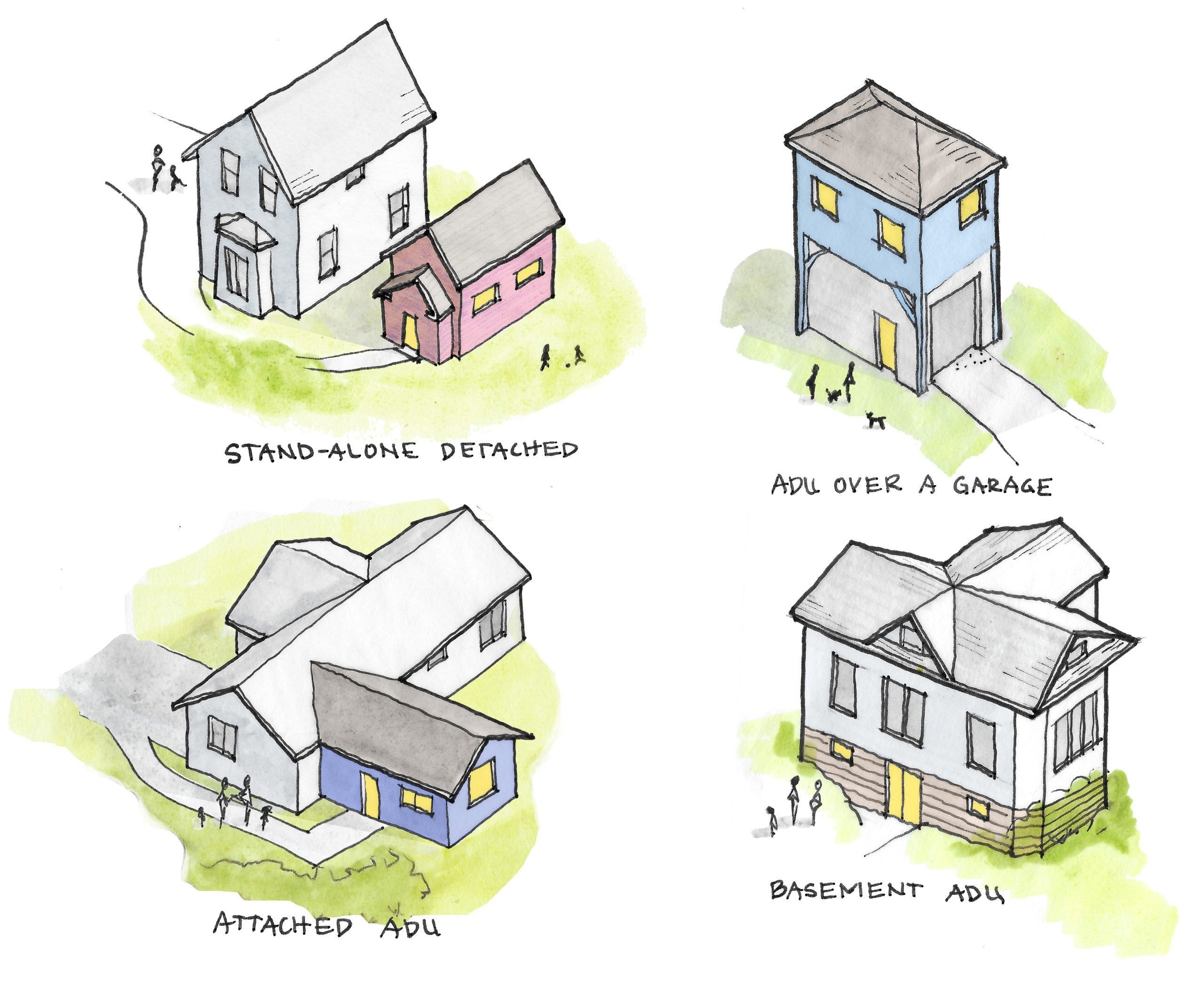
Here is a fact that should not be true.
A detached accessory dwelling unit in Los Angeles costs $200--$600 per square foot to build. A unit in a conventional apartment building costs $150--$250. On every metric of construction efficiency, the apartment wins. The ADU is a bespoke backyard project with fixed costs that barely budge whether you build 400 square feet or 800. The apartment is an industrial product: 200 identical units sharing one foundation, one elevator core, one set of plans. Any first-year real estate finance student could tell you which is the efficient way to house people.
And yet.
California permitted 1,269 ADUs in 2016. By 2019: 14,702. By 2023, Los Angeles County alone permitted more than 45,000. One in three homes now permitted in the city of LA is an ADU, in neighborhoods where apartments hadn’t been built in forty years. Meanwhile, national multifamily production has been stuck at roughly 350,000 units a year for four decades. Through booms and busts, through low rates and high. The line barely moves.
So the expensive, inefficient option is the one that’s actually scaling, while the cheap industrial product can’t get out of its own way. Understanding how this trick works is the key to understanding how housing actually gets built in America. And the YIMBYs reading this (who have spent years fighting zoning battles and are understandably impatient) may find the mechanism delightfully underhanded.
Are You Asking (The Right) Question?
It is easy for housing advocates to hyper-focus on this question: How do we reduce the cost of producing a housing unit? That question leads to debates about modular building, materials innovation, labor costs, and construction productivity. Reasonable debates, sometimes very fun and certainly very important, but almost entirely beside the point.
The key question: What does it actually take to get a unit built, occupied, and on the market?
Ask that, and something interesting happens (as we see in real life). A $300,000 ADU where the homeowner already owns the land, already has equity to finance it, and can get a ministerial permit in 60 days has a total cost to the system that is far lower than a $200,000-per-unit apartment that took 3 years to entitle, 12 months to secure a construction loan, 24 months to build, and required $50 million in institutional capital. The ADU’s construction cost premium is the price of bypassing every bottleneck that makes housing expensive to produce in America.
That premium turns out to be a bargain.
Paul Williams’s Raising the Housing Investment Level documents the bottlenecks with precision. FHA’s 221(d)(4) program, on paper one of the best construction financing products ever designed, takes 270--360 days to close versus 60--90 for conventional financing. Banks have tightened construction lending since 2022. And the result is visible in a single statistic: Williams estimates that roughly 750,000 multifamily units sit in a “shadow pipeline”. Entitled by local planning departments, having survived the multi-year gauntlet of public hearings and environmental review, but not yet applying for building permits because the financing isn’t there. Beyond that, another 117,000 units are formally authorized but haven’t broken ground. The pipeline is clogged at every stage. Multifamily starts fell 25% in 2024 to just 354,000 units, on top of a 14% decline in 2023, even as completions from the 2021--2022 boom continue to deliver, outpacing new starts by over 220,000 units in the past year. The pipeline is draining and not refilling.
ADUs skip all of this. The homeowner is the capital source (home equity), the decision-maker, and the developer. One person, one kitchen-table conversation, one HELOC application. 53% of California ADU builders paid cash. The average Massachusetts homeowner sits on $337,000 in tappable equity. There are 70 million owner-occupied single-family homes in this country. After legalization, each one is a pre-entitled development site with a pre-qualified capital source and a motivated builder.
A System Designed to Produce Nothing
Here is a sequence a typical apartment project must survive: land acquisition → discretionary zoning entitlement (public hearings, design review, political negotiation) → environmental review (NEPA, CEQA) → architectural design → construction financing (its own underwriting, appraisal, committee process) → building permit (plan review: 6--12 months) → construction (18--36 months) → certificate of occupancy → permanent financing takeout. Every stage involves different actors, different requirements, different timelines, and projects die in the handoffs between them.
Williams describes the FHA version: applications move through a fragmented chain, different specialists reviewing the appraisal, market study, cost estimate, sponsor financials, with no single person owning the deal. A 2016 Inspector General audit found the “single underwriter” reform was never actually codified. A 2024 follow-up found HUD still tracked assignments on manual spreadsheets across five regional centers. This program finances 10,000-15,000 units a year, roughly 4% of multifamily production, in a country short 3 to 4 million homes.
The ADU system: one decision-maker, one site, one ministerial permit, one contractor, one financing decision. Decision to occupancy: 6-12 months. The system is lean not by design but by accident. The unit of production is too small for complexity to accumulate. The homeowner feels every cost overrun and every rent check directly. No principal-agent problem. Especially in cities with pre-approved plan programs, fewer moving parts means fewer ways to fail.
The per-square-foot premium is an escape tax. You’re paying to leave a system so broken it can barely function.
It’s Not Housing Policy. It’s a Product.
A common theme among marketing and advertising is that value is perceived, not objective. A $2 cup of coffee becomes $6 in a ceramic mug with good lighting. Some marketers calls this alchemy.
In that sense, ADUs are alchemy.
The homeowner deciding to build one is not performing a pro forma. She’s thinking: Mom is getting older and I want her close but not in my kitchen. My daughter graduated and can’t afford rent. My property taxes went up and $2,500 a month would change everything.
It is a family decision, a retirement decision, a keeping-up-with-the-Joneses decision. The housing unit is a byproduct. FHFA data shows California properties with ADUs appraise at $1,064,000 versus $715,000 without, a gap growing at 9.34% annually since 2013. Homes with ADUs sell for 20-35% more. One study found a 40 to 60% average increase in property value. Rents run $2,000-$4,000 per month. And the land, the single largest cost in multifamily (often 30--50% of total project cost), is already paid for. She already owns it.
Her comparison isn’t “ADU versus apartment per unit.” It’s “ADU versus doing nothing and missing the rental income, the appreciation, or it’s a solution for Mom.” At almost any construction cost, the ADU wins.
I am puzzled by, well, actually I laugh at economists puzzled by the cost premium (yes, I am aware that some economists are aware of this, some just really want to stick with the purity of Econ 101 or just plain hate Econ 102 or 202 ie microeconomics). They assume all actors optimize on the same variable. The homeowner is optimizing on a bundle (financial, emotional, practical) that’s invisible to macro analysis. The premium looks irrational only if you ignore everything she actually cares about. Housing production is just a side effect.
The implication for YIMBYs, and this is the part that should make you grin, is that we have more ways on top of political advocacy to increase the number of units in a city. Once legalized, tactics like figuring out how to market ADUs are on the table or working with local and state-level developers and banks on something that can get units online ASAP.
Preying on NIMBY Self-Interest
Here is where the alchemy gets unsettling in the best possible way.
The NIMBY who opposes the apartment building on her block will never stop being a NIMBY. She will show up to every hearing, file every appeal, fund every lawsuit. NIMBYism is a political identity, not a misunderstanding, and she’s not going to grow out of it.
But that same NIMBY will build an ADU in her backyard without blinking. Not because she’s been converted (she hasn’t) but because what’s good for her is, in her mind, different from what’s good for everyone else. The apartment threatens her neighborhood and brings strangers she didn’t choose. The ADU enriches her property and houses Mom, or a tenant she screens personally, who pays $2,500 a month. Same unit of housing. Completely different calculus, because self-interest overrode principle.
People cheerfully exempt themselves from rules they impose on others when doing so is profitable. A crafty YIMBY can prey upon that (which is another article in itself!).
The play: make it as easy, as profitable, and as frictionless as possible for everyone , including NIMBYs to build ADUs after ADUs are legalized, knowing they’ll keep fighting every apartment, every triplex, every upzoning. The pitch is: Your home is your biggest asset. Here’s how to make it work harder for you. Here’s the pre-approved plan. Here’s the HELOC calculator. Here’s what your neighbor earns in rent. Here’s where Mom could live. The word “density” never appears, and the housing unit gets built anyway.
You don’t need converts, just to appeal to the more self-interested actors inside a permissive regulatory framework. The NIMBY builds her ADU for the same reason Willie Sutton robbed banks: that’s where the money is.
And every ADU she builds makes the next affordability fight easier. Not because she changes her mind, but because the neighborhood changes around her. One ADU on a block is invisible. Five normalize density. Ten make the “character of the neighborhood” argument sound ridiculous, because the neighborhood already has ADUs and I want one. Greed, not ideology, is the transmission mechanism. California ADU permitting grew 42-76% every year from 2016 onward, driven largely by neighbor-to-neighbor diffusion. She built one. I want one too.
Why the Battle Stays Won
ADU legalization is fought once, at the legislative level, and once it’s law, individual projects are ministerial: no hearing, no council vote, no neighbor veto. The YIMBY movement fights the one battle that matters, and then self-interest handles the rest.
Auburn, Maine proves this beautifully. Mayor Jason Levesque, “The YIMBYest City in America”, spent six years pushing ADU legalization, form-based code, and zoning reform. Permits spiked from 26 units in 2021 to 237 in 2022. Then in November 2023, he got crushed 62--38 by Jeff Harmon, a retired state police deputy chief who had literally sued a housing development near his property.
The NIMBYs won the election, but ADUs stayed. The ADUs are standing, the apartments are occupied, and the reforms were not repealed, because a new mayor can’t unbuild a house. Levesque lost, but the production outlasted his political career. And while Auburn is now certainly going after other types of housing, Levesque-era ADU regulations are left mostly alone.
(YIMBYs: if you take nothing else from this piece, take Auburn. Win the legislative fight. Let self-interest handle the rest. The housing survives the backlash.)
Jersey City: The Sophisticated Version
Auburn is the optimistic case: a blunt NIMBY who can’t unbuild houses. Jersey City under Mayor James Solomon, who took office in January 2026, is the worrying one.
Solomon is no Jeff Harmon. He doesn’t oppose development. He knows better. He concedes openly that “rents would be higher if a lot of those buildings hadn’t been built.” He understands supply and demand. He understands that Jersey City produced 13 homes per 1,000 residents in 2024, twice as many apartments as all of Queens, and that this production is why the city remains livable for working families. He is pursuing policies that will reduce future building anyway, and he knows it.
Within six days of taking office, Solomon signed an executive order auditing all 100+ active tax abatements in Jersey City, framed against a $250 million budget deficit he inherited. He campaigned on raising the inclusionary zoning mandate to 20% affordable units in all major new developments. He voted against every luxury tax abatement brought before him on the council, including what he called “the Pompidou, a $150 million giveaway to the Kushner family”(Kushner Companies, Jared Kushner’s family development firm, is a major Jersey City builder). The rhetoric is progressive, but he knows what the math does.
Jersey City’s current inclusionary zoning ordinance requires 10-15% affordable units. No project has yet broken ground at the 15% rate. Not one. Solomon wants 20%. An independent analysis by Better Blocks NJ, using the financials from an actual audited Jersey City project, calculated that making a universal inclusionary mandate work would require tax abatements for every covered project, costing roughly $184 million annually in foregone property tax revenue. The analysis concluded that the most probable outcome is “no affordable housing is built under the Solomon plan in the short run, while in the long run, housing development grinds to a halt.” Solomon has a Harvard public policy degree and can read a pro forma. He knows this.
The small-developer squeeze is where the cynicism becomes structural. Solomon’s proposals target “projects of 50 or more, 100 or more” units, with the exact threshold left deliberately vague. The PILOT audits, the inclusionary mandates, the compliance overhead: these are costs that Kushner Companies, with its legal department and government affairs team, can absorb. A small or mid-sized developer building their first 30-unit apartment project cannot. The large firm negotiates carve-outs and restructures deals around new requirements. The small firm looks at the regulatory uncertainty, the audit threat, the inclusionary math that doesn’t pencil, and builds in Hoboken instead.
Notice what is absent from Solomon’s housing platform: any mechanism to actually fund new housing production. No revolving construction loan fund like MassHousing’s $20 million ADU program. No state HFA acceleration fund like the ones Williams describes in Massachusetts, New York, and Michigan. No subordinate financing to unstick stalled projects. No streamlined permitting. His entire framework is extractive: audit existing abatements, mandate inclusionary units from developers, cap rent increases, collect development fees. Every policy takes from the production pipeline and none puts capital into it. For a man with a Harvard public policy degree who concedes that supply matters, that’s not an oversight.
The construction trades noticed. During the 2025 mayoral race, the Hudson County Building and Construction Trades Council endorsed Bill O’Dea, not Solomon. So did the Hudson County Central Labor Council, the Teamsters, and IATSE (the stagehands’ and technicians’ union). The workers who pour concrete and frame walls looked at Solomon’s platform and backed someone else. Solomon’s labor support came from SEIU 32BJ, which represents building serviceworkers (janitors, doormen, security guards), and the Working Families Party. The distinction matters. The people who clean finished buildings endorsed Solomon; the people who actually build them did not. They understood what his policies would do to their pipeline of work.
The effect is to consolidate Jersey City’s development market among the very “big developers” Solomon campaigns against, while squeezing out exactly the small and mid-sized builders who represent the farm system for housing production. The progressive posture produces a market that is more concentrated, not less. The man who rails against Kushner creates a regulatory environment that only Kushner can play in. We suspect this is the intended outcome, not merely the predictable one. Solomon is not stupid, and he is not confused about how development economics work. He told us so himself.
This matters for our argument because it illustrates the type of political risk that multifamily housing faces and that ADUs do not. Solomon doesn’t need to ban development or repeal zoning. He just needs to make the deal worse for every project in the queue. Higher inclusionary mandates. PILOT audits with a $250 million hole to fill. Vague thresholds that create uncertainty. Each lever individually sounds reasonable. Together, they freeze the pipeline.
ADUs are structurally immune to this. No abatement to audit, no PILOT to revoke, no inclusionary percentage to ratchet up. The homeowner’s HELOC doesn’t need the mayor’s approval. A city that chills its multifamily pipeline through regulatory accumulation cannot touch the ADU pipeline at all, because the ADU pipeline doesn’t run through city hall. It runs through kitchen tables, one self-interested homeowner at a time.
The irony, which Solomon knows perfectly well even if his supporters don’t: the homeowners building ADUs in Jersey City’s residential neighborhoods are adding housing supply in exactly the distributed, incremental, politically invisible way that his policies make impossible for apartment builders. If he succeeds in choking the multifamily pipeline, ADUs become not a complement to apartment production but its substitute. Less housing, produced less efficiently, at higher per-unit cost. ADUs because of ease of capital and distributed development are the sort of housing cockroaches we can learn from.
Where It’s Working, and Where It’s Going
Nationally, ADU permits hit 200,000+ annually, with 2.8 million cumulative permits tracked. Oregon (72% ADU-to-construction ratio), Washington (62%), Hawaii (54%) show California-consistent adoption. Massachusetts legalized statewide in 2024 and saw 1,600+ applications in year one, slower than California, but Governor Healey is pushing hard on design programs and financing. New York City’s “City of Yes” targets 80,000 ADUs, which would represent the largest single municipal ADU program in the country.
Austin: Where ADUs Meet Walkability
Austin is doing something nobody else has tried: layering ADU liberalization on top of a comprehensive density reform that already produced the steepest rent declines of any large U.S. city from 2021 to 2026.
The HOME Initiative allows three units per single-family lot, slashed minimum lot sizes to 1,800 square feet, and in year one, permits in single-family zones jumped 86%. Homeowners can build two ADUs per lot, on lots as small as 2,500 square feet, with zero parking. At Austin’s lower costs ($80,000-$300,000) and rental rates of $1,500-$3,000/month, the payback is faster than California.
But the genuinely interesting development isn’t housing. It’s commerce.
Accessory commercial units (ACUs) are the commercial cousin of the ADU: a small-scale business on a residential lot. A corner coffee kiosk. A backyard salon. A garage bike shop. The Congress for New Urbanism calls them a return to pre-Euclidean zoning, the streetcar suburb where a corner grocery was woven into the residential fabric before mid-century zoning laws banished retail to strip malls.
Ten ADUs on a block make a denser suburb. Ten ADUs plus three ACUs make a walkable neighborhood. The difference matters. And ACUs run on the same self-interest engine: the homeowner doesn’t open a kiosk because she read Jane Jacobs. She opens it because she can rent 400 square feet to a coffee roaster for $1,500 a month. The walkability is a byproduct. Each ACU makes nearby ADUs worth more (closer to amenities, higher rents). Each ADU makes nearby ACUs more viable (more customers walking distance). The whole thing is a self-reinforcing loop powered entirely by greed.
ACU startup costs can be as low as $10,000, an order of magnitude below conventional commercial rents of $20-$70/sqft. Austin, with its density reforms and transit-oriented overlays along the Project Connect light-rail corridor, is positioned to test ADU-plus-ACU neighborhood formation at scale. YIMBYs: push for ACU legalization alongside ADUs. The two together produce neighborhoods, not just bedrooms.
San Diego: When “ADUs” Had Elevators
San Diego tested what happens when you remove the ADU density cap entirely. The Bonus ADU Program (2020) allowed one market-rate bonus ADU for every affordable ADU. In Transit Priority Areas: no cap. Permits surged from under 500 in 2019 to over 2,700 in 2023. 20% of new homes built in the city were ADUs by 2024. Developers built 17-unit projects on single-family lots. Someone proposed 120 units in Pacific Beach. At a certain point you have to admire the audacity of calling a 120-unit development an “accessory dwelling.”
The council imposed caps in a 5-4 vote in June 2025. But three things matter:
One, the program proved the thesis stone cold. The Terner Center found developers chose Bonus ADUs over traditional multifamily because the pathway was faster, cheaper, and less encumbered. Rational actors picked the “expensive” unit type because total system cost was lower.
Two, the backlash shows you can’t shoehorn apartment-scale production into the ADU frame. ADUs get their political cover from being small, incremental, homeowner-controlled. At 17 units, that cover evaporates. Use the ADU pathway for what it does best (one to four units, distributed, homeowner-driven) and build a separate streamlined pathway for bigger projects. That’s Williams’s federal investment agenda.
Three, even after the rollback, San Diego remains more ADU-friendly than almost anywhere. The program overreached (not really, but you get the point), got slapped back, and still left the city with a permitting regime most metros would envy.
If a more straightforward approach fails, we may be able to take advantage of San Diego’s little experiment to help other cities “upgrade” their own ADU laws.
Trick’s Limits, & Why the Apartment Agenda Matters
ADU alchemy is real, it’s magical, but it has boundaries. 200,000 ADU permits a year won’t close a 3-4 million unit shortage alone. A third of ADU builders use them for family or personal space rather than rental housing. Production skews toward wealthy homeowners who can self-finance. You can’t build a 200-unit apartment with a HELOC.
Here is what the YIMBY movement needs to reckon with: the zoning fights are necessary, and they are not sufficient. We have spent a decade getting very good at legalizing housing. We have not spent nearly enough time figuring out how to fund the housing we’ve already legalized. The 750,000 units in the shadow pipeline, the 117,000 with permits and no shovels in the ground, the 25% drop in multifamily starts even as we kept winning zoning victories: these are not zoning failures. They are financing failures. We are legalizing units faster than the financial system can produce them.
This is the gap Williams’s Raising the Housing Investment Level fills, and I think every serious YIMBY should read it. It is the clearest articulation I’ve seen of what comes after the zoning fight. The proposals are not exotic: streamline FHA so it closes in 90 days instead of 360, match state revolving loan funds so stalled projects get subordinate financing, let the GSEs participate in construction lending, accelerate depreciation so the after-tax math improves for investors, redirect the FHLB system toward its original mission. Together they could add 230,000-355,000 units to annual multifamily production. Most cost the federal government little or nothing. Several require regulatory changes, not appropriations. And history says they work: the HUD boom of 1968-1973 produced 3 million units in four years; the tax relief boom of 1981-1986 produced 2.6 million in five. When the feds made apartments pencil, apartments got built.
For small developers and community banks, ADUs are the farm system. ADU lending is underexploited by community lenders. MassHousing authorized $20 million for ADU construction loans. The San Diego Housing Commission offers construction loans and technical assistance. A developer who delivers twenty ADU projects has the track record a community bank needs before underwriting a 30-unit apartment building. The on-ramp to the multifamily market runs through backyards. But if the multifamily market itself remains frozen because the financing system is broken, the on-ramp leads nowhere.
ADUs are housing cockroaches: they survive everything because of easy capital and distributed development. We should learn from them. But the lesson isn’t “just build ADUs.” The lesson is that capital access, having multiple developers on hand, and system simplicity produce housing, and their absence kills it. Apply that at the ADU scale and you get backyard cottages popping up. Apply it at the institutional scale, through the reforms Williams lays out, and you get the 500,000 multifamily units a year we need to actually end the shortage.
Do you have data on $150-$250 psf for new ground up elevator/sprinkler apartment buildings? My experience in RI is that hard costs are at least 280/sf, and I've heard estimates of
350+/sf. Total development cost is 50% more on top of that. I agree that ADUs are expensive to build, but the comparison narrows a little, in my experience as a developer.
Really well done. An excellent job of laying out what some of us have tried to articulate with the scalability of ADUs. I’d probably say it as simply, when you empower millions of decision makers instead of a small number of professionals, that’s how you get scale and speed.
Couple quick points:
I take small issue just with the line that the home ownership system is accidental, not designed. That’s not true - it’s 100% the American system of distributed private ownership with associated rights. When we value and lean into that, we get quicker, better solutions
Second, as next reforms are considered, the lesson here should be about empowering the same sort of change with middle scale housing. How do smaller investors and owners incentivized by process to build 4, 6, 12 units apartment buildings? As in fact, we did historically before zoning and before the creation of discretionary approvals for building.