

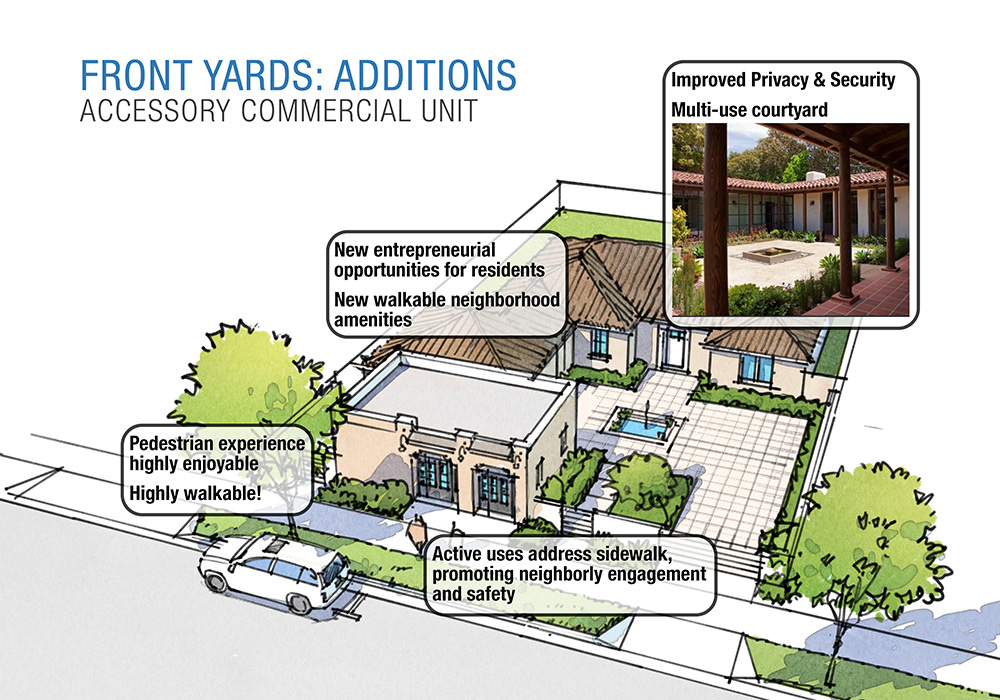
On March 26, 2026, the Austin City Council unanimously voted to legalize Accessory Commercial Units and Front Yard Businesses: small commercial spaces, up to 200 square feet, that homeowners can operate from residential lots. A bakery in a converted garage. A corner store stocking what surrounding blocks actually buy. A coffee window cut into the side of a bungalow. All now legal, by-right, in a major American city. The vote went almost unnoticed outside planning circles. It should not have.
Here is what Austin just did, in terms the real estate market will recognize. Walkable urban neighborhoods (the Georgetowns, West Villages, Pearl Districts, Beacon Hills) command price premiums of 50% to 200% over comparable non-walkable neighborhoods in the same metros. Christopher Leinberger’s research at George Washington has documented that walkable urban places occupy roughly 1% of land in major U.S. metros but capture disproportionate shares of office and retail rent premiums. Demand clearly exceeds supply. One of the most beloved things about Disney World, for what it’s worth, is its walkability.
And yet, in the entire 21st century, the U.S. has produced nearly zero new walkable neighborhoods, and even fewer through conventional development. The few exceptions don’t inspire confidence, even though urbanists and residents love them. Culdesac Tempe, the first car-free neighborhood built from scratch in modern America, required a startup, a zoning negotiation, and about five years to deliver one neighborhood. Carmel, Indiana required a 28-year mayoralty under Jim Brainard and hundreds of millions in public investment to produce one walkable downtown district inside an otherwise well-designed but still car-dependent suburb of cul-de-sacs and roundabouts. Walkability has a scaling problem.
Austin’s vote is the first serious attempt by a major American city to fix it through a different mechanism. ACUs are a refinement of what ADUs already proved with their alchemy. ADUs, at the end of the day, added housing to (mostly) desirable neighborhoods one parcel at a time, faster than any conventional project. ACUs do the same thing for the other half of the walkable-neighborhood equation: destinations.
The premium and the bottleneck
The walkable urban premium is well documented and routinely ignored by policy. The pattern is the same across markets. Office rents in walkable urban places run 75% above their drivable suburban equivalents. For-sale residential and retail command comparable premiums, with neighborhood retail sustaining rents big-box formats simply cannot match. A small fraction of the metropolitan footprint produces a disproportionate share of economic output and an even larger share of land value.
The supply side is the puzzle. American cities know how to build subdivisions, office parks, big-box retail, and strip malls. They don’t know how to build walkable neighborhoods, and the evidence is in the production stats. Two prominent new examples in the last quarter-century. One required a startup-backed developer and a desert. The other required a generational mayor and a downtown island floating in a sea of conventional suburbia.
Carmel is a real accomplishment. The few hundred acres of walkable urbanism it produced are valuable both as places and as proof that retrofit is possible. But even the modern gold standard of American suburban retrofit, run by the most committed mayor of his generation, produced walkability for a small fraction of the city’s footprint. If 28 years and a singular political career buys you one walkable district inside one suburb, the conventional pathway is in worse shape than the conventional praise of Carmel suggests.
The building across the street
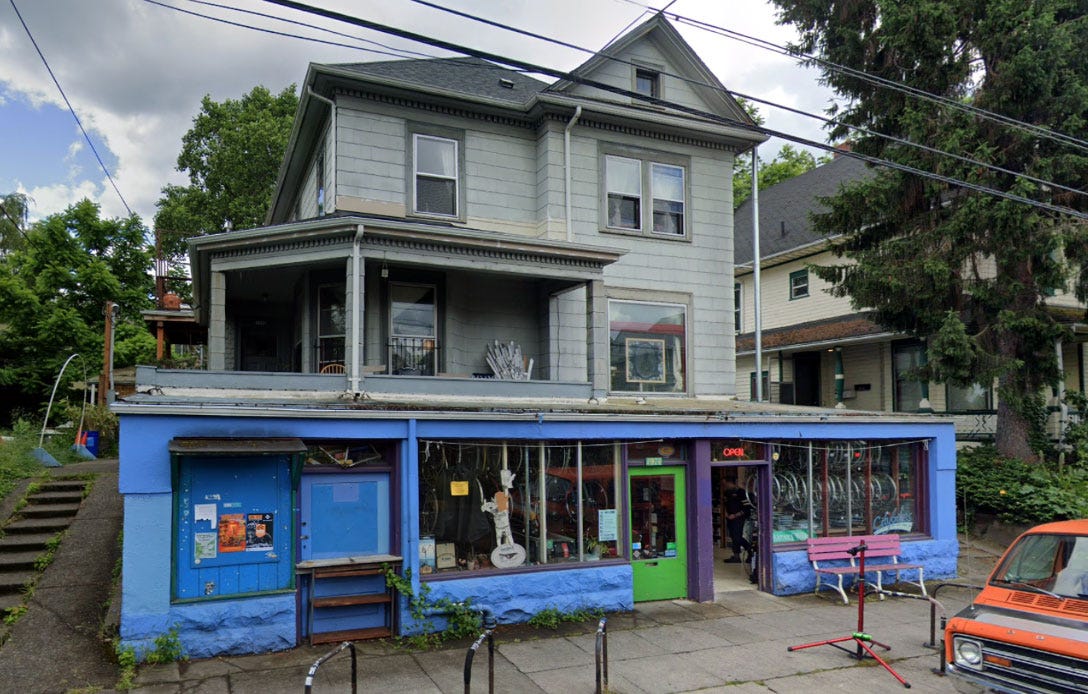
Walk almost any older American neighborhood and you’ll pass it: a small commercial use operating inside a residential zone, legally, profitably, without complaint. A corner store. A neighborhood bakery. A barbershop in what used to be a front parlor. These exist because they were grandfathered when the zoning changed in the mid-20th century. Strong Towns documents these “clearly used to be a corner store” houses as architectural fossils: the chamfered corner, the slightly-too-large front window, the faded ghost-sign on the brick.
You can guess where this goes. An identical building, proposed today, three blocks over, would be illegal. Same footprint. Same use. Same neighborhood. Different answer. The grandfathered store doesn’t generate traffic chaos. It certainly doesn’t depress property values. The cities most celebrated for their charm (Portland, New Orleans, Charleston, older parts of Boston) are precisely the cities where these uses survived. The Bywater corner store profiled in Planning magazine is one of thousands of examples sitting in plain sight.
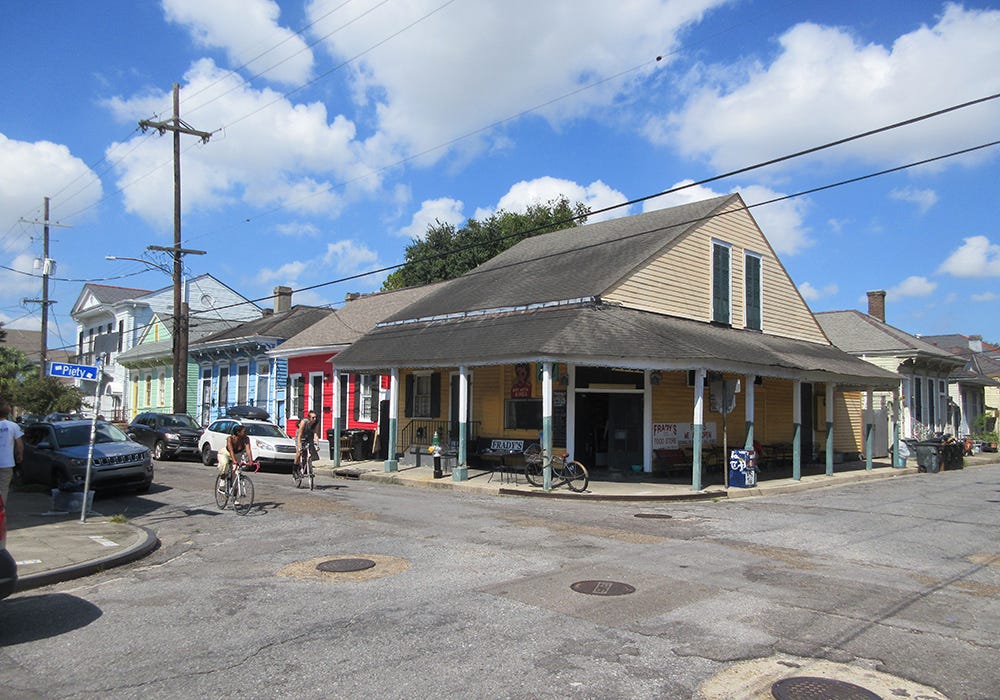
The control group and the treatment group sit across from each other on the same block. The grandfathered corner store anchors a neighborhood that, partly because of the store, commands a premium. The block with the store is worth more than the block without. We’re arguing to legalize a value-creation mechanism that already works in every major American city. You can see it in operation. You don’t have to speculate about it.
Two columns of math
The economic case for ACUs is clearest in two columns of numbers.
Column one is what an ACU bakery costs to launch, all in. A homeowner converting an existing garage or front room pays only for equipment and inventory: $10,000 to $25,000 per the standard home-bakery cost data, with some operators starting on as little as $5,000. A homeowner building a new accessory structure adds the shell cost. Austin ADU construction runs $80,000 to $150,000 for a full residential unit; a 200-square-foot commercial accessory structure without full residential plumbing should run materially less, maybe $20,000 to $50,000, though direct ACU construction data is thin. All in for new construction: roughly $30,000 to $75,000.
Column two is the alternative. A small leased brick-and-mortar bakery typically runs $26,600 to $36,700 at the low end before lease deposits, and that’s for borrowed space the operator doesn’t own. A medium commercial bakery, per Sharpsheets data from 1,600+ bakeries, requires $125,200 to $393,000 (leasing mind you). A franchised Panera runs nearly $1 million. This is all before ACUs.
You most likely aren’t going to build an ACU from scratch in this example (unless your neighbors really, really love your baked goods). So for the more realistic case, a garage-conversion ACU bakery launches somewhere between roughly one-third and near-parity with a small leased bakery, depending where you land in each range. Against a medium commercial format, though, even the high end of the garage conversion comes in at a fraction of the cost. The new-construction ACU bakery is messier: its top end ($75K) overlaps with the bottom end of a medium commercial build ($125K), so the savings are real but not dramatic at the margin. And critically, in both ACU cases, the operator owns the asset rather than renting it, which changes the long-run economics entirely. Add lease deposits and monthly rent to the column-two numbers and the gap widens over time.
But the more interesting number is the one that doesn’t appear on the bakery’s books. The bakery is not just selling coffee (well, it probably is selling coffee, alongside the baked goods). It’s producing value, and almost none of that value shows up on its P&L. The operator captures the coffee margin and builds equity in a small commercial structure. The neighborhood captures the bigger prize (if you run a good business): amenity capitalization, because people genuinely do want to grab a fresh bagel or croissant or whatever before heading out to work. Leinberger’s work and the broader literature on amenity capitalization suggest the value uplift on surrounding parcels from successful neighborhood-serving commerce is measurable and significant. Direct ACU-specific studies don’t yet exist. The inference rests on the broader walkable-premium evidence, but it’s a strong one.
That’s the point of the ACU as a policy instrument. It lets a small operator produce a large public good, financed by their own willingness to run a business and own a small structure. The city writes one ordinance and gets a value-creation engine in return.
What a storefront is for
There’s a question worth asking before we go further: in an age of Amazon next-day delivery and ghost kitchens, why does the visible storefront matter at all? (Besides the fact that Amazon didn’t really kill retail. Private equity did. RIP Joann Fabrics.) Why not just let the bakery operate from a hidden production kitchen and ship?
Because the storefront is the product, not just a delivery mechanism for goods. A residential block punctuated by a hand-painted bakery sign, a corner store’s chalkboard listing today’s tacos, a coffee window with two stools tells a passerby this is a place where things happen. It tells them it’s reasonable to walk here. The grandfathered corner store on a Boston side street is photographed by tourists. The identical-on-paper block four miles out is not. The difference shows up in property values, in tax base, in the simple fact of people choosing to live there.
Austin’s resolution rejected the existing legal preference for what it called “hidden” commerce and embraced “the active, visible neighborhood engagement that defines Austin’s character.” Visible commerce is a public good, and the public pays for it in rent, home prices, and neighborhood premiums.
This is also why ACUs can’t be replaced by their digital substitutes. Walkability isn’t a market for goods. It’s a market for the presence of small commerce within walking distance, and presence requires visibility.
ACUs were only possible because of ADU normalization and the demand for denser housing (for whatever reason, people want to live near each other). The 2010s and the HOME initiative’s three-units-per-lot reform created the cultural and procedural baseline. The 2026 ACU vote arrived on top of a decade of that work. Berkeley, Spokane, and Burien are following similar paths, and Texas H.B. 2464 and S.B. 541 already protect “no-impact” home businesses statewide.
The hardest objection
The objection that matters isn’t traffic, parking, or gentrification. If you’re reading this, chances are you’re on the urbanist or YIMBY side of things, so your real objection is probably this: a 200-square-foot bakery is a curiosity, not a policy. ACUs at this scale won’t move the needle on walkability or housing affordability at any scale that counts.
ACUs, like ADUs, are easier to set up despite being more expensive per square foot to build. And one corner store per residential block in a typical Austin neighborhood, plus a few specialty operators (the bakery, the coffee window, the bicycle repair) layered on top, would replicate the destination density that the grandfathered pattern already produces and that already commands a premium. It’ll take time. But like ADUs, which genuinely surprised everyone with how many units they ended up producing, ACUs may transmute neighborhoods in ways we don’t fully see yet.
Each successful ACU also makes the next one politically and culturally easier, the way each successful ADU did. The 200-square-foot cap is annoyingly low, but it’s a floor, not a ceiling. The trajectory of these reforms (visible already in Burien’s draft framework) is upward, toward 1,500-square-foot neighborhood corner stores.
I should also address Pomona, because it’s the most important counter-data point. Pomona legalized ACUs by-right and has not yet seen homeowners apply. The lesson is humbling. Legalization is necessary but insufficient. Cities serious about ACUs need to build the supply chain alongside the ordinance: financing pathways, pre-approved design templates, a permit concierge for the first wave of applicants, demonstration projects that show neighbors what a successful ACU actually looks like. Austin’s parallel investments in ADU lending pathways suggest the city has learned this lesson. Other cities should learn it before passing the ordinance, not after.
NIMBYs, at the end of the day, are going to NIMBY. But it’s going to be fun pointing out the grandfathered rebuttals. Traffic? Point across the street at the grandfathered store that hasn’t generated any. Property values? Point at the premium attached to the block with the bakery. Neighbor opposition? Point at the surveys showing that residents of blocks with small commercial spaces describe them, in Berkeley’s case, as the reason the neighborhood “feels like a community.” Revealed preference is what people pay premiums to live near. Strong NIMBYs, just like with ADUs, will always oppose the new whatever, but they also have a nasty habit of building out what’s good for them personally: some want their own ADU. All of them just don’t want others building one.
A note on what ACUs will and won’t do. A 200-square-foot homeowner-operated corner store is not about to disrupt 7-Eleven. The format will stock a curated selection because it has to. It’s small. That’s the point. The ACU corner store wins on walking distance and curation, not on selection. It fills a gap that convenience-store retail abandoned years ago: the half-block, daily-trip, recognize-the-owner gap. It doesn’t compete with the corridor formats. It complements them, or ignores them.
The production process for the premium
The reforms that change cities most are rarely the ones that cost the most. They’re the ones that remove a small obstacle to something people already want to do. ACUs cost a city nothing to legalize. They generate tax revenue, foot traffic, social capital, entrepreneurship, and the street-level texture no master plan can manufacture from above.
The next Georgetown won’t be built. It’ll be grown, parcel by parcel, by homeowners who were finally allowed to. Austin started growing one in March. Cities that legalize the growing will capture the premium. Cities that wait for the next Culdesac probably won’t get one.
If you’re a developer, treat ACU progress as a leading indicator for land acquisition. The amenity capitalization will accrue to surrounding parcels well before it accrues to the ACU operator. If you’re a mayor, write the ordinance now instead of waiting for a Brainard-grade political career to materialize. If you’re a franchise strategist, design the 200-to-1,500-square-foot neighborhood concept before your competitors do, the way Starbucks colonized commercial corridors a generation ago. And if you just care about the kind of neighborhood worth living in: the question isn’t whether the production process works. Austin proved it does. The question is which city builds the second one.
I live in a walkable neighborhood because my house was built in 1897 and is close to the little downtown area.
I have long dreamed of selling baked goods from my parlor but I can’t, of course!