

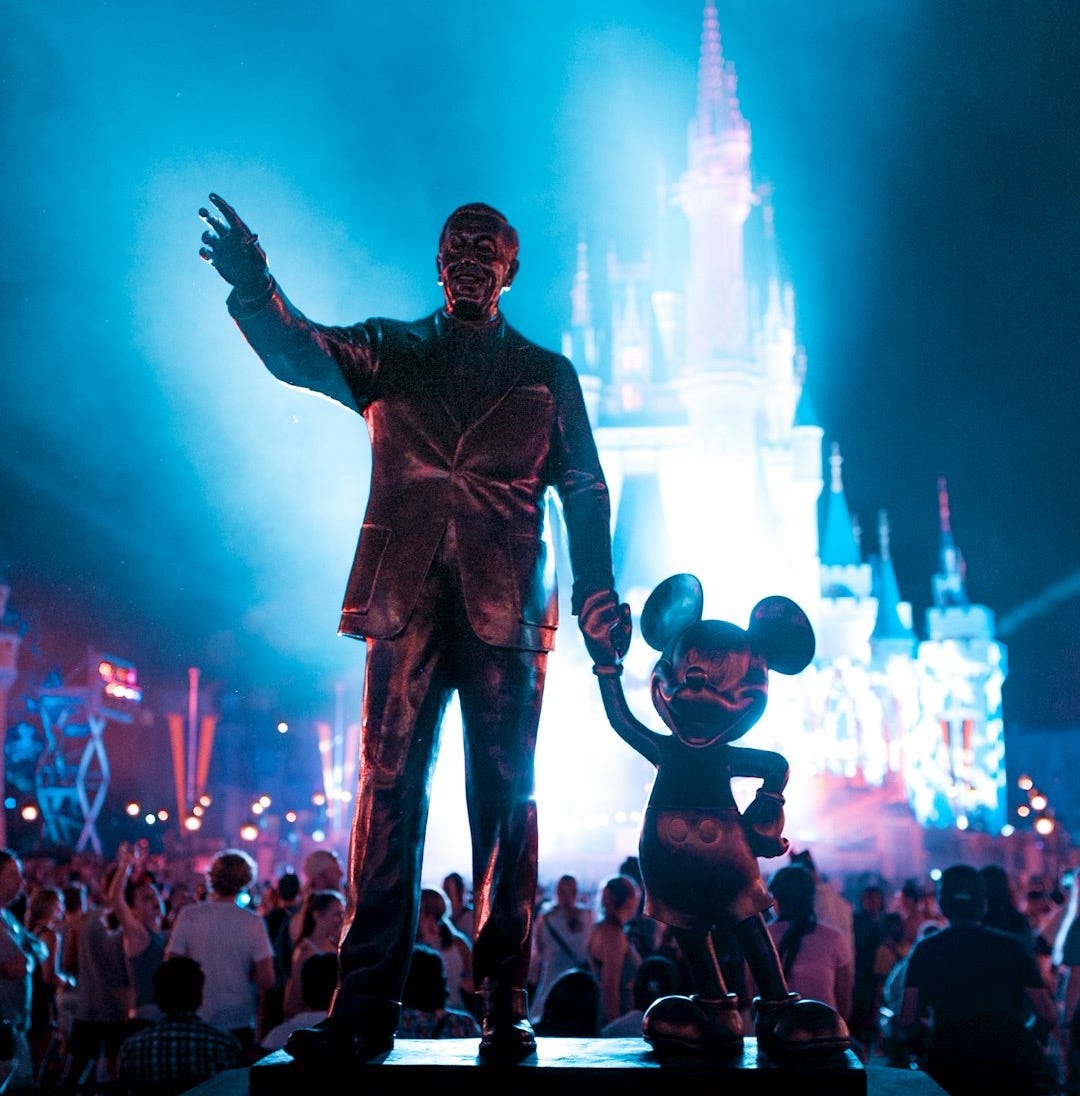
There is a lamp lit above the firehouse on Main Street, USA, and it has been lit since 1955.
Walt Disney lived in the apartment above the firehouse during construction. The lamp signaled, by company convention, that he was in residence. He died in 1966. The lamp stayed on. It is still on.
I’m a bit too obsessed with this little detail. I mean, about fifty-six thousand people walk past it on a typical day. Past pastel storefronts, a horse-drawn omnibus, the smell of vanilla pumped through the doors of the Confectionery, gas lamps that came from Baltimore and were bought by the pound. Past the most successful piece of pre-war American small-town urbanism in continuous operation in the country. Tens of millions of Americans pay every year to walk through it.
It almost did not get built, because the project was irrational and a bit whimsical.
When Walt pitched Disneyland to his brother Roy and the board of Walt Disney Productions in 1952, the board said no. The company was already overextended on three other risky bets: high-budget live-action films, nature documentaries, and television. Estimated cost of the park, ten to twenty million dollars. Company net profit the prior year, $720,000. Banks told Walt the outdoor amusement business was “a cultural anachronism that had already declined into senility.” That was the actual phrase. Cultural anachronism. Declined into senility.
Walt did it anyway, in a way that today would be career-ending. He took a $60,000 loan against his life insurance through Commerce Bank in Kansas City, pledging the financial safety net of his wife and children as collateral. He sold his Palm Springs vacation home. He set up a personal corporation called WED Enterprises (his initials) outside the studio’s risk-management process so the board couldn’t kill the project. And he gave ABC television an equity stake in the park in exchange for the network distributing Disney programming and putting up roughly seventeen million dollars in construction money.
The park opened on July 17, 1955. By the end of its first year it had attracted 1.2 million visitors and was profitable. Disney bought ABC out five years later. The bankers were wrong about cultural anachronism.
Sixteen years later, Walt and Roy would build a place forty-six times the size. To pencil it, they had to convince the Florida state legislature to invent a county.
What does it take to build something big in America?
Most of what I write about is the small stuff: ADUs, infill, and sometimes reviving the downtowns of small cities and towns. The political economy supports that work right now, and what gets built matters. But it isn’t everything I want. I want more Main Streets across America, at a greater scale than I usually talk about. I want a country that still knows how to plan and build at Disney-World scale, places imagined (and even ridiculed for the absurdity of them) before they get reduced to spreadsheets. The political economy for that kind of ambition doesn’t exist in 2026, and I know it.
So. Government-engineered financing vehicles are how more ambitious urbanism actually gets built in this country. Private capital, by itself, cannot do it, and never has. Disneyland required Walt to mortgage his family’s safety net. Disney World required the Florida legislature to invent a special-purpose taxing district with bond-issuing authority. The 1968-73 apartment boom required a federal stack of Section 236 interest subsidies, FHA 221(d)(4) construction insurance, and Ginnie Mae securitization. The 1981-86 apartment boom required ERTA’s accelerated depreciation. Every time. The pattern is structural.
At the same time, YIMBY victories like California’s ADU laws (which are responsible for nearly a quarter of all new units in the state), Oregon’s HB 2001, Montana’s middle-housing reforms, and Massachusetts’s Section 3A are real wins. Without them, this country would be building less housing than we do now. To deny their impact is wrong, and the people doing the denying are doing more damage to American housing politics than they realize.
What if we had a better political economy? What if we could build on top of those victories? What are the next steps?
I’d like to start with Paul Williams’ recent report for the Center for Public Enterprise. American multifamily starts have been stuck at roughly 350,000 units a year for forty years, through every conceivable interest-rate regime, zoning regime, and political cycle. The two moments when production exceeded 500,000 sustained were the HUD boom of 1968-73 and the ERTA boom of 1981-86. Both came directly out of federal credit and tax infrastructure. When the machinery was on, supply boomed; when it was off, supply collapsed. The flat line is a policy artifact, not a market verdict.
So the next step is to turn the federal credit apparatus back on. Five levers. Most cost little (for the deficit hawks reading). All build on infrastructure that already exists. They would, plausibly, raise multifamily production to 500,000-700,000 units annually for the decade we need to work through the shortage.
Is zoning reform enough?
The YIMBY/urbanist argument, which I share, runs something like this. Zoning prevents apartments from being built in the metros where they’re most needed. Single-family-only districts, parking minimums, height limits, FAR restrictions, discretionary review, and weaponized environmental procedures collectively make it illegal or financially infeasible to build the housing demand exists for. Williams uses a container metaphor for this: your zoning, permitting, and planning regime is the size of the container you hold out to collect rainwater. An unpermissive regime is a tablespoon. The right reforms are an upgrade to a gallon jug.
But the metaphor itself half-admits the problem. The container does not summon the rain.
YIMBYism, urbanism, Strong Towns, whatever you want to call it: the working coalition has always been more than willing to talk about what zoning reform can and can’t do. ADU and infill reforms often outperform other zoning reforms because homeowners or small businesses who want to redevelop will do so for personal or local reasons, without reference to the broader market. It’s only the more market-optimistic “abundance” framing that argues you only need to reform the regulatory regime and the supply will come.
Look at Austin. Through the 2010s, Austin liberalized its zoning more aggressively than most peer metros. The pandemic added a one-time domestic-migration shock and zero-percent interest rates. Multifamily starts in Austin surged. National multifamily permits broke 500,000 in 2021-2022, the highest since the 1980s, and a large share of that bump came from Sun Belt metros where zoning had been preemptively cleared. Then the Federal Reserve raised rates from zero to over 5% in eighteen months. Construction loan rates followed them up. The bump unwound as interest rates increased and the tech industry that powered Austin’s growth shed workers. Permits are now down roughly 25% from peak.
But notice what YIMBYism and its organizers actually accomplished. They upgraded Austin to a gallon jug. The jug worked exactly as advertised: when the financing rain fell, the jug filled, and rents fell. They are still falling, and they need to fall further to get Austin’s rent burden back to pre-COVID levels. Without the organizers, the council members, and the years of work behind them, Austin would have fewer units and be more expensive today than it is. The constraint that arrived in 2024 was not the size of the jug. It was the rain.
The lesson here is not “zoning reform doesn’t work.” Zoning reform absolutely works, and it is a prerequisite for everything else. The lesson is that zoning reform alone gets cyclically captured by the financing environment. When finance is loose, supply surges. When finance is tight, supply collapses. Net production over a decade ends up barely distinguishable from a non-reformed regime, and the YIMBY-coalition victories of the 2020s end up looking, in 2035, like Austin in 2024.
The flat line is older than YIMBY. It tracks the disappearance of federal credit and tax infrastructure that historically made apartment construction financially attractive at scale. Forty years, one number, untouched by anything that happened at the local level.
To see why federal financing infrastructure is the structural answer, look at how Disney World actually got built.
How did the Disneys actually pull it off?
1955: how did Walt finance Disneyland?
Disneyland’s financing, at $17 million, was modest by today’s standards. A present-day developer would consider $17 million a routine project. And yet, in 1955, $17 million was approximately twenty-five times the parent company’s annual net profit. The board wouldn’t fund it. Walt had to invent his own vehicle.
The vehicle was personal. WED Enterprises, set up outside the studio. A life insurance loan from Commerce Bank in Kansas City, backed by his family’s safety net. The Palm Springs sale. A line of bank credit through Bank of America, where Walt had banked since the 1930s. And the ABC equity deal, which converted television rights into construction money.
By the time the park opened, Walt had pledged his personal financial existence against the project. The board’s caution had not been wrong, exactly. The project was a bet that could have ended Walt’s career and his family’s wealth. It paid off because Disneyland turned out to be a perpetual cash machine, and the cash machine became the funding source for the next attempt.
But notice what this means. The most beloved piece of small-scale American urbanism the country has produced in the postwar period was financed by a single individual borrowing against his own life. The capital markets said no.
1971: why did Walt need a county?
A decade later, Walt’s ambitions outgrew the personal capital stack. He wanted 27,000 acres in central Florida, forty-six times Disneyland’s footprint, including Magic Kingdom, hotels, transportation infrastructure, and the planned EPCOT city he wouldn’t live to see. The estimated cost was $400 million. In 2026 dollars, roughly $3 billion.
The Disneyland playbook would not scale. You cannot finance a $400 million project through life insurance loans. The bond markets would not lend on a swamp. Orange and Osceola Counties had no power, water, or sewer infrastructure within ten to fifteen miles of the site. And the governance infrastructure for a 27,000-acre, multi-municipality, master-planned development simply did not exist in 1965.
Walt’s solution, executed with Florida’s governor Haydon Burns and finalized after Walt’s death by Roy, was Reedy Creek. On May 12, 1967, Florida Governor Claude Kirk signed Chapter 67-764, creating the Reedy Creek Improvement District: a special-purpose taxing district with the same authority and responsibility as a county government. The district could levy property taxes. It could provide municipal services. Most importantly, it could issue tax-exempt municipal bonds.
The Florida legislature included an unusual pledge in the enabling act. The state pledged to bondholders that it would “not in any way impair the rights or remedies of the holders ... until all such bonds, together with interest thereon, and all costs and expenses ... are fully met and discharged.” This pledge was the financial keystone of the project. It made Reedy Creek’s bonds state-backed in all but name, salable at low interest rates to risk-averse institutional investors. By the time DeSantis tried to dissolve the district in 2022, Reedy Creek carried roughly $1 billion in outstanding bond debt, serviced annually by approximately $58 million in district taxes paid by Disney itself.
The state was challenged in court on whether a special-purpose district mostly serving a private corporation was a valid public purpose. The Florida Supreme Court upheld the district in 1968, on the explicit reasoning that “tourism, recreation and the conservation of natural resources” were valid public purposes.
Combined with retained operating cash flow from Disneyland and conventional corporate financing, Roy completed Disney World on time and on budget for $400 million without taking on additional corporate debt. Magic Kingdom opened October 1, 1971. By every measure (visitor count, longevity, cultural durability) it’s the most successful piece of master-planned American urbanism ever built.
The thing that gets me about Reedy Creek is what was actually required. The most ambitious piece of urbanism in modern American history needed a custom-built state-chartered taxing district with bond-issuing authority and an explicit state pledge to bondholders. Without Reedy Creek, the project does not pencil. Even with Walt and Roy. Even with Disneyland’s cash flow. Even with Florida cooperating.
1984: did building Disney World almost kill the company?
Disney World didn’t insulate the Walt Disney Company from the consequences of building it.
By the early 1980s, Disney was capitalized for content and theme-park operations but thinly defended on equity. In March 1984, the financier Saul Steinberg purchased 6.3% of Disney’s stock and triggered a takeover scare. By June, Steinberg controlled 12.2% and offered to acquire 49% for $1.3 billion. At the time, that was more than the company’s available cash, which was under $10 million.
To fend Steinberg off, Disney paid $297.5 million in greenmail plus $28 million in expenses, took on $850 million in new debt, and acquired the real-estate firm Arvida and the greeting-card maker Gibson Greetings as defensive bulk. The company that built Reedy Creek almost became a forced-sale target precisely because building Reedy Creek had left it financially exposed.
Think about what this means for the argument. Even Walt and Roy Disney’s playbook (decades of operating cash flow, a state-engineered financing vehicle, the most successful master-planned urbanism in American history) left the parent company close enough to the edge that a single hostile financier with $11 million in initial capital could nearly take it down a decade later. The state vehicle was necessary. It was also not quite sufficient. The parent corporation absorbed risk that no rational private capital structure would have absorbed unaided.
If the country’s most resourceful urbanist, with the State of Florida actively in his corner and a perpetual cash machine in California funding him, still ended up exposed to a hostile takeover in 1984, the proposition that present-day urbanism can be financed by private capital alone isn’t merely wrong. It’s senile.
2026: could anyone build Disney World today?
What would it take to build Disney World today?
I keep trying to imagine the capital stack and I cannot construct it. The Reedy Creek mechanism was partially dismantled in 2022, and its successor, the Central Florida Tourism Oversight District, is governor-controlled. No state legislature is currently in the business of inventing custom special-purpose districts for ambitious urbanism. The federal credit apparatus that produced the HUD boom of 1968-73 was dismantled after Nixon’s 1973 moratorium. The tax apparatus that produced the ERTA boom was dismantled by the 1986 Tax Reform Act. Construction lending from regional banks has collapsed since 2023, with the post-SVB regulatory environment and the $1.8 trillion CRE maturity wall hitting simultaneously. Conventional construction credit is nearly impossible to price under current input-cost inflation and tariff regimes.
A 2026 Walt Disney could not finance Disney World. No state would invent Reedy Creek for him (even Texas with its MUD system); the political environment for doing so has been actively poisoned by the 2022 fight. Conventional banks won’t lend at terms that make the project pencil. And without a federal pledge equivalent to Florida’s 1967 pledge to Reedy Creek bondholders, he could not securitize his way through the bond markets either.
Has the federal government ever done this for apartments?
The HUD boom of 1968-73 was the federal version of what Florida did for Disney one year earlier. The Housing and Urban Development Act of 1968 set a goal of 26 million new housing units over ten years. To hit that target, HUD deployed three integrated tools that, taken together, were essentially Reedy Creek for apartments. Section 236 interest-rate subsidies that reduced effective mortgage rates on qualifying rental projects to as low as 1%. FHA 221(d)(4) construction insurance, which provided non-recourse, fixed-rate financing covering up to 90% of project cost. And Ginnie Mae securitization, issued in 1970 for the first time in American history, which connected FHA multifamily lending to global capital markets and removed lender capacity as a binding constraint on production.
Multifamily starts surged from 400,000 in 1968 to an annualized 1,000,000 units in March 1973. Three million apartment units in four years. Then, in 1973, the Nixon administration imposed a moratorium on new commitments. Section 236 wound down. The boom ended.
The ERTA boom of 1981-86 was the tax-code version of the same idea. The Economic Recovery Tax Act of 1981 created accelerated cost recovery for real estate (15-year depreciation with front-loaded methods) that made apartment investment a tax shelter capable of generating paper losses sufficient to offset other income. Multifamily starts climbed from under 300,000 in 1981 to over 500,000 by 1985 and stayed there for five years. Then, in 1986, the Tax Reform Act extended depreciation to 27.5 years, switched to straight-line methods, and added passive loss limitations. The tax economics of rental housing development collapsed almost overnight. Multifamily starts fell to 140,000 by 1991 and have never sustainably exceeded 500,000 since.
Every time American urbanism or housing produces at scale, a custom financing vehicle is created to make it possible. Disneyland in 1955 ran on WED Enterprises, an ABC equity deal, and a personal life insurance loan. Disney World in 1971 ran on Reedy Creek and the state bondholder pledge. The HUD boom ran on Section 236, 221(d)(4), and Ginnie Mae together. The ERTA boom ran on accelerated cost recovery and passive loss treatment.
Every time we dismantle the vehicle, production falls back to a baseline that is a policy artifact rather than a market equilibrium. The 350,000-unit flat line for multifamily starts (forty years long, through every conceivable macroeconomic environment) is what happens after we turn the machinery off.
The pattern matters more than usual right now because the credit cycle is at exactly the wrong point. Multifamily loan maturities surge from $104 billion in 2025 to roughly $162 billion in 2026. Builder bankruptcies are accelerating. Construction lenders have widened spreads or pulled out of the market entirely. We are sitting in the sharpest construction-credit collapse since 2008, with the federal apparatus off, and a $1.8 trillion CRE maturity wall arriving on top of it.
What would turning the machine back on look like?
Five levers. What follows is the technical version.
The federal credit apparatus that produced the 1968-73 boom is, in modified form, still sitting on the federal balance sheet. It has just been allowed to atrophy. Reactivating it does not require inventing new agencies. It requires turning existing infrastructure back on.
Lever 1: why does an FHA loan take a year to close?
On paper, FHA’s 221(d)(4) is unbeatable as a construction financing product. Fixed-rate, non-recourse, up to 90% loan-to-cost, 40-year terms. It’s the lineal descendant of the program that financed the 1968-73 HUD boom. Today it finances roughly 10,000-15,000 units a year, about 4% of multifamily production, a rounding error against the three to four million unit shortage.
Why? Process friction. Loans routinely take 270-360 days to close, against 60-90 days for conventional construction financing. HUD launched a “single underwriter” reform in 2014 that was never fully implemented. A 2024 OIG auditfound HUD still tracking applications across five regional centers on manual spreadsheets.
Williams’ fix: codify single-underwriter in the MAP Guide, fund the IT modernization HUD has been promising for a decade, expand categorical exclusions for infill, and resource the program like the production platform it could be. Cost: negligible. FHA mortgage insurance is statutorily actuarially sound; the investment is in HUD’s operational capacity. Scale: 50,000-75,000 units a year in normal markets, with upside toward 100,000+ in crunches. For context, in 2010, during the GFC’s private-credit retreat, FHA across all programs financed more than 150,000 rental units.
Underrated, because it skips Congress and appropriations entirely. All it needs is an HUD secretary who cares about execution.
Lever 2: what are the states already doing?
While the federal apparatus has atrophied, state housing finance agencies have been quietly building the next generation of construction finance infrastructure. MassHousing’s BILD program pairs preferred equity with Freddie Mac permanent debt at debt-like returns, targeting 25-35% of total project equity. New York’s Housing Acceleration Fundprovides subordinate construction loans through CDFIs and banks at 3% interest-only. Michigan’s Housing Accelerator Fund is structured similarly.
These programs collectively represent about half a billion dollars in capital and have worked at small scale. MassHousing’s BILD has a pipeline of 33 projects representing 7,000+ units against an initial $50 million fund.
The match: a $2 billion one-time federal contribution capitalizing similar programs in 25-30 states, structured to revolve so the funds recycle into new projects after permanent conversion. Cost: $2 billion one-time, ongoing zero. Scale: roughly 30,000 additional units a year. The mechanism crowds in private capital, leverages existing state HFA expertise, and produces mixed-income housing rather than just deeply-subsidized affordable units. It also creates durable production infrastructure that can operate counter-cyclically, which is what we need given the post-2023 bank pullbacks.
Lever 3: why aren’t Fannie and Freddie in this market?
Fannie Mae and Freddie Mac dominate multifamily permanent lending, together roughly 41% of total origination volume in 2024, but are essentially absent from construction financing. This is a historical artifact, not an inherent limitation. The GSEs’ charters emphasize permanent mortgages because that’s where their underwriting expertise developed. Construction has always been left to banks and insurers.
The fix has three parts. Forward commitments on permanent financing, structured like MassHousing’s FORGE Loan, which uses a 36-month rate lock to let developers secure permanent financing terms before breaking ground. Mezzanine and preferred equity products that fill the gap between senior construction debt and developer equity, currently served at high prices by CDFIs and impact investors. And a secondary market for construction-to-perm loans, enabling true scale through MBS structures.
Cost: essentially zero from a federal-budget perspective. GSE products are priced to be self-funding. The policy lever is regulatory (FHFA scorecards, possibly a charter clarification from Congress), not fiscal. Scale: 50,000-100,000 units a year depending on portfolio share. This is the lever that does the most to address the post-2023 regional bank pullback, because it puts patient capital into the gap that private credit has vacated.
Lever 4: could the tax code do for housing what it did for solar?
The 1981 ERTA boom was driven by 15-year accelerated depreciation. The 1986 Tax Reform Act extended that to 27.5 years straight-line, and production collapsed within five years.
The proposal is to restore some version of accelerated treatment. Three options, ordered by aggressiveness: shorten the straight-line schedule from 27.5 years to 15-18 years; partially expense the first $100,000 per unit; or fuller expensing under tighter passive-loss rules. Today’s 37% top marginal rate is well below the 50% rate that prevailed during ERTA, which materially reduces both the per-dollar value to claimants and the revenue loss to Treasury. We can get much of the production effect without recreating the worst tax-shelter abuses that drove the 1986 backlash.
The closest analog is the IRA’s clean-energy production-tax-credit and investment-tax-credit structure. We just demonstrated, on the energy side, that this approach can mobilize hundreds of billions of private capital toward an industrial-policy goal in a few years. The mechanism translates to multifamily.
Cost: real but bounded. Shortening the depreciation window costs less than partial expensing, which costs less than full expensing, with corresponding production effects. Estimates range from a few billion annually for shorter straight-line to tens of billions for full expensing. Scale: 50,000-100,000+ units a year. This is the most fiscally substantive lever in the package and also the one with the cleanest recent precedent.
Lever 5: what is the FHLB system even for?
The Federal Home Loan Bank system is a $1.3 trillion government-sponsored enterprise that, per the CBO’s 2024 analysis, receives roughly $6.9 billion a year in implicit federal subsidy through the spread between FHLB consolidated obligations and Treasuries. Almost none of this flows into housing production. The 11 regional FHLBs primarily make collateralized advances to member institutions, totaling $737 billion in 2024. Affordable Housing Program contributions in 2024 were about $751 million, roughly 12% of net income.
In 2023, Silicon Valley Bank, Signature Bank, and First Republic Bank held tens of billions in FHLB advances days before failing, using the system as a lender-of-next-to-last-resort rather than a housing-finance institution. The FHLBs were repaid in full because their statutory super-lien gives them priority over the FDIC.
The fix: amend the FHLB Act to authorize construction-to-permanent multifamily lending, either directly or through member institutions. FHFA would set risk-based capital requirements and a 10% portfolio target for housing construction and permanent financing. The bipartisan CURB Act shows there is appetite for FHLB reform across the aisle.
Cost: zero federal-budget impact. The FHLBs are self-funding. Scale: 50,000+ additional units a year at a 10% portfolio share, supporting roughly $70 billion in housing investment. This creates permanent counter-cyclical infrastructure that lends into downturns when private capital retreats.
Why isn’t the technical case winning?
You can make a strong technical case for building lots of housing. The political case isn’t. “Build more apartments” has been the YIMBY ask for over a decade and has produced state-level wins, but at the federal level, where the credit apparatus actually lives, the slogan has been weak. There is no political coalition for “more apartments” that competes effectively with organized homeowner interests and the institutional capital that profits from the current product mix.
This is, at its root, a problem of register. At the national level, the case for housing supply has been argued in the language of supply, and the language of supply is technocratic, demographic, and a little bit boring. The arguments are correct. They have not produced federal credit reform. They have not produced a coalition broad enough to break the forty-year flat line.
The rest of the country isn’t listening because the rest of the country doesn’t read white papers. The rest of the country reads memory. Memory of how a place felt, of what your grandparents could afford, of the courtyard you played in when you were nine. The rest of the country has feelings about a 1925 courtyard in Pasadena, or about the lamp above the firehouse on Main Street USA, or about the 2BR their grandparents raised three kids in and that no developer in their current city would dream of building. Those feelings are politically active, and at the moment they’re being routed almost exclusively through reactionary politics, because reactionary politics has been more willing to speak the register of memory than YIMBYism has.
This is, plainly, a self-inflicted wound, but the wound belongs to the national policy conversation, not to the organizers who have actually been winning. Talk to anyone who knocked doors for California’s ADU bills, or who packed a city council hearing in Montana, and you’ll find people who already know how to speak the register of memory and loss and aspiration. The organizing has always been emotional. The white papers came after.
And I want to be specific about a particular dynamic, because it has gone uncalled-out for too long. There is a class of national-level housing commentator, usually writing for some big publication like the NYT or something small like a substack, occasionally from a think tank, rarely from a city where they’ve ever had to flip a council vote, who has spent any sort of time arguing that state and local YIMBY wins haven’t actually moved the needle. That California’s ADUs aren’t real urbanism. That Montana’s middle-housing reforms are theater. That Oregon’s HB 2001 didn’t change anything. That the whole movement needs to reset, get serious, get federal, get something. The argument has the causation exactly backwards. Those wins were the largest legalization expansions in fifty years of American housing policy. They were also the only consistent housing-policy victories of the last decade, full stop. They were earned by people who packed council hearings, knocked doors, got primaried, sat through six-hour zoning debates, and absorbed personal abuse from neighbors who showed up to call them slumlords for wanting to allow a duplex. The framing that “not enough is being built” is technically true and rhetorically poisonous, because it concedes the only working model American housing politics currently has to whoever shows up next claiming a better one. If you want more housing built, the organizers who have actually been winning are not the problem. They are the proof of concept. Defend their work like your political project depends on it, because it does.
And here is the thing the national discourse rarely says out loud. Local and state YIMBY organizing is, by every standard of rational self-interest, delightfully irrational. The expected personal benefit of any given organizer’s hours at a council hearing is somewhere south of zero. Show up, get yelled at, lose a Saturday, possibly lose a neighbor, possibly lose a friend, possibly get primaried, in exchange for what? A marginal bump in the probability that a duplex gets allowed three blocks from your house, in a city you might leave in five years anyway? Mancur Olson wrote a whole book about why this kind of organizing isn’t supposed to happen. The logic of collective action says every rational actor should free-ride.
And yet here they are, year after year, going to the hearings, knocking the doors, doing the thing the rational ledger says they shouldn’t (among other things), and producing the wins, despite the NIMBYs’ biggest support base is often the upper crust, in addition to the upper middle class Boomers. The largest developers consistently shown to be fair weather friends at best, and often opposed to the YIMBYesy candidates (Tom Steyer for example) .
The rational version of the movement, by contrast, is the national abundance commentariat: white papers, Substack posts, conference panels, no Saturdays lost. It has produced excellent analysis. It has not produced housing. The same was true of Walt Disney mortgaging his life insurance to build a park the bankers called a cultural anachronism. Big things get built by people willing to do what the rational ledger says they shouldn’t. So do small things.
The gap is at the national level, where the housing supply argument gets laundered into technocratic language before it reaches the people who might fund it or legislate it. Cost burdens, vacancy rates, permits per capita, whatever. None of that is how anyone ever got a state legislature to invent a county. The frames below are suggestions, not instructions. Organizers don’t need instructions from anyone. The frames are sketches, three of many possible ways to carry what organizers know into rooms where the conversation has lost its nerve. Treat them as starting points, not a definitive list.
What the frames share is the willingness to be moved. That posture is sometimes called nostalgia, sometimes whimsy, sometimes romance. I’m going to use whimsy and romance because they’re the most accurate. Whimsy is advocating for things because they’re charming. Romance is advocating for things because we used to have them and we miss them. Both are politically powerful in ways the supply argument has not been.
Frame 1: why can’t your daughter afford a 2BR?
You know a 28-year-old like this. She’s your sister, your daughter, your friend’s kid, the person at the next desk. She has a partner. They’ve been together for four years. They want to get married, they want to have kids, and they want to do it in the city where they actually live, which is the city where their jobs are. They make decent money. Combined, more than her parents made when they bought their first house. They cannot find a 2BR they can afford. They’ve been looking for two years. The 1BRs they can afford have a den that her partner uses as an office, which means the kid would be in their bedroom, which means they aren’t going to have the kid yet, which means they aren’t going to get married yet, which means the whole thing keeps getting pushed back, six months at a time, for what is starting to feel like the rest of their twenties.
Multiply her by twenty million. Under-35 household formation has cratered. The median first-time homebuyer is in their late 30s. Marriage and first-birth ages are at all-time highs. The classic American life script (meet someone, partner up, household, kid, equity, roots) is being delayed. Young people still want it. They cannot afford the shelter it requires.
Couillard’s 2025 paper finds that half the U.S. fertility decline since the 2000s is attributable to housing costs, with subsidies for 3+BR construction generating 2.3x more births per dollar than equivalent 1BR subsidies. The mechanism is not subtle. Families form in apartments with rooms for children. The apartments without rooms for children are what the current capital structure builds, because they pencil. The levers above can be tuned toward family product at near-zero administrative cost: a fast-track FHA processing tier for projects above some 2+BR threshold, GSE pricing tilts for above-baseline family-unit shares, depreciation schedules that favor larger units. Every lever, retuned slightly, builds the apartments where the 28-year-old can finally start her life.
The coalition this frame assembles is the broadest of the three. Young-adult voters who can’t launch. Their parents, who watch them not launch. Family-policy moderates on both sides of the aisle. Pronatalist conservatives who want the birth rate to go up. Affordability progressives who want renters to not be crushed. The frame is romantic about a particular thing, which is the American life script: the script that says you should be able to meet someone and marry them and have kids with them and put down roots in the city where your work is, and that the country owes its young people the conditions under which that script remains possible. The script is contested in the discourse. It is not contested in the actual preferences of under-35 Americans. They want it. They are being denied it. These levers are how we give it back to them.
Frame 2: do you remember when America built things?
Walt Disney was 51 years old, in declining health, with a board that opposed him and bankers who told him his project was a cultural anachronism. He built Disneyland anyway. Five years later he was already planning Disney World, forty-six times the size, and personally lobbying the Florida state legislature to invent a county to make the bond math work. Roy finished it on time and on budget for $400 million.
Walt is the patron saint of building big in America. Not “build a corporation.” Not “extract returns.” Not “exit at stabilization.” Build the place itself, at the scale the vision actually requires. And he wasn’t alone. The country we built before 1986 was a country full of Walts. We built the Interstate Highway System and the post-war suburbs. We built the master-planned new towns of the 1960s and 1970s, places like Reston and Columbia and Irvine and the Woodlands, designed from scratch and now home to hundreds of thousands of people. We built the HUD-boom apartment stock that put a roof over three million families in four years. The TVA dams. The L.A. aqueduct. The Brooklyn Bridge had been built two generations earlier, and yet here we still were, building. We built at scales that present-day America looks at and assumes must have been done by a different species.
We weren’t a different species. We were the same country, with the same union contracts, the same bureaucratic dysfunction, and the same political rancor. What we had that we no longer have is the machinery. Federal credit infrastructure. Tax policy that pointed at production. State legislatures willing to invent counties when counties needed inventing. The HUD secretary in 1968 had tools the HUD secretary in 2026 does not. The result is that Walt’s playbook, the playbook of all the postwar urbanists, doesn’t run anymore.
This is the romance of a lost capacity. It runs on the felt sense, which I think a lot of Americans have, that we used to be a country that could do things, and we’ve forgotten how. The forgetting is correctable. The correction is a tune-up of dormant infrastructure that previously produced, and could again produce, the construction curve that built modern America.
The coalition this frame assembles is the strangest and possibly the largest. Abundance liberals. Nostalgic conservatives. Infrastructure-state Democrats. The post-liberal right. The technocratic center. The people who read Marc Andreessen and the people who read Ezra Klein and the people who read both. Strong Towns sympathizers. Anyone who has stood in a piece of postwar civic infrastructure (a Carnegie library, a TVA dam, even a Robert Moses parkway, the lobby of a 1930s post office) and felt something that wasn’t there in the strip mall they drove past on the way over. The coalition is genuinely cross-partisan because the romance of national building capacity predates current partisan alignments. It belongs to FDR and Eisenhower and LBJ and the Reagan of accelerated depreciation. It belongs to the country before 1986.
Frame 3: why can’t we build bungalow courts anymore?
Alicia Pederson covers courtyard apartments better than I will over at Courtyard Urbanist, so I’m going to come at this from the precursor.
You know the form when you see it. A cluster of small one- and two-bedroom homes arranged around a shared landscaped courtyard. Four to ten units. Two or three stories. Wood windows, built-in cabinetry, decorative tile. Front porches that face the courtyard rather than the street, so when you come home you walk through a garden to your front door and your neighbor is on her porch and her kid is playing on the path between the units and the bougainvillea is doing what bougainvillea does in October light. The form is called the bungalow court. It was pioneered in Pasadena and Hollywood in the 1910s, spread across the Los Angeles basin in the 1920s, and was killed in the 1930s and 1940sby zoning ordinances, parking minimums, and the FHA underwriting standards that pushed American multifamily toward the double-loaded-corridor apartment block we have been building, more or less unchanged, ever since.
The bungalow courts that survived are beloved a century after they were built. They are nationally registered historic districts. They are the things people fly to Pasadena to walk through. They are also, as a building type, the most obvious example of missing middle housing: the form factor that everyone who has stood in one understands as what good American urbanism looks like, and that nobody has been able to build at scale for ninety years.
It isn’t because we forgot how. The form is well documented. Architects know how to draw it. Contractors know how to build it. Cities are starting to allow it again. The problem is that nobody can finance it. The Terner Center’s 2024 analysis finds that under current financing terms, missing-middle projects are not financially feasible in most California markets. The only category that pencils is for-sale duplexes in the East Bay and Sacramento. Harvard GSD’s researchconfirms the structural problem: the current financial system is designed primarily to support either single-family homes or large multifamily developments, leaving missing-middle projects at a disadvantage. The small-balance construction loan that finances a six-to-twelve-unit courtyard building is the loan regional banks have stopped making, that GSEs have never made, and that private credit cannot price profitably.
Enterprise Community Partners’ analysis is explicit about what’s needed: low-interest, low-cost small-balance loans that cover a larger share of construction cost (80% or higher), plus loan guarantees and pre-development support. This is exactly what the state HFA accelerator funds and streamlined FHA 221(d)(4) deliver.
So the frame, in plain terms. We used to build a kind of building that everyone who has ever stood in one loves. The zoning fight to allow it again is half-won; the financing fight to make it pencil hasn’t started. Pull the levers above and the bungalow court can pencil again.
The coalition this frame assembles is the most aesthetically self-aware. New Urbanists. Missing-middle advocates. Strong Towns sympathizers. Landscape architects. Anyone who has ever stood in a 1925 courtyard at 4pm in October and felt the light come down through the bougainvillea and wondered why we stopped building this. The pitch is concrete and small and specific in a way the other frames are not: these levers will let us build bungalow courts again.That’s a promise that can be drawn. It can be photographed. It is not a demographic abstraction. It’s a place you can stand in.
So what?
Government-engineered financing vehicles are how ambitious American urbanism actually gets built. WED Enterprises was Walt’s. Reedy Creek was Walt and Roy’s. The Section 236 stack was the country’s, for the 1968-73 boom. Accelerated depreciation was the country’s, for the 1981-86 boom. The pattern is structural. The flat line is the cost of pretending otherwise.
Williams is right that the apparatus exists, the levers are mostly low-fiscal-cost, and the production response would come fast because the entitled-but-unbuilt pipeline is already roughly 750,000 units deep. The infrastructure that produced the 1968-73 boom is sitting there. Turn it back on.
The technical case is settled. The political case isn’t. The agenda needs framing that builds coalitions broader than “more apartments” has historically built. I’ve offered three as starting points, not a definitive list: let young Americans start their lives, build big like Walt did, and finance the bungalow courts. Better frames almost certainly exist. The work is to find them.
And the coalition starts with crediting the people who have actually been doing the work. The state organizers. The local YIMBYs. The council members who took the votes that cost them friends. The tenants’ rights folks and the missing-middle architects and the Strong Towns chapters and the Pasadena preservationists who keep the bungalow courts standing. They built every inch of political ground the federal credit agenda could plausibly stand on. Anyone who shows up to the federal conversation and treats them as a problem to be routed around is not a serious participant in that conversation.
The bankers told Walt Disney that outdoor amusement was a cultural anachronism that had already declined into senility. They were wrong. The equivalent dismissal of multifamily today, that the market can produce what we need without federal credit infrastructure, is wrong the same way.
The lamp above the firehouse is still lit. The flat line is the choice we keep making, and the choice is reversible, if we want it to be.
1) "because they pencil"
If something doesn't pencil, maybe it shouldn't exist.
You are incredibly obsessed with government subsidies. Low interest loans, tax breaks, etc.
If something needs a government subsidy, maybe it shouldn't exist. That's not a "market failure".
For every Walt Disney there are a ton of people that failed. That's why the bank doesn't give free money to everyone with a dream. It runs the math and makes rational choices.
2) "They cannot find a 2BR they can afford. They’ve been looking for two years. The 1BRs they can afford have a den that her partner uses as an office, which means the kid would be in their bedroom, which means they aren’t going to have the kid yet, which means they aren’t going to get married yet, which means the whole thing keeps getting pushed back, six months at a time, for what is starting to feel like the rest of their twenties."
You put your office in the bedroom and make the den the crib room. That's what we did, because we aren't retarded.
Also, we got married after a year of dating and had a kid immediately, because an extra $300 a month in rent for an extra bedroom isn't exactly what is holding up family formation.
If you want to get people to have kids, GIVE THEM MONEY. Specifically, refund their payroll taxes as an acknowledgement of their raising the next generation of taxpayers.
NOT low interest loans or tax deductions for things YOU THINK THEY WANT. Cash! Maybe they rent a bigger apartment. Maybe they stay in the small apartment and use it for daycare or baby formula or WHATEVER THEY WANT.
3) "National problem" = blue state problem. I.E. not national.
4) There is a class of YIMBY that thinks anyone that wants to exercise any control over building is either evil, stupid, or both. That all opposition should be swept aside by state level legislation issued by the enlightened.
I think that this is misguided. I think most YIMBY-ism is rational. Not every old fart at a planning meeting, but the kind of sustained NIMBY-ism driven by rational self interest.
The main thing NIMBYs are trying to do is preserve community safety and school districts. There are other local issues but those are the big ones.
I think the reason that blue states have failed is that they have failed on these core issues. Homeowners have then decided to use zoning as their way to defacto provide security and "good schools" for themselves because the government failed.
This problem can't be solved by fiat from the governors office. That's why you aren't seeing the building and the local resistance has persisted.
What your critics are trying to say is "you need to solve these big structural problems and you can't pave over them." It's constructive criticism.
I get why you don't want to hear it. Who wants to hear "get a blue state to enact school vouchers" or "get a blue state to be tough on crime". They want to hear that their enemy is some white grandma who's racist and just wants to see her house price go up because she's greedy. They don't want to take on third rail blue state constituencies. I get it. Its still cowardly.
And it's still not going to work. That young family wants to buy into a safe place with a good school district. They can already rent a two bedroom in a slum.