

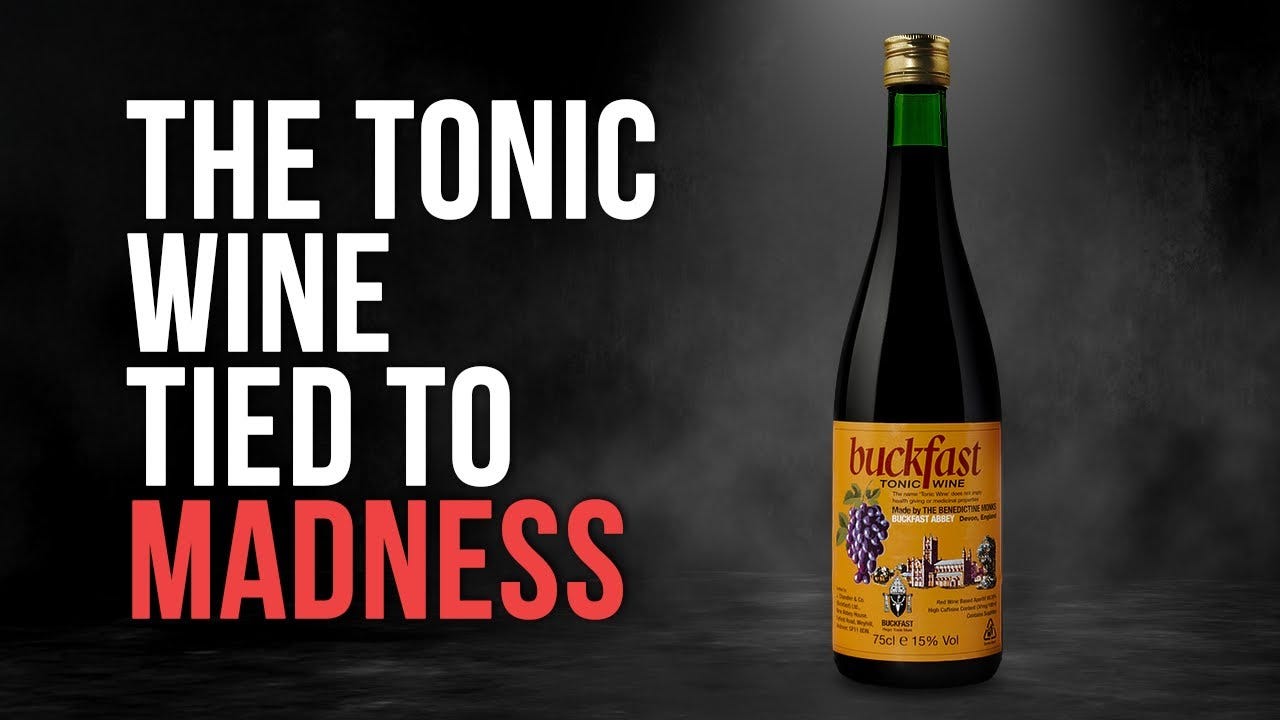
As Easter is coming up at time of writing, I decided to be a little festive with this article. Buckfast Abbey, founded in 1018 during the reign of King Cnut, dissolved by Henry VIII in 1539, and refounded in 1882 by exiled French Benedictine monks, is today best known to the British public for two things, neither of which the monks are entirely comfortable discussing in the same breath.
The first is Buckfast Tonic Wine, a caffeinated fortified wine (15% ABV, 281 milligrams of caffeine per 750ml bottle, roughly eight cans of cola) that the monks began producing in the 1890s as a medicinal tonic. I can personally guarantee that if you want to put a little pepper in a party, this wine/tonic does the job. Originally marketed with the charmingly antique slogan “Three small glasses a day, for good health and lively blood,” Buckfast has become, improbably and somewhat horrifyingly, one of the most crime-associated beverages in Scottish history. A BBC Scotland investigation found it mentioned in 5,638 crime reports in the Strathclyde police region between 2006 and 2009. The Scottish Prison Service reported in 2015 that Buckfast was a significant factor in over 40% of its inmates’ arrests. The drink has earned itself an extraordinary litany of folk nicknames: “Wreck the Hoose Juice,” “Commotion Lotion,” “Cumbernauld Rocket Fuel,” and, perhaps most evocative, “a bottle of What the Hell Are You Looking At.”
The second thing Buckfast Abbey is known for, or rather should be known for, is bees.
For seventy-eight years, the Abbey housed one of the most consequential applied-science programmes in the history of entomology: a breeding operation that produced a disease-resistant honeybee now raised in more than twenty-six countries. The man who ran it, a German-born Benedictine monk named Brother Adam, logged over 100,000 miles searching for breeding stock, kept pedigree records spanning half a century, and retired at ninety-three. He was awarded the OBE. He received honorary doctorates from Uppsala and Exeter. He is, by any reasonable measure, one of the most important figures in modern agriculture.
The public discourse around Buckfast Abbey has overwhelmingly focused on the wine. The bee work receives a fraction of the attention. That imbalance is this article in miniature. What happened to the bees at Buckfast is now happening to bee conservation writ large. The moral panics get the headlines. The practical work gets the results. And if you care about keeping bees alive, you have to understand why.
The Scope of the Crisis
In January 2025, commercial beekeepers across the United States began reporting something catastrophic. As they prepared their colonies for the annual migration to California’s almond orchards, the single largest pollination event on earth, they discovered that their bees were simply gone. Not dwindling. Not struggling. Gone. Colony after colony, dead or abandoned, at rates that dwarfed anything in the modern record. By the time the surveys closed, the numbers told a grim story: an estimated 1.6 million colonies lost, commercial operations absorbing average losses of 62%, and total economic damage exceeding $634 million.
The 2024–2025 U.S. Beekeeping Survey, conducted by Auburn University and the Apiary Inspectors of America, recorded estimated annual colony losses of 55.6%, the highest since annual tracking began in 2010–2011, and 14.2 percentage points above the fourteen-year running average of 41.4%. Winter losses alone hit 40.2%, exceeding all historical averages. State-level annual losses ranged from 34.3% to 90.5%. The triage survey administered by Project Apis m., which covers beekeepers managing roughly 68% of the nation’s colonies, found that commercial operations reported average losses of 62% between June 2024 and February 2025. Honeybees pollinate more than 70% of major global crops. Their pollination services are valued at roughly $15–20 billion annually in the United States alone.
One detail from the surveys deserves particular emphasis. For the second consecutive year, and contrary to the first fifteen years of survey data, commercial beekeepers experienced more severe losses than hobbyists. Commercial operations (those managing more than 500 colonies) lost an estimated 62%, compared to 51% for hobbyists. Commercial beekeepers have more resources, more experience, and more sophisticated management practices than most hobbyists. They are the backbone of pollination-dependent agriculture. When the professionals are losing more bees than the amateurs, something odd, something structural, has shifted.
And around these beekeepers, as they counted their dead and calculated their ruin, the internet did what it always does. Environmentalists blamed neonicotinoid pesticides. Agrochemical defenders blamed Varroa mites. Left-leaning commentators accused Big Ag of ecocide. Right-leaning commentators accused green activists of Luddism. On social media, the bees became, once again, a mascot for everyone’s priors.
How Bees Became a Culture-War Football
Left’s Story: Ban the Neonics and Punish Big Ag
We should be generous with this camp, because they identified something real. Neonicotinoid pesticides, a class of systemic insecticides introduced in the early 1990s typically applied as seed coatings, are toxic to bees. That is not in serious dispute. Laboratory studies have repeatedly demonstrated sublethal effects on navigation, immune function, and reproduction. Environmental organisations (Friends of the Earth, the Center for Food Safety, the Sierra Club, the Pesticide Action Network) identified a genuine stressor and pushed it into public consciousness at a time when the agrochemical industry was doing its best to minimise it. The EU’s 2018 ban on three neonicotinoids (imidacloprid, thiamethoxam, clothianidin) reflected genuine, if contested, scientific concern. These organisations deserve credit for sounding an alarm.
The trouble is what happened next. The narrative calcified into a monocausal story: pesticides are the villain, and a ban is the solution. The political campaign became an end in itself, disconnected from the messy, multicausal reality of bee decline.
The evidence for that disconnect is now substantial. More than a dozen large-scale field studies across North America and Europe have reached broadly similar conclusions: no conclusive observable adverse effects on bees at the colony level from field-realistic exposure to neonicotinoid-treated crops. The EU ban, now years old, has not demonstrably reversed European bee declines. Meanwhile, the campaign absorbed enormous political energy, media attention, and activist resources that might have been directed toward threats where the scientific consensus is considerably stronger. Varroa mites, the single most devastating parasite of managed honeybees worldwide, received a fraction of the public attention devoted to neonicotinoids, precisely because mites do not come with an easily identifiable corporate villain attached.
The politicisation dynamic is worth examining directly. Leaked documents reported by The Times of London described a 2010 meeting at which four senior European scientists discussed a coordinated plan to produce papers with predetermined conclusions and shepherd them through peer review with pre-selected reviewers, explicitly in order to obtain a ban. Whether one regards this as scientific manipulation or legitimate advocacy depends somewhat on one’s priors. But it illustrates a broader pattern: when environmental questions become political campaigns, the incentive structure shifts from “what is true” to “what is useful.”
Right’s Story: It’s All Mites, and Regulation Is the Real Threat
The opposing camp gets the entomology more right. Varroa destructor is, by broad scientific consensus, the single most significant threat to managed honeybee colonies worldwide. The mite feeds on developing and adult bees, transmits deadly viruses (deformed wing virus A and B, acute bee paralysis, chronic bee paralysis), weakens immune systems, and shortens worker lifespans. More importantly, Varroa has developed resistance to amitraz, the most commonly used miticide, a finding confirmed in the 2024–2025 USDA field sampling of failing colonies. If one had to point to a single proximate cause of mass die-offs, Varroa would be the strongest candidate.
But acknowledging Varroa’s primacy should not become a permission structure for dismissing all pesticide concerns or opposing all regulation. Here is where the right-wing version of the story becomes, in some ways, more dangerous than the left’s. Agrochemical industry actors have demonstrably invested in reframing the debate around mites precisely to deflect attention from legitimate pesticide questions. Internal corporate communications reported by The Interceptdescribe Bayer’s “Bee Care” programme as a crisis-PR strategy, with staff celebrating its success in shifting media coverage away from neonicotinoids. CropLife America compiled lists of search-engine terms to manipulate, and consulting firms worked to decouple Google results for “bee decline” from “neonicotinoids.” The mite narrative is scientifically stronger than the pesticide narrative. But it has also been instrumentalised by corporations with obvious financial interests.
And there is a worse problem. The left’s monocausal story is wrong about the mechanism but right that the situation is a crisis requiring public investment. The right’s version (”it’s just mites, stop regulating, let the market sort it out”) provides ideological cover for defunding the very research, extension services, and breeding programmes that are actually solving the problem. Every practical intervention we describe later in this article depends on sustained public funding: USDA research budgets, university grants, extension-service staffing, nonprofit operating costs. The conservative position, followed to its conclusion, eliminates the funding that makes the work possible. Misguided activism that directs resources to the wrong target is bad. A political movement that argues against directing resources at all is worse.
The right answer is not “it’s only mites” any more than it is “it’s only neonics.” Multiple stressors interact in complex ways: mites, pathogens, nutritional deficiency from habitat loss, climate disruption, pesticide exposure, and amitraz resistance. But acknowledging that complexity does not require another round of blame-assignment. It requires work, and it requires someone to pay for the work.
Neither side, through all its fundraising emails, congressional hearings, protest marches, op-eds, and viral social-media content, has bred a single Varroa-resistant bee, developed a nutritionally complete pollen substitute, trained a beekeeper in mite-monitoring technique, or kept one colony alive through a hard winter.
We should be honest, though, that the line between “activist” and “practitioner” is not always clean. Some organisations do both. Project Apis m., a nonprofit funded largely by the beekeeping and almond industries, is the clearest example: it funds applied research, coordinates the triage surveys that produced the loss data cited above, connects commercial breeders with USDA scientists, and advocates for federal research funding, all at once. The Inflation Reduction Act’s conservation funding, the USDA’s breeding programmes, the extension services that train beekeepers in mite monitoring: none of these exist without political advocacy. The question is not whether activism matters. It is whether the activism is pointed at something that will actually keep bees alive, or whether it is pointed at something that will generate donations and media coverage. Those are different targets, and most of the loudest voices in the bee debate have chosen the second.
Which brings us back to the monk.
Brother Adam and the Dartmoor Bees
In the early twentieth century, a mysterious epidemic known as the Isle of Wight disease, later identified as acarine disease caused by the tracheal mite Acarapis woodi, swept through the British Isles, devastating native honeybee populations. At Buckfast Abbey, 29 of 45 colonies were destroyed. The entire native British black bee (Apis mellifera mellifera) was effectively exterminated in the region. The only colonies that survived were headed by Italian queens (A. m. ligustica) crossed with native drones.
Karl Kehrle, the sickly German boy sent to the Abbey at age eleven, joined the Benedictine order, took the name Brother Adam, and in 1915 began assisting Brother Columban in the apiary. By 1919, aged just twenty-one, he was placed in charge of the entire bee operation. He would remain in that role for seventy-three years, retiring in 1992 at the age of ninety-three. He died in 1996, in his ninety-ninth year.
His approach was selective breeding carried out with exceptional rigour and patience, the same logic that livestock farmers had employed for centuries, applied with unprecedented discipline to insects. He established an isolated mating station on Dartmoor, a treeless, windswept moor where no feral bees could interfere with controlled matings. He inbred drone lines and headed drone-producing colonies with sister queens, ensuring the drones were near-genetically identical. Every queen, worker, and drone at Buckfast Abbey had a known descent on both the maternal and paternal side, with records spanning more than fifty years.
He operated on a three-year breeding cycle. Year one: produce and introduce at least thirty queens of each genetic combination, distributed across multiple apiaries for fair comparison. Year two: evaluate mature colonies under real-world field conditions using a standardised scoring system for swarming tendency, aggression, comb stability, and honey yield. Year three: graft larvae from the best-performing queens for the next generation.
Over his lifetime, Brother Adam logged more than 100,000 miles searching for breeding stock: Turkey, the Sahara, the Near East, East Africa, the Kilimanjaro region. He crossed Italian, Carniolan, Anatolian, Greek, and African subspecies into his programme. His selection criteria were precise and practical: low swarming tendency, lack of aggression, comb stability, and what he called “a boundless capacity for foraging work.”
Most importantly, he prioritised disease resistance, not through chemical treatment but through selecting for inherited traits. As he wrote in 1950: “We do not believe greatly in the various treatments generally recommended for bee diseases... by means of careful selective breeding throughout a period of twenty years we have overcome the inherent susceptibility to this disease to such an extent that it practically never occurs.”
That sentence, written seventy-five years ago, remains radical today.
The result was the Buckfast bee: productive, gentle, disease-resistant, and adaptable to diverse climates. In 1920, his colonies averaged 87 kilograms of surplus honey per colony; individual colonies exceeded 152 kilograms. A 1986 BBC documentary reported a single Buckfast colony producing over 181 kilograms, roughly 400 pounds. Today, Buckfast bees are bred across more than twenty-six countries. Norwegian and Finnish Buckfast strains have shown Varroa resistance, achieved through the same patient selection methods Brother Adam pioneered, extended to address a threat that emerged after his time.
He did not campaign for the banning of any substance. He did not write op-eds blaming the government. He identified the problem, formulated a principle (that resistance should be bred, not merely chemically suppressed), developed a rigorous method, executed it for seventy-eight years, and produced a tangible output that continues to benefit beekeepers worldwide.
The question is whether anyone is doing the same thing today.
The New Practical Frontier: Better Feed, Better Breeding, Better Practice
Brother Adam’s methods were brilliant but constrained by the tools of his era: phenotypic observation, physical isolation for mating control, paper record-keeping. What is encouraging about the present moment is not that we have abandoned his approach, but that we can accelerate and extend it. The most promising developments in bee health are practical improvements to the three things that have always mattered: what bees eat, how we breed them, and how we manage them.
Better Feed
Bees rely on pollen for essential lipids called sterols, six specific compounds (24-methylenecholesterol, campesterol, isofucosterol, β-sitosterol, cholesterol, and desmosterol) that are critical for growth and development. Climate change and intensive agriculture have reduced the diversity of available flowers, leaving colonies nutritionally deficient. Existing commercial pollen substitutes (protein flour, sugars, oils) provide calories but lack these sterols. The analogy one researcher offered: it is comparable to the difference for humans between eating balanced meals and eating meals missing essential fatty acids.
A team led by the University of Oxford, in collaboration with Royal Botanic Gardens Kew, the University of Greenwich, and the Technical University of Denmark, set out to close this gap. First, they figured out which sterols bees actually need by painstakingly dissecting individual nurse bees and analysing pupal tissues, identifying the six key compounds that dominate bee biology. Then they developed a way to produce those sterols at scale using precision fermentation: growing yeast (Yarrowia lipolytica) in bioreactors and drying the output into a powder that can be mixed into standard bee feed.
The results, published in Nature in March 2025, were dramatic. In controlled glasshouse trials over three months, colonies receiving the sterol-enriched diet produced up to fifteen times more larvae that reached the pupal stage compared with colonies on standard diets. Supplemented colonies continued raising brood throughout the entire study period; unsupplemented colonies stopped producing brood after approximately ninety days. The nutrient profile of larvae in the supplemented group matched that of bees feeding on natural pollen.
Why does this matter structurally? Because most of the specific sterols bees need do not exist in commercially harvestable quantities in nature. No amount of wildflower planting or pesticide banning could produce a nutritionally complete artificial feed. If field trials confirm the laboratory results, the supplement could reach beekeepers within two years. It would also reduce competition for limited wildflower pollen, indirectly benefiting wild bee species.
Better Breeding
What Brother Adam did by observation and paper records over seventy-eight years, modern breeders can do faster using molecular tools, not to modify bees, but to identify desirable traits more quickly and select for them more efficiently. The breeding is still conventional. The selection is informed by better data. This is the same logic as using a blood test to identify which cattle carry a trait for disease resistance, rather than waiting years to see which ones get sick.
The most consequential breeding work being done today centres on a trait called Varroa-sensitive hygiene (VSH): the behaviour of detecting and removing mite-infested brood from the hive. Bees with strong VSH behaviour can smell the mites inside capped brood cells, uncap them, and remove the parasitised pupae before the mites can reproduce. It is a natural defence. Asian honeybees (Apis cerana), which co-evolved with Varroa, possess it instinctively. The question is whether European honeybees, which did not co-evolve with the mite, can be selected to express it strongly enough to suppress mite populations without chemical treatment.
The answer, after a decade of work, is yes. And the evidence comes from three distinct programmes, operating independently, on two continents. No organism has been genetically modified in any of them. Bees have been selected, with better measurement tools and coordinated effort, for traits they already possess.
Arista Bee Research, founded in 2014 in the Netherlands, has coordinated a network of over 300 beekeepers across seven countries in a systematic VSH-selection programme. In their 2022 assessment, the first year they passed the milestone of 1,000 test colonies, 130 breeders across 31 groups evaluated 1,065 colonies. The results: 34% of these colonies (367 in total) were classified as high-VSH, meaning they can suppress mite populations without any chemical treatment. Of those 367, fully 43%, or 149 colonies, were 100% VSH: after researchers deliberately introduced 100–150 mites into each hive, not a single reproducing Varroa mite could be found in the brood. They opened 300 to 600 brood cells per colony to verify this. By their ten-year review in 2024, Arista could report that in their own hives, there is “no longer bee mortality due to Varroa, and this without any chemical treatment.” At their Luxembourg mating station, more than half of all colonies showed high levels of Varroa resistance.
Meanwhile, in the United States, the USDA’s Honey Bee Breeding, Genetics, and Physiology Research Laboratoryin Baton Rouge has been developing Pol-line bees since the late 1990s, a stock selected specifically for VSH behaviour. In head-to-head commercial trials across four states (Mississippi, California, North and South Dakota), Pol-line colonies that received no mite treatment in the fall had a winter survival rate of 62.5%, compared to just 30% for standard untreated colonies, more than twice as likely to survive. Even when both groups received treatment, Pol-line bees maintained a significant advantage: 72% survival versus 56%. They also showed significantly lower levels of deformed wing virus A, deformed wing virus B, and chronic bee paralysis virus. As the lead researcher put it: “We would like to replace reliance on chemical controls with honey bees that have high mite resistance of their own.”
And the breeding logic is now reaching the commercial sector. Wes Card in Louisiana and Ryan Lamb in Texas have been independently selecting for mite resistance in their production stock for years. In February 2025, during the worst colony-loss season on record, Project Apis m. and the USDA’s Bob Danka visited both operations to evaluate their potential breeder queens. Colonies untreated since April 2024, through an entire production season and a full winter, showed very low mite infestations in the brood. During a year when 62% of commercial colonies nationwide were dying, these bees were thriving. They were also among the top honey producers in their respective operations.
One of the selection methods used across all these programmes deserves mention for its endearing hands-on quality. Researchers collect mites from the hive floor, put them under a microscope, and count how many legs are missing or partially chewed off. High levels of mite damage indicate colonies where worker bees are actively grooming and attacking parasites, a heritable behavioural trait. By breeding queens from these high-grooming colonies, breeders develop more resistant lines.
This is Brother Adam’s vision, scaled and diversified. More breeders. Better measurement. Faster feedback loops. The same fundamental logic: observe, select, breed, evaluate, repeat.
Better Practice
The 2024–2025 triage surveys revealed something the culture-war narratives completely obscure: colony survival varied enormously depending on management practice. Differences in mite-monitoring frequency, protein and carbohydrate feeding schedules, miticide timing, and overwintering methods all correlated with significantly different loss rates. The headline losses are real and alarming. But they are not uniform. Some beekeepers, using the same stock in the same regions, lost dramatically fewer colonies because they managed better.
The single most impactful intervention, according to extension specialists, is regular Varroa monitoring: counting mites per hundred bees at scheduled intervals and treating when thresholds are crossed. This is not high technology. It is disciplined practice. Many beekeepers, including some commercial operators, do not do it consistently. The gap between best practice and average practice is wide, and closing it requires training, not legislation.
An increasingly significant management innovation is indoor cold storage: placing colonies in climate-controlled facilities (typically around 7°C and 25% relative humidity) during winter months. The practice, long used by some Canadian beekeepers, has been rapidly gaining adoption among U.S. commercial operations. Colonies in cold storage stop producing brood, which creates a “brood break” that prevents Varroa from reproducing. Bees that cluster indoors rather than flying age more slowly and consume fewer resources. USDA-funded research combining Varroa-resistant Russian bees with cold-storage overwintering found that the approach produced survival rates and colony sizes comparable to outdoor apiaries in warmer climates, at lower cost per colony. In an era when warmer autumns are extending Varroa’s reproductive window, cold storage is a practical adaptation to climate change that requires no new legislation, no bans, and no breakthroughs. It requires a shed, a thermostat, and good planning.
On the landscape side, hedgerow and habitat restoration near farmland has shown measurable pollinator benefits. One study found bee abundance increasing by 8% within a single year of growing hedgerows, with species richness continuing to improve over seven years. Programmes like the Pollinator Partnership’s Bee Friendly Farmingcertification and the Xerces Society’s farmland conservation work have begun translating these findings into practical guidance for growers: flowering cover crops during fallow periods, reduced-mowing regimes on field margins, retention of scrubby marginal land that costs more to farm than the pollination benefit it provides by being left alone.
Training infrastructure exists and is growing. In the UK, BeeBase has grown from 19,000 registered beekeepers in 2010 to 47,000 today. In the U.S., state extension services, university programmes, and nonprofits like Project Apis m. offer free or reduced-cost courses for both commercial and hobbyist beekeepers. The infrastructure for improving practice exists. What it lacks is the political sex appeal of a pesticide ban or a corporate takedown.
Why the Discourse Fails when Work Succeeds
Bee decline is multicausal. Political narratives require identifiable villains. The mismatch between the complexity of the problem and the simplicity demanded by activism generates a predictable pathology: each side selects the causal factor that best fits its pre-existing ideological commitments, amplifies it, and dismisses the rest.
Applied breeding programmes, nutritional research, and extension education operate on different incentive structures. They are optimising for measurable outcomes: larval survival rates, mite loads per hundred bees, overwinter survival percentages, honey yield per colony. The feedback loop between intervention and outcome is tighter, more honest, and more productive than the feedback loop between a Twitter campaign and bee survival. One better queen this year. A slightly more resistant line next year. A measurably healthier apiary the year after that.
We should be careful, though, not to let our own argument become a comfortable distortion. “Activists bad, practitioners good” is a satisfying story, and it has the same structural flaw as “neonics bad, Bayer evil”: it is too clean. The practical work we have described does not fund itself. The USDA Pol-line programme exists because Congress appropriated money for it. The Inflation Reduction Act’s $20 billion in conservation funding exists because advocacy organisations pushed for it. Extension agents have jobs because state legislatures decided to pay for them. The 2008 and 2014 Farm Bills expanded federal bee research funding partly because beekeepers showed up and made noise. If the takeaway from this article is “ignore the political process and just do the work,” we have failed. The work requires political support, and political support requires advocacy.
The real failure is not activism per se. It is activism that optimises for the wrong objective function, measuring success in media coverage, petition signatures, and corporate-villain narratives rather than in research funding secured, extension programmes staffed, and breeding networks supported. It is also, and perhaps more damagingly, a conservative counter-narrative that uses “it’s just mites” as a reason to cut public spending on the very programmes that are producing results. The worst outcome is not that we fight about pesticides. It is that we fight about pesticides instead of funding the USDA, and then cut the USDA’s budget anyway.
There is the question of opportunity cost, but it runs in both directions. Every dollar of activist funding spent litigating a neonicotinoid ban is a dollar not spent training beekeepers in mite-monitoring techniques. But every dollar cut from USDA research budgets in the name of fiscal conservatism is a dollar that could have funded the next Pol-line. Every news cycle consumed by “beepocalypse” rhetoric crowds out the unglamorous truth that better feeding schedules and community-based breeding programmes are producing concrete results right now. But the silence that replaces it is not better, because the public learns nothing at all, and the appropriations committees have no political reason to act.
Objections
“You’re dismissing activism.” I hope the preceding section made clear that we are not. Without advocacy, the practical work has no funding. Our problem is with activism that measures its success in headlines and petition signatures rather than in research dollars secured and extension programmes staffed. The energy is not the problem. The targeting is.
“You’re letting corporations off the hook.” Agrochemical companies have engaged in documented efforts to shape scientific discourse and deflect blame. That behaviour warrants criticism and, where appropriate, legal accountability. It’s not even dead and buried events that drive this distrust, just Roundup alone more than justifies distrust and hostility again and again. But corporate malfeasance, real as it is, does not change the entomological reality: Varroa mites are the single largest proximate threat, nutritional deficiency is a growing crisis, and the most effective interventions available right now are better breeding, better feed, and better management. Holding both truths simultaneously is not corporate apologetics.
“You’re letting fiscal conservatives off the hook.” This is the objection we take most seriously, because our essay’s rhetorical structure (”stop fighting and start working”) can easily be co-opted by people who want to stop fighting and stop funding. Every programme I have praised depends on public money. The USDA breeding lab, the extension services, the university research grants, the nonprofit networks: all of them require sustained appropriations from legislatures that are perpetually looking for things to cut. If this article provides ammunition for anyone arguing that bee conservation is a solved problem that no longer needs government support, I have written it badly. It is not solved. It needs more support, not less.
“You can’t scale a monk.” Brother Adam had institutional backing from a monastery, no family obligations, a lifetime tenure, and the personality of a single-minded obsessive. His story is inspiring but not reliably replicable.
Fair enough. And yes, we would happily fund more monks (even if they are making violence in a wine). Institutions that provide long-term stability and patient capital for multi-decade applied research are invaluable. Brother Adam’s monastic context was not incidental to his success; it gave him something almost no modern researcher enjoys.
But most of the work now being done to save bees is being done by non-monks. The Arista Bee Research network is three hundred amateur beekeepers in seven countries, sharing data in spreadsheets and checking mite-damaged legs under microscopes on weekends. The USDA Pol-line programme is government scientists working within constrained budgets. Wes Card and Ryan Lamb are commercial beekeepers running businesses, not contemplative orders. The Oxford nutrition team are university researchers on fixed-term grants. Extension agents across the United States and the UK are civil servants offering free courses to anyone who shows up.
The method is replicable. The discipline is replicable. I are not arguing for more monks, though I wouldn’t turn that idea away. I am arguing for more of what the monk did: systematic, patient, craft-based work, carried out by communities of practitioners who share methods and data. That is already happening. It deserves more support than it currently receives.
The Monk, the Moor, and the Powder
Brother Adam spent seventy-eight years on Dartmoor, in the wind and the cold, scoring queens and recording pedigrees. Today a network of amateur breeders across Europe checks mite-damaged legs under microscopes and shares data in spreadsheets. A commercial beekeeper in Louisiana carries untreated hives through a catastrophic winter because he selected the right queens. A team at Oxford dries yeast into powder that may keep colonies alive through pollen-poor winters. A shed full of bees in Idaho sits dark and cool at seven degrees, breaking the mite’s reproductive cycle while the beekeeper saves twenty-three dollars per colony.
None of them need a hashtag. They need time, rigour, funding, and the recognition that in environmental crises, as in most things, it is work, not outrage, that bends the curve.
Bloody good article Dave! I think this provides the framework on how the Abundance movement should deal with particular challenges...