

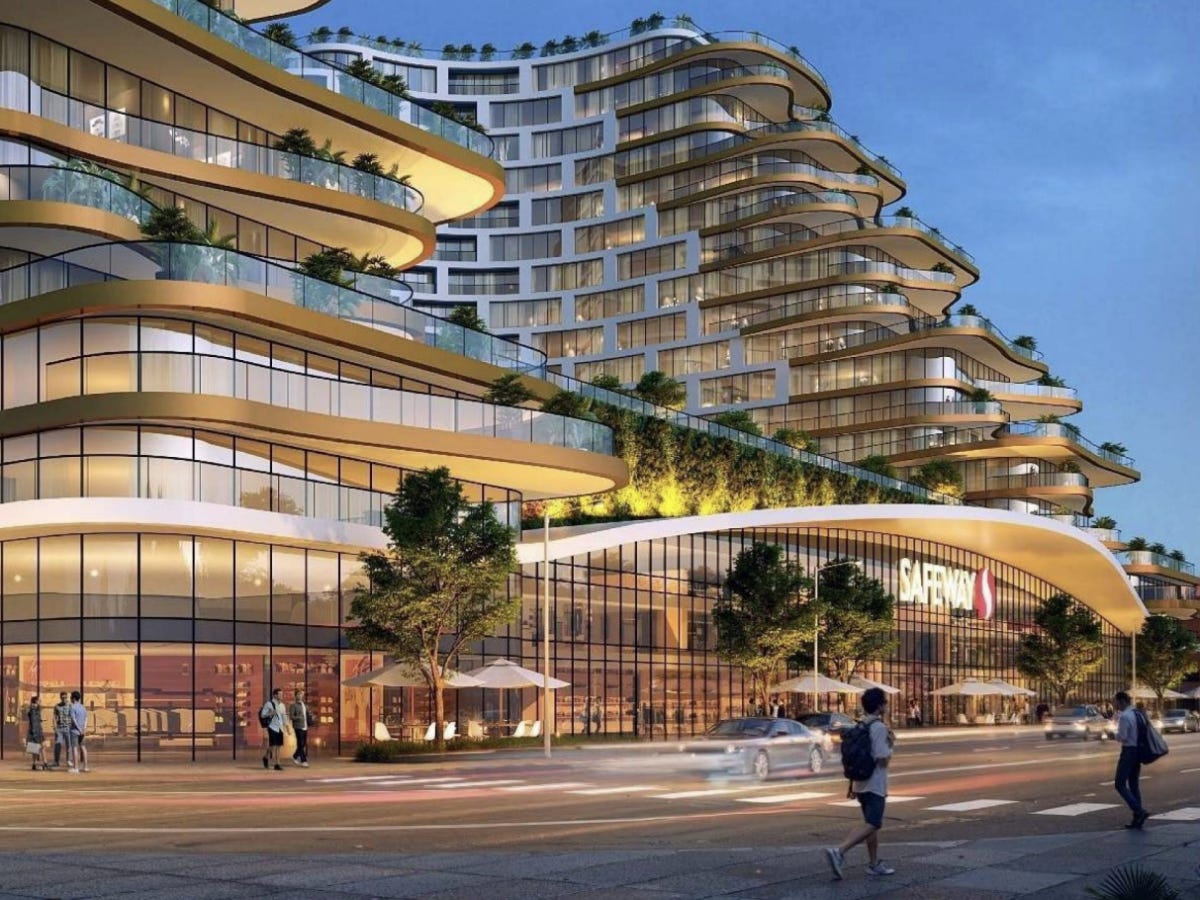
Here is a sequence of events worth examining.
Mayor Daniel Lurie has positioned himself as a pro-housing reformer. His signature initiative, the “Family Zoning Plan,” would upzone much of San Francisco to allow denser development. When developer Align Real Estate proposed a 790-unit housing project on a Safeway site in the Marina, including 86 affordable units, one might have expected the mayor’s support.
Instead, Lurie opposed it. His spokesperson declared that a developer “trying to sneak in a project before our plan takes effect is a complete violation of the spirit of that work.” The administration pledged to “stand up firmly to developers that game the system” and “pull every lever” to reshape the project.
The accusation has rhetorical appeal. But it collides with an inconvenient fact: according to the San Francisco Standard, Supervisor Stephen Sherrill (Lurie’s ally in District 2, whom the mayor recently endorsed) “submitted amendments to the mayor’s Family Zoning Plan that would exempt portions of his tony district from sky-high towers.” Mission Local reported that Sherrill “went parcel by parcel with neighborhood groups, and subsequently cut the Marina Safeway parcel out of the upzoning plan.”
Put plainly: the administration’s ally deliberately excluded this site from local upzoning, leaving state density bonus law as the only path to significant housing production on the parcel. The administration then accused the developer of “gaming the system” for using that path. Bad faith is the charitable interpretation.
The Project
The Marina Safeway project would transform a 2.6-acre site at 15 Marina Boulevard into a 25-story, U-shaped residential tower. According to the San Francisco Chronicle, the development would include 790 rental units (86 of them affordable, approximately 11%), along with a new Safeway expanded from 40,520 to 63,000 square feet. No tenants displaced. No businesses displaced. Safeway returns to the ground floor after construction. The site sits within walking distance of multiple Muni lines and parks.
Some numbers for context: the Marina has added only 14 affordable homes since 2005. These 86 affordable units alone would represent six times that figure. According to The Frisc’s analysis of city housing inventory data, “The Marina and Outer Sunset managed to add not a single new home” in 2022. SPUR has documented that “well-resourced neighborhoods represent more than 50% of the city’s total land but only 10% of all new housing built in the last 15 years.”
A neighborhood that has contributed essentially nothing to San Francisco’s housing supply for decades. A proposal for 790 units with no displacement and improved retail. The mayor opposes it.
The Objection and Why It Fails
Lurie’s stated rationale is that Align is exploiting a timing loophole. Supervisor Sherrill called the proposal “outrageous,” “cartoonish,” a “publicity stunt.”
The objection fails on every count that matters.
California’s Density Bonus Law has existed since 1979 and was significantly expanded by AB 2345 in 2020. The law explicitly allows developers to exceed local height limits when they include affordable housing. This is the incentive structure California’s legislature designed to encourage affordable unit production. Sam Moss, executive director of Mission Housing, told Mission Local: “Those state laws were passed by elected politicians and have been around for years. No one’s gaming the system here.”
The state enacted these provisions because cities like San Francisco consistently failed to build adequate housing in high-opportunity areas. Using the law is not gaming the system. It is using the system as designed.
Then there is the circularity problem. Sherrill carved this site out of the Family Zoning Plan. The administration ensured state law would be the only viable path, then expressed outrage when the developer took that path. A developer cannot circumvent a rule designed not to apply to them.
Finally, the selective outrage. Align has announced redevelopment plans for four Safeway sites using identical state density bonus provisions. The Fillmore project would be 30 stories, taller than the Marina proposal. The Outer Richmond project sits one block from Ocean Beach. Lurie has commented on none of them. When Mission Local asked why, the mayor’s office pointed only to the irrelevant fact that the Marina project wouldn’t be possible after upzoning, a plan that deliberately excluded the site.
Laura Foote who writes In Practice told Mission Local: “Talking about the need for housing in general is easier than looking at a specific project and dealing with the specific people in a 10 block radius who are mad about that specific project.” One YIMBY blogger was blunter: “Not sure why the mayor is opposing this one. Bad move politically: supporting hack designs in the less well-off hoods and opposing a decent one in the fancy Marina.”
The Pattern
If principle does not explain Lurie’s selective opposition, what does? The political economy of District 2.
According to Mission Local, at least two-thirds of Marina households earn above the city’s area median income of approximately $127,000; 56% earn more than $200,000. Wealth buys exclusion. Sam Moss: “It’s important to remember that the Marina is a ‘low-slung neighborhood’ because mostly high-income, privileged individuals decades ago decided that we would only let tall buildings happen in the low income, Black and brown neighborhoods of San Francisco.”
Sherrill traded housing capacity for endorsements. The Standard reported that by exempting portions of District 2 from the Family Zoning Plan, “the supervisor won over community leaders who endorsed his reelection in 2026.” The reporting names names: “Andreini said neighborhood residents, which includes wealthy and politically connected San Franciscans, such as former Mayor Mark Farrell, found Lurie’s plan to be ‘way overboard.’ Andreini said he endorsed Sherrill after the supervisor pushed to limit zoning in the area.”
Sherrill’s official biography notes membership in Northern Neighbors, a YIMBY Action affiliate. Jane Natoli of YIMBY Action told The Standard: “It is politics at the end of the day, whether we want it to be or not.”
Lurie’s housing commitments have always been conditional. According to KQED, he campaigned on speeding up affordable housing production. But the SF Examiner reported that as a candidate, Lurie has indicated that he supports allowing buildings of six to eight stories along commercial and transportation corridors, far short of what state law enables. YIMBY Action did not endorse him. They backed London Breed, whom they described as “walking the walk” on housing.
The opposition may be purely performative. The Chronicle reported that under state law, “the city will almost certainly have to approve it” absent legal errors in the application. Mission Local noted that “if the developer wants to move forward with it as is, there is little that Lurie and Sherrill can do.” Credit for fighting the good fight. No responsibility for the outcome.
Implications
Perhaps Lurie genuinely believes projects should proceed through local channels regardless of legal entitlements. Perhaps he objects to a 25-story tower near the waterfront on aesthetic grounds.
But the simpler explanation fits the evidence. A wealthy neighborhood’s residents don’t want a tall building. Their elected representatives are responsive to that preference. Sherrill faces reelection in June 2026. His opponent, Lori Brooke of Neighborhoods United San Francisco, told Mission Local: “It’s kind of surprising to hear them oppose this, considering none of those words were uttered out of their mouths when we were complaining about 14-story buildings along Lombard Street.”
Critics have long accused housing advocates of being developer pawns, or of supporting density only in neighborhoods too poor to fight back. The charge sticks more easily when prominent figures muddy the waters. A few of many incidents, Elon Musk calls himself pro-development while promoting the Hyperloop, a vaporware project that helped block California transit. Marc Andreessen preaches housing abundance and “techno optimism”, then lobbied to block an apartment building near him. Commentators like Matt Yglesias urge the movement (and Democrats broadly) toward closer ties with both, despite these incidents and many more.
But real life YIMBYism is not a Twitter tendency. This case offered an easy off-ramp. Lurie ran as pro-housing. Sherrill claims YIMBY credentials. The Marina is wealthy and politically connected. Housing advocates could have stayed quiet. They didn’t. It’s not a one time thing just in SF. In New York, Manhattan’s biggest developers are convening billionaires at the Seagram Building to stop Zohran Mamdani. YIMBYs endorsed Mamdani and Mamdani is now surrounding himself with YIMBYs.
San Francisco’s housing crisis is not abstract. The city needs tens of thousands of new homes. A 790-unit project on a site with no displacement and transit access represents precisely the kind of development the city claims to want. That the mayor opposes it in his own backyard while remaining silent about taller projects elsewhere tells us what we need to know.
Great article! I think a key to YIMBY is to insist that all neighborhoods contribute to higher density housing and work with developers that build projects that fit well with the neighborhood. I think the Marina project does that so it should have been an approved not blocked.
Love this write-up!