


Edit: Added clarification after reader feedback that this critique targets a vocal minority, not productive online organizing. As one commenter noted, ‘Online is where people find new communities’ - essential for movements like YIMBYism
Freddie deBoer wrote (in a now deleted) note that claimed“It’s just so unfortunate that YIMBYs are trying to push everyone to get behind a massive ‘just build’ agenda but also say that it’s totally unrealistic to construct new buildings that look as good as [historic buildings] and that if you care about aesthetics at all you’re some sort of simpleton.”
I made it clear, that I have significant disagreement with that statement, but Freddie gotten more specific: “Every time someone posts a picture of a beautiful old building on Twitter a hundred Very Online YIMBYs show up and call them dumb and say that Actually, Ugly Buildings Are Good, accept your identical glass and brushed steel slop for the rest of your life.”
As much as I would like to deny it, Freddie happened to be right about a specific (and I can’t stress enough) VERY SMALL MINORITY OF THE ONLINE COMMUNITY, only the “Very Online” YIMBYs, though this shouldn’t obscure the excellent work by organizations like YIMBY Action, YIMBY Law, Strong Towns, and others I can rattle off. There’s a genuine tension between what works in real life and what gets amplified online. Social media incentives can corrupt movements when engagement metrics become the primary feedback mechanism, rewarding a vocal minority that celebrates ugliness and dismisses aesthetic concerns while serious advocates demonstrate that density and beauty aren’t opposing values. This “Very Online” problem extends beyond architecture and zoning. In pronatalism, organizations like Boom Campaign are smaller but promising, doing research on what works, yet online discourse often skews toward accounts demanding tradition while defending workplace policies that prevent family formation. Meanwhile, real-world cities deliver measurable fertility increases through sustained institutional commitment. It’s almost like what’s said isn’t exactly what gets done.
Say it with me : “The Purpose of a System Is What It Does”
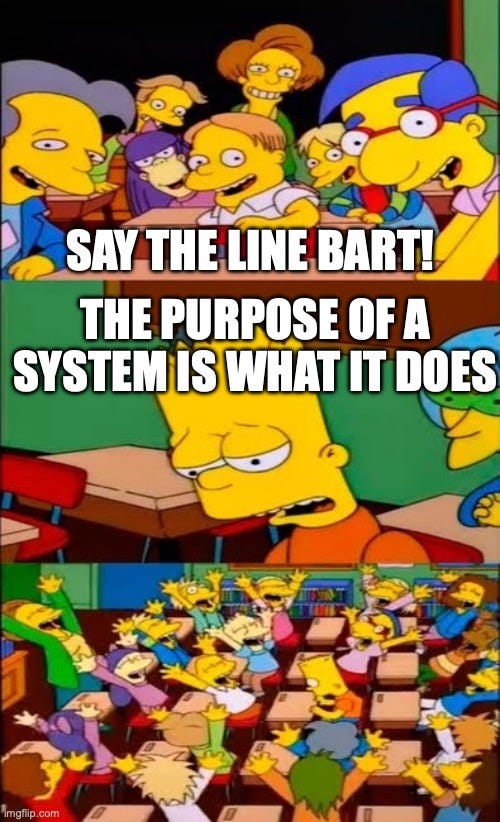
Organizational cybernetics offers a concept that cuts through stated intentions to actual purposes: POSIWID, or The Purpose of a System Is What It Does. Judge systems by their outputs over time, not their claims. If a system consistently produces X despite stating it pursues Y, then producing X is the actual purpose, whatever anyone says.
At the end of the day, what does “Very Online” YIMBY discourse produces what, exactly? Not housing permits. The outputs are viral threads celebrating ugliness, in-group status through extremity, personal brand building for advocates, movement cohesion through symbolic battles with “normies”, while housing supply declines and prices keep on rising. Real-world YIMBYism produces Minneapolis 2040’s 16-34% lower housing costs versus counterfactual, Austin’s 9.3% rent decline (the largest in the country). Japanese architectural fame is beloved worldwide precisely because minimal design review enables rather than constrains quality.
Pronatalism follows the same pattern. Online pronatalists produce manifestos and media attention while their supposed leaders like Elon Musk’s actual workplace practices undermine fertility. Real-world fertility policy produces South Tyrol’s 40 years of sustained family payments delivering 1.64 fertility versus Italy’s 1.2 (37% above baseline), Akashi City’s budget reallocations cutting public works to fund child welfare achieving 1.65 versus Japan’s 1.3 (27% above baseline), remote work policies enabling 0.2 additional children per couple through time recovery addressing material constraints.
Juran distinguished between vital few and trivial many: in any collection of problems, a vital few account for most impact while a trivial many account for very little. Effective improvement requires identifying and attacking the vital few rather than dissipating energy across everything . Minneapolis succeeded by focusing on parking minimums, height limits, transit-oriented development (the vital few regulatory barriers preventing housing production). Online “advocacy” systematically focuses on trivial many: aesthetic signaling, symbolic victories, viral arguments that just doesn’t seem to recruit many real life people. The vital few constraints determining actual outcomes get ignored, especially if they require trust from other real life factions for any hope of a clean bill.
We’re looking at how different institutional structures produce radically different outputs through their feedback loops, information flows, optimization targets. Not individual failures or bad actors.
Housing: How Online Fails While Real-World Succeeds
Design Review Makes Buildings Uglier (And More Expensive)
What Freddie spotted (“Very Online” YIMBYs celebrating ugliness while claiming to support abundance) reflects a misunderstanding about what produces ugly buildings. Discretionary design review committees systematically degrade architectural quality through three compounding mechanisms creating exactly the monotonous mediocrity Freddie objects to.
Risk aversion drives committee mediocrity (I know, I know, it is a bit cliche). Design review commissioners engage in what M. Nolan Gray called “meddle management”: making their worth felt through constant engagement with projects for which they have no professional responsibility but over which they wield veto power. The safe choice becomes what looks like what already exists. New York’s Landmarks Preservation Commission reviewed a thoughtful brick redesign of a decrepit storefront. Commissioner Michael Goldblum objected that the existing building was “very much reflective of the period of significance” while the new design “needs to be examined and made more location-specific.” Translation: make it look more like what’s already there, regardless of whether what’s already there is any good.
Public feedback mechanics compound this by favoring vocal minorities over silent majorities. A Seattle architect diagnosed the problem: design review boards function as a “megaphone for NIMBYs to complain about housing.” Three retirees show up to every meeting with the time and inclination to object. Working parents with young children don’t have that luxury. Organized opposition dominates unorganized support, not because they represent community consensus, but because the process systematically selects for those with time and motivation to participate repeatedly.
Delay itself drives standardization in ways having nothing to do with aesthetics and everything to do with economics. Seattle’s design review delayed a passive house project for 19 months because the board requested more bricks before eventually approving it without the bricks anyway. The lesson developers learned wasn’t about architectural quality. Use formulas that cleared review before. Avoid innovation triggering additional meetings. Time is money, uncertainty is expensive. The rational response to lengthy discretionary review is deploying the safest possible design minimizing procedural friction, not attempting anything architecturally distinctive.
Tom Radulovich of San Francisco’s Livable City observed a system failure: “Something happened in the culture of architecture and design, which went from a system that was unregulated but consistently producing things that are good to one that is heavily regulated but still turns out crappy buildings.” We get neither beautiful variation nor affordable monotony. We get expensive monotony designed to survive committee review. The “gentrification building” with its variegated façade, quietly receding roofline, massing as a collage of intersecting cubes in four different colors and materials appears in both market-rate and affordable housing precisely because both face the same procedural gauntlet.
Dismissing aesthetic concerns as illegitimate or claiming that caring about building appearance marks someone as a simpleton isn’t just incredibly stupid. It contradicts the fact that YIMBYism enables prettier buildings to even get built along with everything we know about how people actually value architecture and what drives opposition to development. Manhattan Institute’s comprehensive analysis synthesized Dutch research showing neo-traditional homes commanding higher prices than modern designs, with price premiums not explained by higher build costs. People simply valued the aesthetic more. A Savannah study found brick and stucco exteriors adding 24-35% to property values compared to wood and aluminum. More than adding bedrooms (6% premium), bathrooms (10.5%), courtyards (17%), swimming pools (17%). For those who value market’s opinion on things, the market makes it clear: people value beautiful design more than they value a lot of physical amenities.
Yale research on opposition found that mentioning developers as beneficiaries increased opposition to identical projects. Concerns about “ugly or particularly large” buildings appeared repeatedly as primary drivers of resistance. Beautiful buildings command 24-35% premiums and reduce opposition. Celebrating ugliness doesn’t just alienate normal people aesthetically; it burning up political capital (that others, not the “Very Online”, earned btw!) needed to actually build anything.
What Happens Without Design Review? More Pretty Buildings
What happens in the real world? Well most of the evidence contradicts everything online YIMBYs carelessly claim about “abundance” vs aesthetics. Japan has minimal design review and produces globally celebrated architectural creativity: the “pet architecture” of Atelier Bow-Wow squeezing inventive buildings into traffic islands and triangular interstitial spaces, minimalist streetscapes with innovative responses to site constraints, avant-garde houses accessible to middle-class families rather than reserved for the mega-rich.
Light regulation with clear frameworks enables both quality and quantity simultaneously. Discretionary review produces neither. “Very Online” YIMBYs showing up to mock people for appreciating beautiful old buildings and insisting that “Actually, Ugly Buildings Are Good” (or defending a landlord cartel for that matter) aren’t advancing more housing supply, let alone housing “abundance”. They’re signaling for in-group status within a social media bubble, despite all of the real world evidence or the fact that the online YIMBY movement was built on top of urbanism (which celebrates aesthetics), through provocative extremity while systematically undermining the movement’s stated goals. The system produces viral engagement for the “Very Online” while producing zero housing permits and actively alienating the broader public whose support is necessary for political success.
The Andreessen Contradiction
This dynamic extends beyond anonymous Twitter accounts to the movement’s most prominent advocates. Marc Andreessen writes manifestos lamenting that we “can’t build nearly enough housing in our cities with surging economic potential, which results in crazily skyrocketing housing prices in places like San Francisco, making it nearly impossible for regular people to move in.” The rhetoric signals concern about broadly shared prosperity.
Two years after his “It’s Time to Build” manifesto, The Atlantic uncovered that he and his wife had sent a comment to Atherton officials expressing “IMMENSE objection” to the town allowing 137 multifamily units and demanding they “IMMEDIATELY REMOVE all multifamily overlay zoning,” warning the change would “MASSIVELY decrease our home values.” Atherton is the richest US zip code five consecutive years and faced a state mandate to plan for 348 units by 2031. After receiving more than 300 mostly negative comments from residents including Netflix, EA, and Benchmark executives, the town dropped its multifamily rezoning and now relies on accessory dwelling units and lot splits that won’t remotely meet the mandate.
Andreessen’s manifestos reach a broad public and build his “visionary” reputation. His Atherton opposition stays local and procedural, only becoming visible through investigative journalism. Benefits flow from both rhetoric and contradictory practice. The contradiction only surfaces through deliberate investigation rather than any sort of automatic feedback. No forcing function requires consistency. The system produces personal brand value and elite property protection simultaneously. Neither output is housing.
What Real-World YIMBYism Actually Delivers (In Addition to Prettier Buildings)
The gap between online discourse and real-world results shows how policy actually works when designed to solve problems rather than generate engagement. Real success comes from comprehensive reforms addressing the vital few constraints systematically.
Minneapolis 2040 passed after 150 public engagement sessions gathering 20,000 comments over two years. Neighbors for More Neighbors started with Ryan Johnson and John Edwards creating memes and hosting bar meetups, building through face-to-face engagement to more than a hundred people at Gluek’s bar mobilizing for density reform. They organized a coalition with AARP, the transit authority, community institutions (groups who needed housing, not industry lobbyists bargaining over who gets what). The City Council vote was 12-1 in favor, near-unanimous despite vocal opposition, because voters had elected five new council members in 2017 who campaigned explicitly on equity and affordable housing. Political culture shifted through democratic choice rather than backroom deals.
The reform itself was comprehensive but focused on vital few constraints. Allowing duplexes and triplexes everywhere provided political cover. The real impact came from eliminating parking minimums, removing height requirements in high-density zones, enabling transit-oriented development that unlocked apartment construction along corridors. Not a bill loaded with symbolic wins or theatrical gestures. A clean approach addressing the specific regulatory barriers preventing housing production.
Five years post-implementation, housing cost growth in Minneapolis was 16-34% lower than counterfactual Minneapolis. Rents 17.5-34% lower than they would have been otherwise. Placebo tests showed Minneapolis had the lowest housing cost trajectory of 83 donor cities. Not Twitter success. Rent decreases people can feel in their bank accounts every month.
Austin followed a similar path. The Home Builders Association organized a diverse coalition including the Austin Board of Realtors, AARP, Austin EMS, CapMetro (community groups rather than just industry interests). Council Member José “Chito” Vela explained the shift in political culture: “We were working under the premise for a couple of decades that if we did not allow new construction, that would help preserve neighborhoods. That has been objectively shown to be false.” The HOME Initiative passed 9-2 in December 2023. Phase 2 compatibility reforms passed in May 2024.
National Multifamily Housing Council analysis found the construction boom driving rent decreases actually preceded most zoning reforms: “Austin’s last substantive revision to its Land Development Code was in 1984... recent regulatory changes can’t explain the surge in development beginning in 2022.” Market signals met a relatively favorable regulatory environment. Political culture shifts reduced procedural opposition. The city issued 51,000 housing permits in 2021 at four times the rate of comparable cities, matching Phoenix, Atlanta, and Philadelphia combined. 9.3% rent decline from May 2023 to May 2024, the largest in the country. Median rent dropped from a $1,726 peak in August 2022 to $1,399. Jake Wegmann at UT Austin described it: “Like adding chairs to a musical chairs game.”
Minneapolis didn’t try solving every housing problem simultaneously. It eliminated the specific regulatory barriers (parking minimums, height limits, single-family-only zoning) preventing market response to demand. Austin didn’t load its reforms with every possible housing intervention. It addressed compatibility standards and allowed development to respond to price signals. Clean comprehensive reform addressing core constraints works. Loaded bills trying to address everything or theatrical spending diffused across marginal interventions doesn’t.
Fertility: When Pronatalism Prevents Births

If this pattern were unique to housing, we might dismiss it as domain-specific dysfunction junction. But identical dynamics govern fertility policy, where the gap between online performance and real-world outcomes shows even more starkly who advocacy actually serves.
Musk’s Contradiction: RTO Costing 100,000 Births Annually
Elon Musk warns that population collapse from low birth rates poses a bigger risk to civilization than global warming and positions his fourteen-plus children as ideological commitment made flesh. The rhetoric signals profound concern about demographic sustainability.
His actual workplace practices? Musk explicitly embraced return-to-office mandates as an attrition tool, writing with Vivek Ramaswamy about federal workers that “requiring federal employees to come to the office five days a week would result in a wave of voluntary terminations that we welcome.” Research by Nicholas Bloom and colleagues estimates that forcing employees back to office five days weekly could reduce fertility rates by perhaps 100,000 births per year in the US compared to a regime of strong support for hybrid and remote work.
The mechanism so far appears straightforward. Remote work saves approximately 1.5 hours daily on commuting. When both partners work from home at least one day weekly, total lifetime fertility increases by 0.2 children (an 11% increase from baseline). RTO eliminates precisely the flexibility research shows increases fertility.
Beyond RTO, Musk’s companies create workplace environments so hostile that employees successfully sue over racism and sexism. They fund population research while firing employees for writing open letters in ways the NLRB found illegal. The rhetoric serves personal branding and ideological positioning. The actual workplace practices serve labor cost reduction and control through voluntary attrition. The system produces both personal brand value about civilizational concerns and cost savings through labor control. The output it doesn’t produce is births.
The “Trad Wife” Discourse
Darby Saxbe‘s recent critique of tradwife discourse identifies the same pattern from a different angle. The problem with following the script now being pushed on the far-right (skip college, forego career, start having kids young and have many of them): your choice of husband becomes incredibly important. Wind up with someone who isn’t responsible, isn’t kind, doesn’t respect you, and you have very little recourse when things go south. The paradigmatic 1950s traditional mothers understood this lifetime risk. They told their daughters to go to college and have careers.
But the men most eager to land tradwives don’t seem to respect women or value their contributions, if the online discourse is any indication. Building a movement around telling women to set themselves up for significant lifetime risk while the men advocating this simultaneously push workplace policies preventing family formation isn’t just internally contradictory. It shows who the advocacy actually serves. Online pronatalists advocate traditional family formation while implementing policies costing 100,000 births annually. They celebrate having many children while creating workplace conditions fundamentally incompatible with caregiving. The gap between rhetoric and practice isn’t accidental. It’s what the system is optimized to produce.
What Real-World Fertility Policy Delivers
Real-world fertility policy success contrasts sharply. These successes share a common pattern: sustained institutional commitment over decades to unglamorous interventions that don’t generate viral content but do enable people to actually have and raise children.
Boom’s Phoebe Arslanagić-Little has a great article on how South Tyrol has maintained family support payments since the 1980s, forty years of sustained commitment proving government will reliably support families. The region provides 200 euros monthly per child until age three plus a 1,900 euro annual national payment, free “Ben Arrivato Bebé” packages with clothes and books and vouchers, family transport passes, shopping discounts, a Family+ card for households with three or more children providing supermarket discounts. 1.64 fertility versus Italy’s 1.2 (37% above the national baseline), sustained through high female labor force participation and the second-smallest gender employment gap in Italy despite relatively low religiosity. On top of that, Peter Foreshaw Brookes has a fantastic report on how these polices don’t just increase the TFR, but also the Total Maternity Rate, i.e. how many women even have a child.
The policies themselves drive results with a secret ingredient, consistency. After decades of repeatedly proving that government supports families with dependable payments and predictable childcare, people believe it and plan accordingly.
Akashi City in Japan took a different path revealing the political economy constraints most municipalities face. Former mayor Fusaho Izumi from 2011-2022 doubled child welfare spending by cutting public works budgets, prioritizing families over construction interests in ways most cities won’t because elderly voters outnumber young families and construction lobbies want their budgets maintained. The city now provides free medical care for children through age 18, free school lunches through age 15, free nursery and kindergarten for families with two or more children, free diapers delivered by midwives (combining material support with professional outreach addressing maternal isolation). 1.65 fertility versus Japan’s 1.3, 27% above baseline, with population growing ten consecutive years as young families relocated specifically for the policies. Research across 1,741 Japanese municipalities found child welfare spending dominated every other predictor with a 0.47 coefficient, demonstrating that municipal budget choices matter more than national policy when local incentives point elsewhere.
Remote work is the cleanest natural experiment in addressing material time constraints. Bloom’s 2025 study across 19,277 people in 38 countries found that when both partners work from home at least one day weekly, total lifetime fertility increases by 0.2 children (described as a “massive” effect, roughly 11% of baseline). The Economic Innovation Group found remote workers were 10 percentage points more likely to be pregnant or trying among women whose finances improved significantly, 6.3 percentage points more likely to plan marriage. NBER research by Bailey, Currie, and Schwandt identified the 2021 fertility increase as concentrated among college-educated women who saw drastic reductions in opportunity cost when able to work from home. This addresses how people actually live rather than offering symbolic gestures or loaded bills with diffuse benefits.
Why This Pattern Is A Problem
Why does online discourse (from a very vocal minority mind you!) consistently produce performance rather than substance across both housing and fertility, drowning out other voices in the online community? The systematic divergence between stated goals and actual outputs has structural causes.
Fundamentally, it’s feedback my dear Watson . Effective systems require rapid, accurate feedback from outputs to decision-makers so the system can learn from mistakes and build on successes. Online advocacy has near-instant feedback about engagement metrics (likes, retweets, follower counts, viral thread performance) but essentially zero feedback about actual policy outcomes unfolding over years rather than hours. Andreessen gets immediate feedback on how many people share his manifestos but no feedback connecting his Atherton opposition to housing scarcity because the connection requires investigative journalism to surface. Musk gets immediate feedback on engagement with his pronatalist tweets but no feedback linking his RTO mandates to prevented births because that connection requires academic research to quantify.
The interventions most likely to succeed are precisely those least likely to generate online engagement. After all, we expect people to be competent and do good things. Remote work policies increasing fertility by 0.2 children don’t make compelling tweets. They’re boring HR policy requiring sustained institutional commitment to implementation. Budget reallocations cutting construction interests to fund child welfare are unglamorous municipal finance battles invisible to anyone not following local government (let along local governments in another country!). Forty years of sustained family payments proving government reliability is the opposite of viral (repetitive, undramatic, technically complex policy maintenance). The 150 public engagement sessions Minneapolis held gathering community input happen in church basements and community centers rather than on social media, requiring patient relationship-building that doesn’t scale through retweets.
What does generate engagement? Celebrating ugly buildings gets upvotes and in-group status while alienating the broader public. Writing manifestos about civilizational challenges builds personal brands without building housing. Blocking developments in your own town while advocating abundance online generates both visionary reputation and property protection. Mandating return-to-office while funding population research signals both labor control and demographic concern. The contradiction doesn’t matter because benefits flow from both performances.
Again, with social incentives reward hype and fights over real world results in ways that compound over time. Twitter (or what’s left of it) select for provocation rather than bridge-building because provocation generates engagement. Suggesting that celebrating ugliness seems like bad politics spoils the fun and marks you as insufficiently committed to movement purity by the “Very Online”. The most extreme positions get the most engagement, which incentivizes increasingly extreme positions, which drives out moderate voices, which makes the movement less effective at achieving stated goals while more effective at generating viral content.
Overall of course I agree with you that posting isn't the best activism but even in your telling, there is a role for the online discourse. The Minneapolis YIMBYs made memes, and published them, where?
Online is where people find new communities. I'm online now writing this note, online is where you and I met each other. It would be better for you to just attack a certain kind of shit posting without throwing the baby out with the bathwater.
The existence of the internet is what allows people who experience diffuse benefits to organize in the first place. YIMBYism is a social phenomenon that did not exist before the internet and imo could not have existed. Social scientists in the previous generation assumed it would never be possible for the potential future residents of proposed housing developments to organize and enter the political process in a way that could effectively counter the political effects of the people who experience the concentrated harm of new building. Well, we did, in the 2010s because of the internet.
Important point that real-world YIMBYism is often distinct than a certain strain of the internet poaster. A couple thoughts:
1. There may be a tradeoff between combative online personalities generating engagement that leads to recruitment vs alienating people like Freddie (who doesn’t seem that amenable to YIMBYism anyway…). It’s hard to quantify how much engagement leads to real-world recruitment but apps like Twitter certainly reward combativeness with reach. I personally prefer staying positive and often find the combativeness distasteful, but I’m not sure it’s as bad a strategy as the YIMBY critics say
2. re Specific critiques of online YIMBYs being annoying about design, Freddie’s critiques could be stronger by providing some examples. Freddie might just be setting up a straw man. I have seen, time and time again, somebody post a photo of some old building with the approximate quote “why can’t all new buildings look like this?” And YIMBYs rightfully make the point that mandating all new buildings look a certain way prevents future innovation, is often cover for NIMBYism, and, as you eloquently point out here also, doesn’t actually work to make buildings more beautiful. I’m sure some poasters just blow off the concept of appealing design entirely in an obnoxious way, but I’m not convinced the specific problem Freddie is griping about is as widespread as he thinks. He famously ignores any context or additional information that conflicts with his preconceived notions
Separately, I’d be interested to read more about the impact of design on support for new homes. My impression is the jury is still out (see my recap of recent research here https://substack.com/@theonetruejeremy/note/c-183061815?r=74nn5&utm_medium=ios&utm_source=notes-share-action) but you presented several pieces of evidence I haven’t seen before on the “design matters” side of things