

When Zohran Mamdani won the Democratic primary for mayor of New York in July 2025, not everyone took the news well. The New York Post ran a piece headlined “Zohran Mamdani’s feeding off Gen Z’s misplaced doomerism.” Its argument leaned on Jean Twenge, who has spent fifteen years making the case that each new generation arrives carrying some fresh psychological pathology, rather than, say, responding to a decade that ran from the Great Recession through the COVID years, or anything else with real weight to it. Gen Z, she explained, votes “the bastards out” because depression makes the world look permanently grim.
Twenge is not wrong that perception drives behaviour. Indeed it does, and we would not argue otherwise. Where she goes wrong, in our view, is the perception itself, and the question of whether it tracks anything real. Young New Yorkers, and older ones, were looking at concrete, material things. The Second Avenue Subway cost $2.5 billion a mile, eight to twelve times what comparable lines cost in Paris or Madrid, by the count of NYU’s Transit Costs Project. A cap on food-vendor permits, in place since 1979, had sat untouched for forty-six years. On the black market a single permit now sublet for $15,000 a year, as one investigation found. Six thousand small-business rules had piled up over the decades, and we suspect nobody was keeping count.
Telling a voter that she is depressed, and that the cure is your candidate (one with a certain kind of “distinguished” history), is a way of not discussing the subway, or the economy that makes a plate of halal run over $10.
What about New York?
We are picking on Mamdani and New York for a straightforward reason. The city is thick with history and case studies, and not the dusty kind. Recent history that conservatives to progressives can learn from.
Two years before Mamdani won, New York drove out the one transit official in living memory, nicknamed Train Daddy, who had actually been fixing the system.
Andy Byford took over the New York City subway in January 2018, with on-time performance at 58.1%. He had come up from station foreman in 1989, through the London Underground and the Toronto Transit Commission. A self-described subway nerd, he spent his first weeks walking the platforms.
One of his first orders was for three vacuum cars to clean the track beds. Litter on a track bed delays no train. On any cost-benefit model a consultant would run, the vacuum cars are waste: money spent on something that moves no measurable number. Byford bought them anyway, and said why. “My customers shouldn’t have to look at that.”
That is not an especially technocratic line from Train Daddy. He had practical and safety arguments available to him, and used none of them. Instead he made plain that he was buying a subway that looked cared-for, on the theory that a rider who sees filth correctly concludes that nobody is in charge. Two equally competent engineers could walk the same platform, see the same track bed, and disagree about whether the vacuum cars are worth the money. Looking at the thing directly is necessary. It is not the whole of the skill. The other half is an imagination for what the thing feels like to the person using it.
Byford worked the trains in two ways. Contrary to the popular memory of him, much of it was incremental. A SPEED Unit audited the faulty signals that had been quietly slowing trains for years and raised limits where the engineering allowed. Not to mention, the Save Safe Seconds campaign shaved seconds off millions of daily trips. Eighteen months in, weekday on-time performance hit 81.5%, the highest since 2013.
His second way, and what gets remembered is the big structural projects. Fast Forward, a $40 billion plan to re-signal most of the system on a timeline 75% faster than the baseline. (A note before planning anything that bold, Byford had done the work for three decades across four agencies.) He knew how the procurement and the labour realities actually worked, not from a briefing but from doing them.
The point worth holding onto is that the vacuum cars belong to neither category. Clean track beds and re-signalled track are different kinds of project, and a manager who thinks only in measurable outputs will fund the second and cut the first. Byford funded both, because both mattered to how the system was experienced.
In January 2020 he resigned. Andrew Cuomo, Twenge’s beloved governor, had spent a year freezing him out: briefing Byford’s subordinates while Byford sat in his own office, and overruling his engineering judgement. He brought in AlixPartners to “transform” the MTA by trimming Byford’s authority down to “the day-to-day running of service.” Cuomo’s stated objection to Fast Forward was that it was too slow. A politician with no transit background was informing a four-continent professional that his timeline lacked ambition. Byford went on to run Transport for London, and now leads high-speed rail at Amtrak.
Mamdani
Mamdani took office five years later. Before anyone reads what follows as cheerleading for a left-wing mayor, hold on for a moment. A Republican and an ex-Democrat independent are coming a few sections down, and they are also models of competency.
It was not smooth. Ploughs shoved snow into bus stops, the nearest open space, and nobody was tracking which stops had been cleared. Then sub-freezing cold turned the banks to ice. Riders posted photos of three-foot walls of frozen snow where their stops used to be, and crosswalks vanished. At least 20 people died of cold exposure in the weeks that followed. Some inside their own apartments. City Council Speaker Julie Menin said the deaths “were not inevitable.”
Four weeks later, the city’s first blizzard since 2016 buried all five boroughs under nearly two feet of snow. It was a worse storm by every measure. Mamdani’s response was markedly better. Between storms, the administration had geotagged every unsheltered bus stop and crosswalk so DSNY could track each location and the time it was last cleared. Emergency shovelers went from 550 to 1,300, their pay from $19 to $30 an hour. Warming centres more than doubled. An overnight travel ban kept private cars off the roads. By Monday morning, 2,200 bus stops were clear and no one had died on the streets. You do not often watch a mayor learn that fast from his own mistakes, or learn from them at all.
His administration brought the first enforcement action against a delivery app under New York’s food-delivery laws, an $875,000 settlement with HungryPanda and restitution to 380 immigrant-owned restaurants it had overcharged. The point is not the settlement figure. It is that the legal authority had been sitting there unused for years. Enforcing a junk-fee law against a well-capitalised tech platform was nobody’s idea of “what works”. It had no champion among the pundits who use and abuse that phrase. The Mamdani administration checked whether the law was being followed, found that it was not, and enforced it.
On the more “centre” or “moderate” side of things, Mamdani’s Executive Order 11 directed seven agencies to inventory the 6,000 rules and fees facing small businesses. The order set fixed deadlines and was built with the city’s chambers of commerce. The street-vendor reform is another example. The 1979 permit cap had created a black market charging $15,000 a year for a sublet, while vendors caught working without one faced criminal charges. The administration moved to lift the cap and decriminalise unlicensed vending. The aim was a more legitimate channel towards the 17,000 permits the city is legally required to issue and simply never got round to. When a cap is producing a black market, lift it. Then build the lawful channel, so that the legal path is also the easy one.
None of this is especially ideological, regardless of what the discourse on Twitter has decided. Which raises a fair question. Why did Eric Adams, the supposedly more “respectable” and “centrist” mayor, do none of it? The honest answer is that the credentialled-centrist style does not reward this work. It rewards what presents well to the foundations and the ratings agencies, and an unenforced junk-fee law presents as nothing at all. We are only months into Mamdani’s term, and anyone who tells you how it ends in three years is selling something.
Carmel and Detroit
So how do Mamdani and Byford actually connect? Two more cases, both rather more centrist, bring it round.
Jim Brainard became mayor of Carmel, Indiana in 1995 with no real public-office experience. Early on, a friend pointed at a pile of pipes by the road and asked him what they were. Brainard did not know, so he wrote to urban-planning departments around the country and asked for their syllabi. Twenty-eight years later Carmel had 152 roundabouts and a reputation as “the internet’s favorite small city,” on the strength of an urbanism that is genuinely walkable by American suburban standards.
Carmel’s traffic-fatality rate runs at roughly a fifth of the national one, and a downtown rebuilt from a sidewalk-less suburb now holds more than 150 corporate headquarters. A Republican, Brainard governed against half his coalition’s instincts, not out of heterodoxy, though in effect he was heterodox, but because he wanted Carmel to be a better product for its citizens and customers.
Mike Duggan inherited bankrupt Detroit in 2014. He had already run three Detroit-area institutions and knew them from the inside. As county prosecutor he had once reached back to a law-school class on common-law nuisance and used it to force absentee owners to fix or forfeit houses, an effort that saved an estimated 15,000 to 20,000 of them. As mayor he built a Department of Neighborhoods and watched Detroit post its first population growth since 1957. He has since left the Democratic Party to run for governor as an independent. On results alone, he would make a good governor for Michigan.
The method
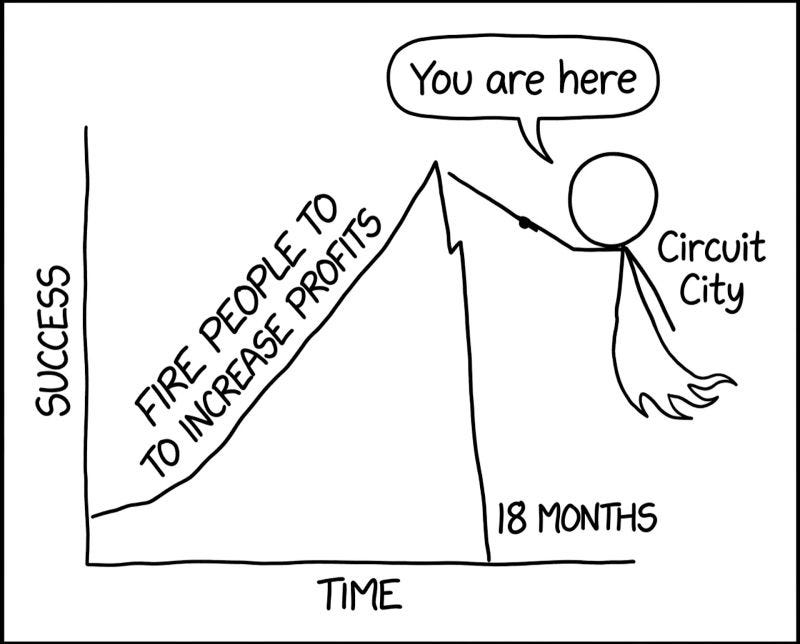
Start with Circuit City, because it is the cleanest case of the failure this whole essay is about. By the technocratic playbook the company did everything right. Watching its costs, it fired 3,400 of its highest-paid store associates in March 2007, about 9% of the workforce, and replaced them with cheaper hires to bring down selling and administrative expense. On the spreadsheet the move was sound, sensible reallocation of capital.
But the spreadsheet was not being empirical. It was being empirical about the handful of things it had decided to count, and the most important fact about Circuit City was not among them: those associates were the company’s actual offer. The reason a shopper chose Circuit City over Walmart or Amazon is the same reason a confused customer walked out with the right television rather than empty-handed. Analysts warned at the time that knowledgeable service was one of the few things the chain had that Walmart did not. The layoffs were not an empirical decision. They were a prior commitment about what a retailer is, dressed in the costume of cost discipline. Knowledgeable service is simply a very hard thing to put on an asset sheet for the respectable types, and what cannot be put on the sheet does not exist.
That holiday, same-store sales fell almost 12%. Circuit City liquidated all 567 remaining stores less than two years after the firing.
What ties Circuit City to the mayors and to Byford? I argue it is two things called customer experience and process improvement. You treat the city as a system with users in it. You ask where the friction sits, and what the system feels like to the person inside it.
What we mean is fixing the process rather than blaming the people inside it. It is an old, unglamorous discipline, and for all its results nobody much embraces it. What respectable technocrat would rather stand near the factory floor and the quality audit than at the strategy offsite?
It is also not the credentialled-centrist mayoralty or some sort of McKinsey-trained reformer. It certainly not anything similar to Rahm Emanuel.
You would ask how a rider feels about track-bed litter, or a station that smells of urine. They ask how a vendor paying $15,000 for a permit the city is meant to issue free could possibly improve anything for the citizen buying lunch. It does not! It only makes the food cost more and restrict people from opening up shop.
It’s also important to not that incrementalism and big reform are not an either/or. The skill is knowing which the situation calls for. When the architecture is sound but clogged, you take a page from “Yes, Prime Minster” and salami-slice. That is hundreds of small cuts, each one beneath notice, and they add up further than you would think. When the architecture is broken, you sometimes have to rebuild.
And there is something for which neither the pundit’s grammar nor the consultant’s has a word. It is as some marketers would put it, changing how a thing is experienced without changing the thing itself. Often it is no more than spending the money to keep something clean more often. You would be shocked how frequently this is the cheapest real improvement available, and the quickest way to lift the very perceptions Twenge worries about. It is also, somehow, the first thing a manager cuts when he funds only what he can count.
Byford’s “my customers shouldn’t have to look at that” is the whole of it. The customer is the rider and the shop owner, not the donor and not the out-of-town activist. And the gap is not only one of interest. The donor and the activist have never stood on the platform at rush hour, and have never met the gig worker the junk fee was skimming. You cannot have an imagination for what a system feels like from inside it if you have never been inside it. A pundit will defend incrementalism as realism, and not just any incrementalism but the slow do nothing kind that ruins the broader reputation of incrementalism itself! The reply to that is constraint was never ambition. It was always capability, with a dab of will.
The pipeline
Why is it so rare? The generous answer is that the incentive structure rewards organised claimants. (On that note, many aren’t even the city’s customers and citizens, like commuters from New Jersey into New York.)
That answer isn’t the whole truth, but it isn’t wrong either. The activist machines are not the villains here, and, like it or not, they do real work. Someone has to gather the volunteers and carry a point of view. Their failing, left or right, is duller than villainy. It does not occur to most people to ask whether the thing actually runs, and they tend to assume, implicitly, that the civil service will do as it is told, which opens a whole other can of worms.
The gap they leave has been filled, for forty years, by a technocratic class. A class that most people, until recently, would have called Cuomo a part of, in spite of Cuomo’s contempt for Byford as “just a division head.”
Now consider what the class built. There is the $2.5-billion-a-mile subway, and the consulting capture of state functions alongside it. It did not merely neglect the unenforced fee cap and the uninventoried rules.
The commentary has the same blind spot. It will praise a mayor for lifting the city’s mood faster than it will praise him for auditing its signals. Morale is real, and worth having. But it is what riders feel when a system works. You cannot reach for it directly, no matter what some pundits will say.
So the question is not how to beat the activist machines. It is how to work with them, on the policy goals they and the city actually share, to cut the friction, and how to build a training pipeline for the operational craft.
We have multiple mayors and civil servants who express a high level of competence in improving cities, with many of them being amateurs on the mayor side. We know this isn’t a one-off. What’s also interesting is that it isn’t limited to partisanship. There is a case to be made for reproducibility, and the activists machines have the networks to actually spread any reproducible training or set of policies and procedures that reduce friction for goals.
Pundits, who have the audience to make that case, would rather produce more punditry.
Great article. I miss Train Daddy
I am not here to argue. I am here to condense.
A CITY IS A SERVICE NOT A BUSINESS.
You DO NOT run them the same way successfully.
In systems theory, we call it "category error.'