

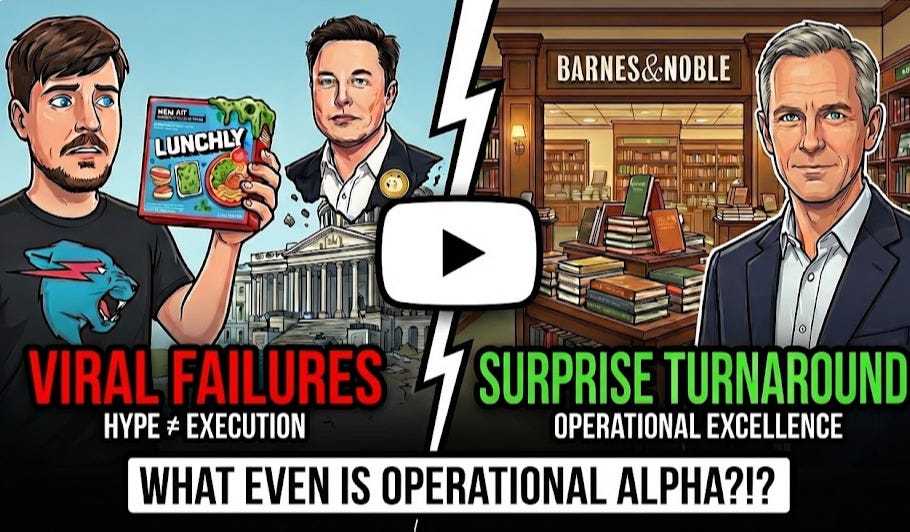
Organizations with extraordinary reach (hundreds of millions of followers, billions in revenue, democratic mandates to govern) fail systematically at basic operational tasks. Mr. Beast mobilizes 323 million YouTube subscribers, more viewers than the entire U.S. population. His Lunchly meal kits, launched September 2024, faced FDA complaints and widespread reports of moldy cheese within one month. YouTuber Rosanna Pansino documented finding mold in products two months from expiration. When pressed, Mr. Beast blamed retailers and consumers, ignoring supply chain, packaging, and storage failures entirely.
Consider Elon Musk’s Department of Government Efficiency (DOGE), launched on Trump’s first day of his second term in January 2025. The promise: $2 trillion in federal budget savings.
Why should we care? The confusion between reach and execution has consequences. When institutions optimize for visibility rather than capability, when dramatic gestures substitute for systematic improvement, people die. Not metaphorically: literally, as the DOGE catastrophe demonstrates. We think the problem runs deeper than individual failures. The pattern reveals a systematic confusion about what operational competence, also know as operational alpha in finance, actually requires.
Private Equity’s Uncomfortable Discovery: Operations Are Hard
Private equity offers a useful frame of reference here. For decades, PE firms claimed to create value through superior management. This is operational capability or excellence is called “operational alpha”. PE firms love talking about operational alpha, but was actually riding leverage and financial arbitrage. Analysis of deal-level returns tells the story: before 2000, operational improvements subtracted 6% from total value creation. In the 2000-2007 period, they contributed just 12%. Post-2008, only 3%. Leverage contributed 70% of value creation pre-2000, falling to 25% post-2008. The rhetoric claimed operations; the returns came from finance.
That said, circumstances changed. Rising interest rates after 2022 eliminated cheap leverage. Suddenly, PE firms actually needed the operational capabilities they’d been claiming to have all along. The industry responded by hiring hundreds of “operational specialists,” hosting conferences on operational alpha, developing sophisticated value-creation playbooks. The shift was genuine, not merely rhetorical.
But building genuine operational alpha proved harder than talking about it. A Harvard study tracking 1,580 deals found that 84% now include operational improvement actions in their plans, and these improvements do persist after successful exits. The operational value creation is real. Yet when initiatives fail, 67% of failures stem from controllable reasons: 53% from poor implementation, 37% from unrealistic business cases. The industry invested in operational capabilities, but execution quality remains highly uneven because operational alpha requires capabilities most financially-oriented operators simply lack.
This demonstrates the central point: when cheap capital that easy financial engineering needs disappeared, the industry discovered that operational improvement is hard.
The Influencer Illusion: Distribution Without Operations

KSI and Logan Paul’s Prime shows the same dynamics as Mr. Beast’s Lunchly. Class-action lawsuits allege caffeine content 15 to 25mg higher than advertised, allegations of PFAS contamination, and a $67.7 million lawsuit from bottler Refresco for backing out of production agreements. After explosive initial success generating $250 million in first-year sales, UK sales fell 50% year-over-year by April 2024.
NielsenIQ tracked 37 celebrity beauty brands and found only 23% failing, versus 90% failure rates for traditional CPG launches. Influencer brands actually outperform because of built-in audiences (at first).
The advantage proves temporary. Only 18% of influencer brand buyers could identify the celebrity who started the brand. Consumers prove “less likely to recommend influencer brands than mainstream brands.” Celebrity preference dropped from 17-22% in 2020 to just 11% in 2023.
Influencer brands excel at generating initial demand but collapse in execution. They mobilize millions to buy products but cannot ensure those products are safe, consistent, or properly manufactured. The asymmetry reveals a fundamental error: assuming distribution reach substitutes for supply chains, quality control, and other things that make up operational alpha.
Barnes & Noble: What Genuine Operational Improvement Actually Requires

Now consider the counterexample. When Elliott Management acquired Barnes & Noble in August 2019 for $683 million, the retailer was approaching Borders-style liquidation. The numbers at acquisition: $3.6 billion in revenue, $111 million EBITDA, a 6.15x multiple. 627 stores, down from 726 in 2008. More than $1 billion in lost market value over five years. CEO James Daunt said the company was “not quite there but pretty darn close” to following Borders into liquidation.
This was classic distressed retail, the type where private equity typically slashes costs, extracts value, and flips or liquidates. Elliott did something different.
Domain Expertise Proved Non-Negotiable
James Daunt had already turned around Waterstones using unconventional methods. Crucially, Daunt was a 30-year career bookseller who opened his first independent bookstore in 1990. He eschewed investment banking for books. This is operational credibility, not financial credentials.
Genuine Decentralization, Not Rhetoric
The core change: Give local store managers full autonomy over book selection, merchandising, and layout. As Daunt put it: “It’s ironic for somebody who runs chains, but I don’t think chain bookselling works. All I’ve done is bring the principles of independent bookselling to a chain.”
The measurable result: Book return rates dropped from roughly 15% industry standard to 9%, targeting 5%. Returns directly measure whether you’re putting the right books in front of customers. They don’t lie.
Counter-Cyclical Investment
During COVID shutdowns, B&N used downtime to refurbish stores, reorganize layouts, and reassess stock. This is the opposite of typical private equity extraction. They spent money improving assets when revenue was zero.
The Verifiable Results
Store expansion after 15 years of contraction. 16 new stores in 2022. 30 stores in 2023. 50 stores targeted for 2024.
Sales growth: “A good year on top of a prior good year” per Daunt in January 2024. Sales returned to pre-pandemic levels in 2021, then exceeded them. Profitability: Daunt in 2023: “We’ve now got both the profitability and the confidence to start opening up stores again.”
Daunt cut corporate staff in half, removing management layers. He eliminated “extraneous products that had turned B&N stores into indoor flea markets”: toys, electronics, random merchandise. Stores were “boring,” “a bit ugly,” and full of “irrelevant” products, in his words.
What Made This Work
Timeline shows patience. Elliott acquired B&N in August 2019. As of late 2024, they still own it, five years and counting. Store expansion accelerated in years 3-5, not months 1-2.
The improvements are operational, not financial. Elliott didn’t rely on leverage, tax optimization, or multiple arbitrage. Value came from fixing operations: better inventory curation, decentralized decisions, improved aesthetics, refocused product mix.
The changes are heterogeneous and specific. Not generic playbooks like “optimize procurement” or “implement ERP system,” but domain-specific improvements. Empower booksellers to curate. Eliminate publisher co-op payments promoting bad books. Reduce returns through better selection. You can’t copy-paste this.
The Private Equity Industry’s Operational Alpha Gap
Barnes & Noble is exceptional precisely because it achieved what most of private equity merely claims to achieve. McKinsey research indicates that PE funds focused on operational value creation achieved returns two to three percentage points higher than peers. PE firms now employ dozens or hundreds of “operational specialists” with sophisticated value-creation playbooks. Industry conferences feature panels on operational excellence. The rhetoric is pervasive.
But the gap between plans and execution reveals itself in operational details. AlixPartners’ survey found that 41% of PE executives identify senior leadership quality as a challenge in portfolio companies, compared to just 13% of portfolio leaders themselves, a massive perception gap. EY research shows that 81% of PE executives report holding periods extended by up to three years beyond historical averages, precisely because firms can’t execute operational improvements needed for clean exits.
The industry has genuinely invested in operational capabilities. We acknowledge that. But capability distribution remains highly skewed. Most firms can now articulate operational improvement plans. Far fewer can execute them. Barnes & Noble succeeded because Elliott hired a 30-year career bookseller, gave him genuine authority, maintained patient capital, and accepted that real improvements take years. These conditions almost never align in an industry where most partners have financial rather than operational backgrounds.
Toyota Versus Detroit: When Sophisticated Evaluators Confuse Metrics with Capability
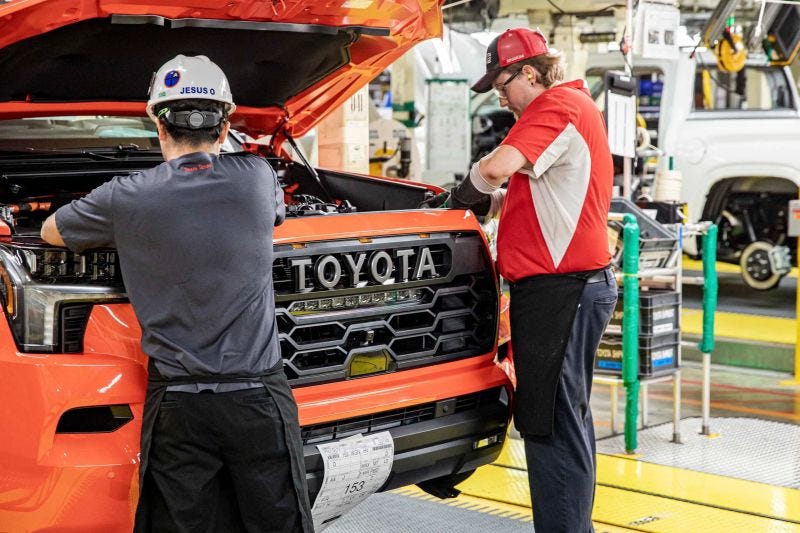
DOGE demonstrates how ignorance destroys operational alpha (we’ll get there). But the problem runs deeper than incompetent reformers wielding chainsaws. Even sophisticated analysts confuse metrics with actual operational competence. The pattern appears not just in viral failures and government catastrophes, but in how markets themselves evaluate what “operational alpha” means.
Consider how credit rating agencies evaluated the auto industry during the 2008-2009 financial crisis.
On February 6, 2009, Moody’s downgraded Toyota from AAA (the highest possible rating) to AA1, citing the “significantly impaired state of profitability” due to severe global auto industry conditions. Just hours before the downgrade, Toyota announced it expected an operating loss of ¥150 billion ($1.66 billion) for fiscal year ending March 2009. This was Toyota’s first operating loss since it began publishing results in 1941 (though internal calculations showed a small loss in 1937-38, its first year of operation). Japanese media called it the “Toyota shock.”
The downgrade was remarkable because Toyota faced the crisis from a position of extraordinary financial strength. The company held $115 billion in retained earnings, savings accumulated, as NPR put it, like “a thrifty family.” Toyota required no government assistance. It did not declare bankruptcy. It returned to profitability by October 2009. The practical effect of the downgrade was to increase Toyota’s borrowing costs at the moment when the company’s operational resilience and financial resources positioned it for rapid recovery.
Contrast this with General Motors and Chrysler. Both filed for Chapter 11 bankruptcy in 2009 (Chrysler on April 30, GM on June 1). The U.S. and Canadian governments provided $85 billion in bailout funds. Employment at the Detroit Three plunged from 250,639 in 2007 to under 170,000 in 2009. GM’s North American hourly labor costs fell from $16 billion in 2005 to $5 billion in 2010 through massive layoffs and wage reductions. GM shed approximately one-third of its American workforce. Both companies terminated agreements with hundreds of dealerships and GM discontinued several brands (Pontiac, Saturn, Hummer).
Ford avoided bankruptcy by securing an $8 billion line of credit and $7 billion loan in 2006-2007, before the crisis hit. The bankruptcy/bailout process in 2009 allowed GM, Chrysler, and Ford to impose concessions on the UAW: two-tier wages, suspended COLA, frozen wages, reduced benefits, giving up the right to strike until 2015. Workers were told these were temporary sacrifices to save the companies. The automakers then enjoyed massive profitability for over a decade while maintaining these concessions, two-tier wages lasted 14+ years, COLA stayed suspended for 14 years, legacy workers got no raises for 9 years. It took a major strike in 2023 to finally reverse the 2009 concessions and restore what workers had given up to “save” the companies.
Meanwhile, Toyota preserved its workforce and never imposed similar permanent concessions.
The Operational Philosophy Divide
The divergence in responses revealed fundamentally different views of labor and operational alpha.
Toyota’s approach: The company did not lay off any permanent employees, though it cut around 9,000 temporary workers. Toyota instituted company holidays with pay of 80% of employees’ base salaries and adopted work-sharing systems to preserve employment. The company used production cutbacks as opportunities for training and improvement projects, including reducing plant breakeven points from 80% to nearly 70% of capacity. Toyota advocated for the view that trained workers as appreciating assets, not variable costs.
This reflected Toyota’s commitment, at the time of the Great Recession, to what is commonly called “lifetime employment,” though research shows this actually covered only 20-30% of Japan’s workforce, primarily at large established companies. By 2009, roughly 34% of Japanese workers were “irregular” (temporary) workers, up from 15% in 1984. Toyota maintained its commitment to permanent employees while shedding temporary workers, preserving the operational knowledge and capability embodied in its core workforce to the point the credit agencies felt like they need to explicitly punish Toyota for dare doing so.
Detroit’s approach: Mass permanent layoffs, forced restructuring, treating labor costs as the primary problem. GM CEO Rick Wagoner was forced to resign as a condition of receiving government assistance. The bankruptcies allowed the companies to jettison pension obligations, reduce healthcare commitments, and implement lower wages for new hires. The restructuring prioritized immediate cost reduction over preserving operational capabilities.
What the Credit Downgrade Revealed
The Toyota downgrade exposes a fundamental problem in how institutions evaluate operational competence. Credit agencies assess short-term profitability metrics. Moody’s cited Toyota’s “significantly impaired state of profitability” and warned the company was “unlikely to meaningfully improve its operating performance” in the following fiscal year, despite acknowledging that Toyota will make it through the Great Recession.
That said, profitability and operational competence are not identical. Toyota’s operational capabilities (manufacturing processes, quality systems, supplier relationships, workforce knowledge) remained intact. The company’s $115 billion in retained earnings provided enormous financial flexibility. Its decision to preserve its workforce maintained the organizational knowledge required for rapid recovery.
The American automakers, by contrast, faced bankruptcy precisely because decades of poor operational decisions had left them with unsustainable cost structures and product quality problems. GM had lost market share for 30 consecutive years. The crisis exposed operational failures that had accumulated over decades.
Yet the credit downgrade happened to Toyota, not to GM or Chrysler (which were already rated junk by the time they sought bailouts). The paradox illuminates our central point: legible metrics (quarterly profitability) dominate institutional evaluation, while actual operational competence (the capability to execute consistently over time) goes unmeasured until failure becomes unavoidable.
Toyota’s sales dropped 33.9% during the recession, but the company maintained profitability by pivoting to fuel-efficient models like the Prius and Corolla. By preserving its workforce and operational capabilities, Toyota positioned itself to capture market share as the economy recovered. American automakers achieved cost reduction through mass layoffs but lost the organizational knowledge required for sustained operational excellence.
The credit agency evaluation had a point: Toyota’s short-term profitability had deteriorated, but credit agencies aren’t about the short term but long term expectations. But it missed what mattered: the company’s operational resilience and financial resources would enable rapid recovery, compared to the rest of the industry. This same confusion between legible metrics and actual capability appears repeatedly when institutions evaluate operational competence.
DOGE: When Ignorance Masquerades as Boldness
Now we arrive at the most spectacular recent failure, one that perfectly demonstrates what happens when you mistake speed for competence, cruelty for efficiency, and viral attention for operational alpha.
The Department of Government Efficiency (DOGE), led by Elon Musk and launched on Trump’s first day of his second term in January 2025, promised to save $2 trillion from the federal budget. It disbanded quietly in November 2025, eight months before its scheduled expiration, having achieved a fraction of its goals while causing catastrophic damage.
The Numbers Tell the Story
Musk initially promised $2 trillion in savings, then walked it back to $1 trillion, then $150 billion. DOGE ultimately claimed $214 billion, but multiple analyses showed these figures were grossly inflated. DOGE claimed to have cut an $8 billion ICE contract that was actually worth $8 million, adding two zeros.
The actual cost? The Partnership for Public Service estimated DOGE’s actions cost $135 billion in fiscal year 2025 alone, through lost productivity, paid leave for fired-then-rehired workers, and administrative chaos. This excludes estimated $323 billion in foregone tax revenue over the next decade from cutting 40% of IRS staff.
DOGE claimed $214 billion in questionable savings while generating $135 billion in immediate, documented costs. That’s the scoreboard.
Fire First, Discover Critical Functions Later
DOGE staffers were described as young coders without government experience, making decisions about complex agencies they knew nothing about. The pattern repeated: fire first, discover critical functions later, scramble to rehire.
Approximately 350 employees at the National Nuclear Security Administration, overseeing America’s 5,000 nuclear warheads, were fired Thursday and frantically rehired Friday after Congress warned of “dire national security implications.” The Department of Agriculture fired employees working on H5N1 avian influenza response, then scrambled to rehire them days later. Republican Representative Don Bacon summarized: “There’s an old saying, ‘Measure twice, cut once.’ Well, they are measuring once and having to cut twice.”
The FAA fired approximately 400 employees in February 2025, just three weeks after 67 people died when a passenger plane collided with an Army helicopter near Washington, D.C. DOGE cut 7,000 SSA employees, more than 12% of the workforce, while the acting commissioner admitted DOGE officials were “outsiders who are unfamiliar with nuances of SSA programs.”
And on and on.
The Human Cost: 600,000+ Deaths
The most catastrophic failure came with USAID’s effective shutdown in July 2025. Musk celebrated that he “spent the weekend feeding USAID into the wood chipper” and later wielded a chainsaw at a conservative gathering.
USAID, representing just 0.5% of government spending, had prevented more than 91 million deaths between 2001 and 2021 through programs targeting HIV/AIDS, malaria, tuberculosis, maternal health, and nutrition. A peer-reviewed study in The Lancet projected USAID’s shutdown could result in more than 14 million additional deaths by 2030, including more than 4.5 million children under age five.
As of November 2025, estimates exceeded 600,000 deaths, mostly children, from halted HIV treatment, malaria prevention, tuberculosis control, and nutrition programs. Internal USAID memos obtained by ProPublica warned of these consequences. USAID staff repeatedly shared these projections with political appointees, who “wholly prevented” staff from implementing promised exemptions for lifesaving aid.
When DOGE quietly disbanded in November 2025 after Musk and Trump had a “stunning public feud,” the entity that promised $2 trillion in savings, delivered $214 billion in inflated claims, cost $135 billion in documented waste, and contributed to countless deaths had simply disappeared. No accountability. No reckoning. Just gone.
The Common Thread
Both Mr. Beast and Musk can mobilize enormous attention instantly. Both failed catastrophically at basic operations. The similarity extends beyond reach. Both optimized for what’s visible, visceral, and dramatic: viral launches, mass firings, big numbers, bold claims. Both systematically underinvested in the messy back-office work of actual operations: manufacturing processes, quality control, systems understanding, domain expertise.
When Mr. Beast ships moldy cheese, he blames retailers. When DOGE fires nuclear weapons experts by accident, it claims the people were redundant. The playbook is identical: generate dramatic visible action, ignore operational reality, deflect responsibility when systems collapse.
What Differentiates Success: The Rare Conditions
Barnes & Noble and Toyota succeeded because conditions aligned in ways that are exceptional.
Toyota preserved its workforce precisely because it viewed operational knowledge as an appreciating asset. Daunt already executed successfully at Waterstones. Toyota had decades of refining its production system and treating systematic improvement as core capability. Both approaches empowered workers to identify and solve problems rather than imposing solutions from above.
Both absorbed short-term losses rather than destroying capabilities to preserve quarterly metrics. Both prioritized long-term viability over immediate cost reduction. The improvements are domain-specific. You can’t copy-paste them to other industries. Not generic cost-cutting but careful operational enhancements requiring deep knowledge.
These conditions almost never align. Most private equity firms hire financial operators. Most influencers prioritize reach over manufacturing capability. Most politicians prioritize visible action over operational understanding. Credit agencies evaluate quarterly metrics over operational resilience.
Why Operational Execution Is Hard
Viral marketing scales through network effects. A large following becomes self-reinforcing. Mr. Beast’s 323 million subscribers amplify every launch. Dramatic action is immediately legible. Firing thousands of people, wielding a chainsaw, launching a product to millions: these generate instant metrics, news coverage, apparent results.
Operational execution doesn’t scale the same way. Each product requires specific manufacturing processes, supply chain management, quality control protocols. Each government agency serves different functions with different constraints. The heterogeneity is irreducible.
More specifically, operational execution requires capabilities that influencers and ideologically-motivated reformers typically lack. Deep knowledge of manufacturing processes, supply chain logistics, organizational design, quality systems. Patience, because operational improvements take quarters or years, not weeks. Accepting accountability for outcomes rather than deflecting to external factors. Actually caring about operational details rather than treating them as instrumental to building an audience or demonstrating ideological purity.
Why the Myth of “Efficiency Through Cruelty” Persists
Why do we put up with it? Several dynamics reinforce the pattern.
Cruelty is visible and visceral. Firing 10,000 people generates immediate, measurable results: lower payroll, higher margins, news coverage. Building better systems, improving quality control, reorganizing workflows: these are harder to measure, take longer to show results, don’t make dramatic headlines.
Speed substitutes for understanding. Moving fast and breaking things works when you’re building a consumer app with rapid feedback loops. It catastrophically fails when managing nuclear weapons, disease surveillance, or air traffic control, systems where “breaking things” means dead people and where you often can’t undo the damage. But speed looks like competence.
Ignorance masquerades as boldness. When you don’t know how a system works, radical simplification seems obvious: just cut 80%, obviously there’s waste. When you do know how it works, you understand the consequences: fire the en route charting specialists and controllers (who are also have been cut and short staffed) literally cannot do their jobs because only a handful of trained workers in the country can update navigation charts.
Short-term metrics mislead (assuming they are accurately reported). DOGE claimed $214 billion in “savings” while the $135 billion in immediate costs and 600,000+ deaths wouldn’t show up in the same ledger. Moody’s downgraded Toyota for short-term profitability concerns while ignoring the operational capabilities and financial resources that enabled rapid recovery. GM and Chrysler optimized quarterly metrics for decades while operational competence eroded until bankruptcy became inevitable. When the metrics you’re optimizing diverge from actual value creation, you can look successful while failing catastrophically.
The Lost Capabilities and the Hard Truth
America once built extraordinary operational capabilities. The Bureau of the Budget’s systematic training programs during WWII and the post-war era. The quality management systems that helped achieve 80% public trust in government by the 1950s. These weren’t just policies but complex organizational capabilities built over decades through systematic training, detailed workflow analysis, genuine worker engagement.
President Clinton’s National Performance Review in the 1990s marked the moment when American institutions chose dramatic transformation over systematic improvement. The NPR prioritized politically expedient cost-cutting and workforce reductions over the proven systematic improvement methods that had delivered results in the past. While it achieved some successes (electronic tax filing, FirstGov.gov, new institutional structures), these gains proved fragile precisely because the initiative failed to build sustainable improvement capability within agencies.
The hard truth is that we don’t know how to fully rebuild the capabilities we’ve lost. We can’t simply dust off old manuals or recreate training programs from the 1950s. Some government functions work reasonably well. But the overall trajectory is clear.
That said, we can take careful inventory of what works. We can systematically document successful approaches. We can learn from exceptions like Barnes & Noble and Toyota, cases where operational excellence was actually achieved through domain expertise, genuine decentralization, patient capital, proper incentives.
We can stop confusing viral reach with operational alpha, speed with competence, dramatic gestures with systematic improvement.
Why Government Failures Matter More
Government systems affect everyone with no exit option. When private companies fail, consumers might choose alternatives (though as we learned with the baby formula crisis, significant lag time may occur before alternatives emerge). When government fails operationally (when USAID programs collapse, when FAA fires aviation safety specialists, when permitting processes make housing construction impossible), citizens cannot opt out. The failure is imposed universally, or nearly so. The stakes are categorically higher.
Government systems are often more complex than private sector equivalents: more stakeholders, more constraints, more competing objectives, longer time horizons, higher accountability demands. This means the operational execution gap matters more, not less.
And yet: government systematically underinvests in this operational alpha. Agencies inherit procedures from decades past, bolted onto legacy systems, encrusted with workarounds. Nobody really designed the current system; it evolved. Because there’s no systematic improvement process anymore, the same failures persist.
The Incentive Problem: Why Failure Pays
Here’s what makes the pattern sustainable: the people who generate operational catastrophes rarely bear the costs.
Mr. Beast and Logan Paul continue accumulating wealth, launching new ventures, commanding massive audiences despite repeated operational failures. The market allows them to fail repeatedly because their personal brands remain intact. The operational failures damage suppliers, manufacturing partners, employees, consumers. The influencers move on to the next launch.
Musk’s DOGE disbanded in failure after generating massive documented costs and contributing to hundreds of thousands of deaths. His net worth continued growing throughout. The fired-then-rehired federal employees bore the costs. The children who died from halted HIV treatment and malaria prevention bore the costs. American taxpayers who funded the chaos bore the costs. Musk faced no meaningful consequences, and received bigger and bigger pay packages from the Tesla Board and funding from the US for SpaceX (The youtuber Thunderf00t does a great job at explaining what is going on with SpaceX) .
The consequences of failed private equity operational improvements fall on portfolio company employees, suppliers, communities. PE partners collect management fees and carried interest regardless. The rhetoric generates fundraising success even when reality fails.
Hype and rhetoric remain bad for operational outcomes but wonderful for personal wealth. Those with reach or capital face minimal accountability for operational failures. The broader market rewards narrative over operations, visibility over competence, dramatic gestures over systematic improvement. As long as individuals can extract wealth while externalizing operational failures onto others (and as long as the costs fall on suppliers, employees, taxpayers, and the vulnerable rather than decision-makers) the incentive to develop genuine operational competence remains weak.
The Verdict
We’ve run the experiment of treating government dysfunction as a resource problem, as a leadership problem, as a boldness problem.
The results are in.
None of these work. Until we recognize that operations is hard in ways that audience mobilization, financial engineering, and performative action are not, until we stop mistaking moldy cheese for revolution, mass firings for efficiency, and 600,000 deaths for success, we should expect government dysfunction to persist.
Not because the problems are unsolvable. They’re not. But because we keep trying to solve them by putting charismatic salespeople with methods that hasnot, cannot, and doesnot work. The system is doing exactly what it’s designed to do. Until incentives realign, actors will continue to optimize what’s measured and rewarded.
Which increasingly means optimizing the scoreboard rather than the game itself. And as long as optimizing the scoreboard generates personal wealth while the costs of losing the game fall on everyone else, we should expect more of the same.