

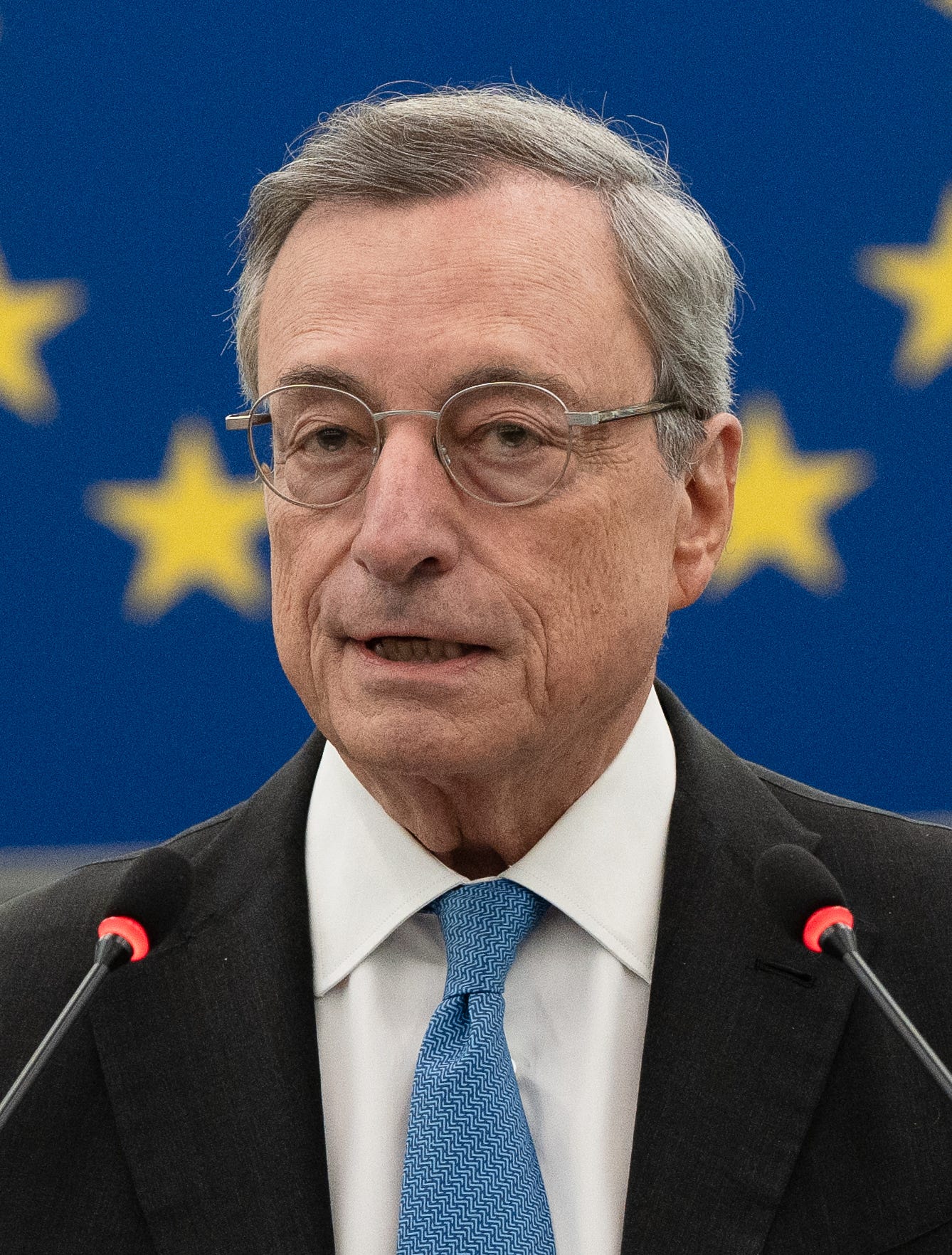
Mario Draghi now calls Europe’s fiscal framework a failure. “A procyclical fiscal policy,” he admitted in an April 2024 speech, combined with wage suppression to produce one result: “only to weaken our own domestic demand and undermine our social model.”
As ECB president from 2011 to 2019, Draghi conditioned bond purchases on austerity commitments even during the depths of the eurozone crisis. He is not a neutral observer of the system he now criticizes.
A study confirms what that approach actually produced. In “Does Politics Matter? A Comparative Assessment of Discretionary Fiscal Policies in the Euro Area,” published in the European Journal of Political Economy this month, economists Giovanni Carnazza (University of Pisa), Paolo Liberati (Roma Tre), and Agnese Sacchi (University of Urbino Carlo Bo) document 25 years of fiscal policy across 19 eurozone countries.
What the Research Found
Carnazza, Liberati, and Sacchi report three findings.
Fiscal policy was systematically procyclical. Across the eurozone from 1995 to 2019, when economies contracted, governments tightened. When economies expanded, governments loosened. The authors find a coefficient of -0.22 to -0.25 on the output gap: a one-percentage-point decline in economic output was associated with a quarter-point fiscal contraction.
Political variables did not affect fiscal direction. The authors examined cabinet composition, electoral cycles, legislative fractionalization, government type, federalist structure, and checks and balances. None altered the procyclical pattern. Their conclusion: “the pro-cyclicality of the fiscal policy is not significantly affected neither by the behaviour of macroeconomic fundamentals nor by institutional and political variables.”
Fiscal rules dominated all other factors. The interaction of rule stringency and debt levels drove outcomes. The authors write: “it seems that the mechanisms introduced to guarantee fiscal sustainability in the euro area can overcome all possible political influences on both the size and the sign of implementable fiscal policies.”
What Draghi Now Admits
Draghi’s April 2024 speech, previewing his competitiveness report, offers the retrospective judgment of someone who enforced these policies.
He acknowledges that Europe invests less in digital and advanced technologies than the US and China, that only four European tech firms rank among the global top 50, and that almost 80% of defense procurement over the last two years came from outside the EU.
He states that European institutions are “designed for ‘the world of yesterday’: pre-Covid, pre-Ukraine, pre-conflagration in the Middle East, pre-return of great power rivalry.”
He calls for “a re-defining of our Union that is no less ambitious than what the Founding Fathers did 70 years ago with the creation of the European Coal and Steel Community.”
Key Data
From the Carnazza, Liberati, and Sacchi paper:
Procyclicality coefficient: -0.22 to -0.25 (governments tightened during downturns)
Sample: 19 eurozone countries, 1995 to 2019
Political variables with no significant effect: government ideology, electoral cycles, legislative fractionalization, cabinet type, federalist structure, bicameralism
Driving factor: fiscal rules interacted with debt levels
From Draghi’s speech:
Mobile network groups: 34 in Europe versus 3 in the US
Global tech players in top 50: 4 European firms
Defense procurement from outside EU: nearly 80% over last two years
Telecommunications investment per capita: half the US level
Collaborative defense procurement: less than 20% of spending
The Promises vs. The Reality
The architects of fiscal discipline claimed that sound public finances would restore confidence, that private investment would replace public spending, that interest rates would fall, and that structural reforms would unleash productivity growth.
The Carnazza paper documents systematic procyclicality that amplified downturns rather than cushioning them. Draghi’s speech acknowledges that Europe fell behind in the sectors that required sustained public investment. The eurozone experienced a double-dip recession that the United States (partly) avoided.
The Accountability Gap
Draghi’s speech uses passive constructions: “We have turned inwards, seeing our competitors among ourselves.”
The Carnazza paper identifies the mechanism more precisely: “discretionary fiscal policies, being mainly driven by the need to comply with fiscal rules, might be scarcely affected by politics and the political characteristics of a country.”
The European Commission pursued excessive deficit procedures. The Eurogroup extracted austerity commitments as the price of crisis support. Draghi’s ECB conditioned market interventions on consolidation. These were choices made by specific institutions.
Draghi now laments insufficient investment in technology, after years of demanding spending cuts. He calls for joint defense procurement, after an era when public investment was treated as a cost to minimize. He identifies energy interconnections as essential, while the fiscal framework he championed made financing such infrastructure politically difficult.
The Democratic Deficit
The Carnazza paper tested every plausible channel through which voters might influence fiscal policy. None worked. The authors talked about the political failures might consist in its irrelevance, including the role of cabinet composition, in shaping the behavior of fiscal policies.
Proponents of fiscal rules framed democratic insulation as desirable. Removing fiscal policy from political contestation would enhance “credibility” with financial markets. The Carnazza findings confirm that insulation occurred. Whether this represents sound policy depends on whose preferences one believes should matter, but the results have been nothing more than subpar (at best).
Two Diagnoses
The Carnazza paper and Draghi’s speech approach the question from opposite directions. The paper offers econometric analysis of what fiscal policy did. Draghi offers the judgment of a policymaker assessing competitive outcomes.
They converge: the fiscal framework failed.
The paper documents rules that enforced procyclicality regardless of economic conditions. Draghi admits to both competitive decline and strategic vulnerability.
Very good analysis, Europe needs to catch up to the USA in terms of policy and accomplishments.