

Kendall White, a Wall Street Journal reporter, spent last month inside New York DSA. She went to Coffee with Comrades, a Socialism 101 seminar, a new-member social, a book club, and a hootenanny. She noted the Mao paperback on the shelf and the Soviet-star fur hat beside it, the expensive riesling, the crowd of young white transplants, the choir singing the Internationale. She filed a piece arguing that the appeal is social rather than ideological, and that the vacuum it fills is one the Democratic Party dug for itself during the pandemic. And it’s clearly not just “social” reasons that keep young people from trusting the likes of Andrew Cuomo.
The piece’s interest stops at the social, which lets it explain away years of institutional failure and declining economic prospects among the young. It’s still useful, because it reminds people what local and state political groups used to do, and what NY DSA has mastered.
Here is the moment. On her way out of the new-member social, the reporter passed a state assembly candidate she had spoken with briefly an hour earlier. He said goodbye to her by name. She wasn’t wearing a name tag.
Her piece offers this as evidence of charm, and yes, it’s charming, the kind of charm you can train into people (not that my saying “charming” this much is, well, charming). The skill shows up in organizing curricula going back to the Industrial Areas Foundation, and the fact that a hostile journalist walked out feeling personally recognized by a stranger is the most charming thing in the article. She went looking for Marxists. She had a good time and came back with something so much more, but didn’t recognize it.
I want to make a case to people who will find DSA and groups like Progressive Victory uncomfortable. Others (Ruy Teixeira, recently) would rather fight factional battles, or discredit these groups because the membership isn’t whatever they define as the “working class”, or dismiss them in the name of “broad appeal” and “popularism” for the over-45 vote. Some used DSA’s rising popularity to justify maliciously punching down at the downwardly mobile. That isn’t interesting or even useful to me.
So, if you work on industrial policy, free speech/privacy, YIMBYism, pronatalism/family policy, unconventional environmentalism, greater security, full employment, and any and all heterodoxy, and if your politics require training people and systems to operate better and deliver higher quality, even a little, then groups like the NY DSA described in that article may have solved a problem you haven’t. That’s a showcase of competence above and beyond what a lot of more established groups with greater resources have. We need to learn from them, recruit from them, or work with the parts of them where we agree. It beats punditing around or fighting more useless factional wars.
Case in point, and by now close to common sense in YIMBY circles: Zohran Mamdani is delivering better results than the more moderate Daniel Lurie.
In short, not because NY DSA or PV politics are yours. Because their operations are probably better than yours (and definitely mine). The neat part about operations is that you can learn from others. I’m certainly taking notes.
A what trip?
In 2017, NYC-DSA lost its first council race; in 2018 it elected a state senator; by 2025 it had put a mayor in Gracie Mansion behind roughly a hundred thousand volunteers; and in an eight-day span this June, DSA-backed challengers ousted the sitting chair of the Congressional Hispanic Caucus, took an open Brooklyn seat by twenty points, and in Denver ended a House incumbency dating to 1997, all against $9.6 million in hostile super PAC spending that largely failed.
A Discord group called Progressive Victory did 290,000 voter contacts in a Georgia runoff, then swing-state canvass houses, then nightly phone banks behind a winning Seattle mayoral campaign. What’s more impressive is that NYC-DSA and Progressive Victory are volunteer groups that don’t have anything like the resources of the people behind Andrew Cuomo or Adriano Espaillat.
So how did they build that volunteer base? Posting online is one thing. Getting those posters to make voter contacts or show up in person is another. Well, we have a skeptical outsider who spent four weeks watching how it’s done.
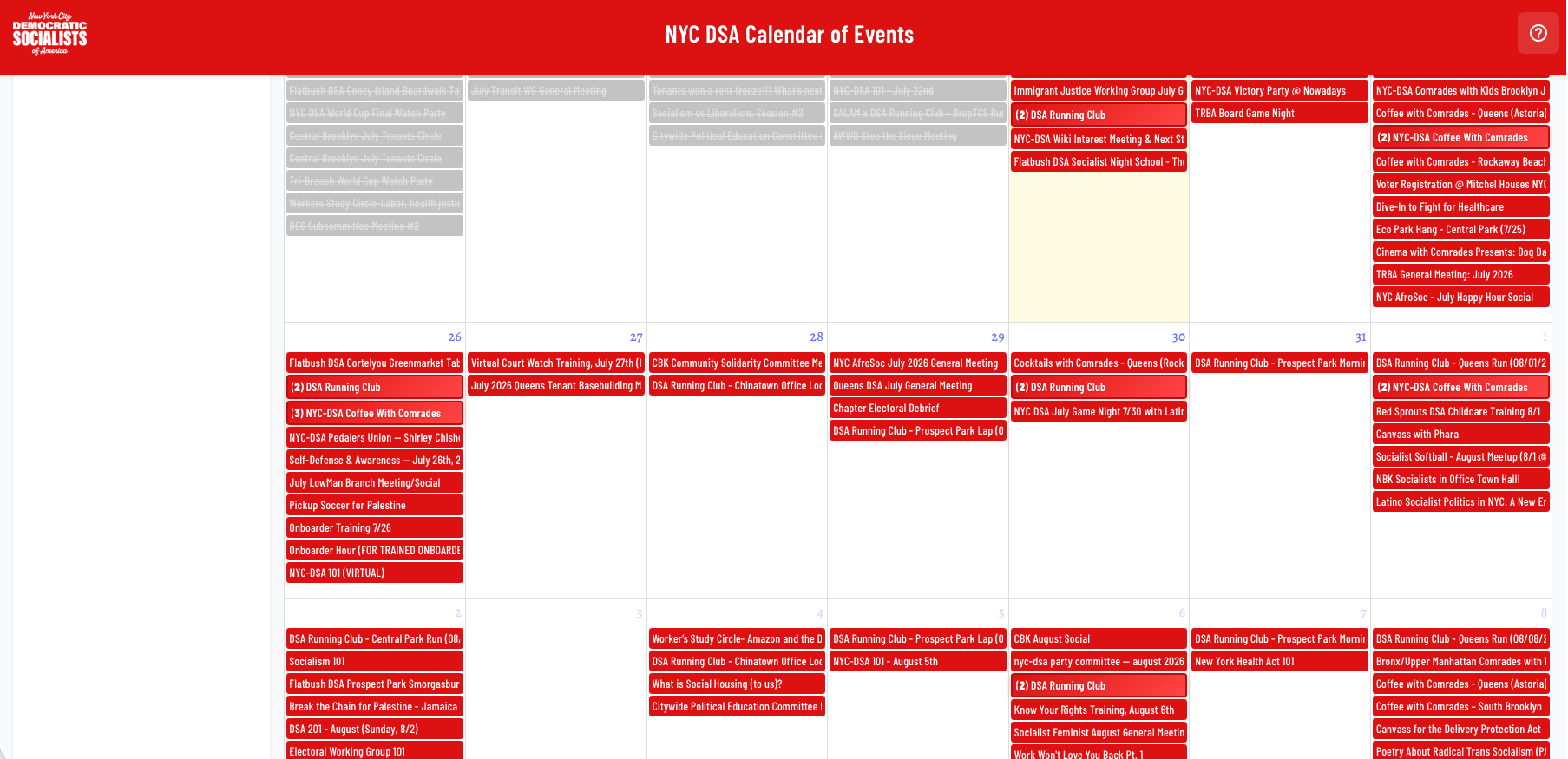
A standing weekly calendar with a low barrier to entry: coffee, a book club, board game nights, a running club. A softball league. A soccer league. World Cup watch parties. Birding trips. A no-audition choir. A structured education track for newcomers, taught by trained facilitators, with a clear curriculum. A new-member social held in a private apartment where existing members were briefed to be welcoming. Elected officials attending as members rather than as speakers. A group chat, an invitation to the next meeting, and phone numbers exchanged, all obtained by a first-time attendee who came in hostile.
Now, near the end of her piece, the reporter describes trying to find the equivalent on the moderate side. She filled out an interest form for the state’s Young Democrats. Two weeks later, no reply. She checked their website. No events listed.
This is a delightful contrast we can all certainly learn from!
Before There Was Phones
The associational base of American politics (where large member-driven groups are active in politics) collapsed across two generations. Robert Putnam’s original 1995 analysis found membership in the General Federation of Women’s Clubs down 59% since 1964 and the League of Women Voters down 42% since 1969; Bowling Alone generalized the pattern across civic groups, unions, lodges, and leagues. Theda Skocpol’s Diminished Democracy tries to explain what replaced them. From the 1960s onward, mass-membership federations gave way to professionally managed advocacy groups, organizations that, as one review of her evidence puts it, speak for members without involving them, in a civil society now dominated by largely memberless associations.
Schlozman and Rosenfeld’s The Hollow Parties documents both parties ceding mobilization, fundraising, and agenda-setting to a consultant-and-nonprofit “party blob,” leaving hard partisan shells with no civic interior. In short, what was populist and member-driven was systemically hollowed out, and the resources now flow to consultants and nonprofits. You can guess how that plays out.
Individual political energy did not decline. People are still interested in politics, after all! Eitan Hersh’s survey research, summarized in Boston Review, found a third of Americans reporting two or more hours a day on politics, and four in five of those spending not one minute on actual political work. You can see the problem (or opportunity). Enormous political attention with almost nowhere institutional to live.
Organized capacity did not completely drain out of American politics. In fact, it’s clearly more concentrated now. The American Political Economy school describes a system whose fragmentation and veto points reward two capacities above all: long time horizons, and the ability to operate across many venues at once. JS Tan’s essay on the data-center boom is a perfect demonstration of this. The same country that cannot permit apartments or fast trains has erected million-square-foot server farms at historic speed, because hyperscalers hold both capacities and can arbitrage jurisdictions against one another for subsidies and permits. JS Tan has a neat little way of boiling it down: the country has “lost the capacity to build for the public.”
Case One: NYC-DSA
NYC-DSA has been active since the 1980s, but was only considered an electoral force after the 2016 Sanders campaign. It prototyped its field model on Khader El-Yateem’s 2017 council race (where a paid canvass manager named Zohran Mamdani first worked with future mayoral field director Tascha Van Auken), then built on that through Julia Salazar’s 2018 win and legislative slates in 2020 and 2022. Then national DSA nearly broke. From a 2021 peak of roughly 95,000 constitutional members, national DSA fell to about 78,000, with members in good standing dropping to nearly 58,000, a contraction of a third, amid a 7.3% single-month membership drop coinciding with the Bowman expulsion fight and a convention-mandated budget roughly $2 million in deficit, projections of running out of money within months, and the national director’s resignation. Through all of it, the organization publicly claimed 70,000+ members while roughly 54,000 were actually paying dues. Keep that gap in mind for every number below, including the flattering ones.
Whether the crash was caused by the Bowman affair or was just the secular deflation of the Trump-era surge is disputed inside the organization. The timing evidence supports a shock-plus-slope reading. That said, the pendulum is swinging back, with more than 95,000 national members by November 2025, over 100,000 today, and NYC-DSA at 14,000+, up from 8,800 at the June 2025 primary.
New York’s divergence is the operational detail most people seem to overlook in favor of the “young people supporting socialists” thing. An analysis using national membership records shows NYC-DSA held steady while the national organization shrank, then accounted for over 30% of all national growth in 2024. The chapter’s own coordinators attribute that to a few basic things they work to get right. Things like a customized join page pushing monthly renewing dues over one-time payments, recurring re-engagement emails to lapsed members, a winter member drive, and a finding that socials and spectacle-style events were consistently the top weekly list-builders. Basic, consistent mechanisms, by the chapter’s own account.
For the mayoral primary, The Nation’s reconstruction counts ~50,000 volunteers, of whom ~30,000 knocked 1.6 million doors and made 2.3 million calls under 400+ volunteer field leads; by the general, the campaign counted about 100,000 volunteers and 3 million doors. It’s four-rung ladder (canvasser to field lead to coordinator to director) that promoted nearly 500 field leads in months, most not yet DSA members is also interesting just for the fact of converting so many volunteers into leads in such a short time. Between elections, the chapter runs dozens of monthly social events: softball, a socialist soccer league, a no-audition choir, game nights, a caregivers’ group, plus a paid night-school Academy taught by academics and a national training catalogue that codifies everything down to child-minding logistics and a two-session course on talking to non-socialists, homework conversations included. A Socialists in Office committee meets weekly with the chapter’s electeds. Mamdani still calls the chapter his “political home”.
In an eight-day span this June, DSA-backed insurgents ousted Rep. Adriano Espaillat, won Nydia Velázquez’s open seat by twenty points, and toppled fifteen-term Rep. Diana DeGette in Denver, putting DSA on track to go from two to at least five members of Congress. In Albany, they added at least six state-legislative pickups against $9.6 million in super PAC primary spending, of which the $2.9 million aimed at socialists largely failed. Chapter co-chair Gustavo Gordillo’s explanation: “The incumbents just were not able to keep up.”
Case Two: Progressive Victory
Progressive Victory was founded in July 2022 by Sam Drzymala with the streamer Vaush. The idea is to get fans of progressive creators to “touch grass,” which here means converting streaming audiences into field volunteers through a Discord community. It’s one of the rare real-life applications of what researchers describe as Discord’s third-place-like design to electoral labor. The organization reports 15,000+ members with about 1,400 paying $5 monthly dues, 290,000 voter contacts in the 2022 Georgia runoff, seven swing-state canvass houses in 2024 producing roughly 10,000 doors per house per month at a claimed ~$1 per door, and 1.6 million total voter contacts in the 2024 cycle.
Progressive Victory, like NY-DSA, also has a pretty full calendar, but with a Discord twist. We’re talking about mixing nightly phone banks (for Mamdani, Katie Wilson’s winning Seattle race, and Aftyn Behn’s Tennessee special) with stuff like A/V meetings, karaoke nights, and other “touch grass” events.
It also helps that PV takes advantage of the discourse. Its “Choose Your Fighter” rally put Hasan Piker beside Rep. Ro Khanna amid a party-wide fight over Piker. There’s something to be said for “all publicity is good publicity” after all.
What the field evidence shows, and doesn’t
So both NY-DSA and Progressive Victory are great at gathering volunteer energy and aiming it at elections. The next question is whether that energy moves votes.
We know face-to-face contact reliably raises turnout. The Gerber-Green New Haven experiment moved contacted voters from roughly 44% to 53%, Yale’s synthesis of hundreds of GOTV trials confirms personal contact as the most consistent method, and relational contact runs stronger still: an 8-point lift in the 2018 Outvote experiment and 13.2 points in a 2020 Green-led study, later repeated by a conservative shop.
That’s turnout, which is good and essential for winning elections. What about persuasion? Kalla and Broockman’s forty-nine-experiment review puts the average persuasive effect of general-election contact at zero, with exceptions only for unusual candidates, heavy targeting, and early contact. National DSA’s own internal research, drawn from membership records across the whole organization, complicates the favorable side from within: growth is driven by outside events, no chapter tactic reliably recruits members who stay, and surge cohorts retain worse than the base they join. Just a reminder that this is at the national level, and that NY-DSA is considered the exception, since it has held its support base and grown its list through more and bigger social events.
Read carefully, none of this establishes a portable campaign playbook, and the marquee case cuts against one. Mamdani was an unusual candidate in the media capital during the most-covered municipal race in decades, with contact beginning the previous December. Those are precisely the conditions Kalla and Broockman carve out as the exception, which makes the win suggestive and unrepeatable in the same breath.
Hegel’s pendulum will keep swinging. So what we really need to think about between the swings is whether we can catch and hold people at scale. The chapter gathered tens of thousands of volunteers, ran them up a four-rung ladder, and promoted hundreds of field leads in months, most of them not yet members.
A permaculture, not an agricultural, model
Most organizing talk is agricultural. You fertilize, you plant, you tend, you harvest what you planted. Weather, famine, economics, and chaos can change the size of the harvest, but there’s some linearity between what you reap and the work you put in.
That’s not a useful way to think about organizing. What comes closer is something called permaculture. Permaculture is the art of catching water, of building the swales and terraces that keep it from running off the moment it falls. It has no linearity to speak of, but the mid- to long-term results can be impressive, like rivers being restored.
Here, our rainfall is political surges. A Sanders campaign, a Trump election, an assassination, a data center proposed in the next county. The standing calendar, the softball league, the no-audition choir, and the book club are the earthworks. Retention through the dry years between surges is the water table: raised slowly, or at least not falling as fast.
Some customer service basics
Underneath the field mechanics sits something public administration understood before campaign science measured it. Lipsky established that a citizen never meets the state, only its agent. Companies like Costco and Chick-fil-A are more than aware of this, hence the friendly staff and better working conditions.
What people think of government usually comes from their experiences with the teacher, the postal worker, the clerk, the caseworker, whatever agent they actually deal with. Fenno’s paradox is the same fact in electoral form: a public that disapproves of Congress while approving of its own member. Why? The member usually votes with the rest of Congress anyway. It comes down to constituent services (a member’s staff helping resolve issues like applying for grants or expediting passports) and earmarks (provisions in federal spending bills that let members of Congress direct money to visible local or state projects).
The canvasser is the movement’s postman. No voter meets “NY-DSA” or “Progressive Victory.” She meets one volunteer on her stoop, or is a member’s “oomfie” online. That encounter is the whole organization as far as her personal experience is concerned.
Why I’m interested in this?
We talked about how the associational base collapsed and took with it the civic pipeline that once turned ordinary people into the labor a polity runs on. That collapse is visible today such as the bottom of the ballot, where a lot of local and state level governing occurs in real life. 70% of all elections from 2018 through 2025 drew no more candidates than seats, a study of school-board races found 53% uncontested with four-fifths of South Dakota’s districts canceling for want of candidates, and the 2024 voting survey recorded over 772,000 poll-worker slots with recruitment difficult in nearly half of jurisdictions. Such as waste don’t you think, and where there is waste there is opportunity.
Even setting aside the sheer volume of content and ground game that groups like NY-DSA and Progressive Victory bring, there’s a plainer reason to learn from them. The idea, or to me the prize, is a base: slowly training up a portion of these people, or at minimum learning enough from them to build your own, beats starting from nothing or resuming the factional wars. That holds even if you’re more conservative than they are. Then again, a lot of pundits love punching down on the downwardly mobile, especially millennials and younger.