

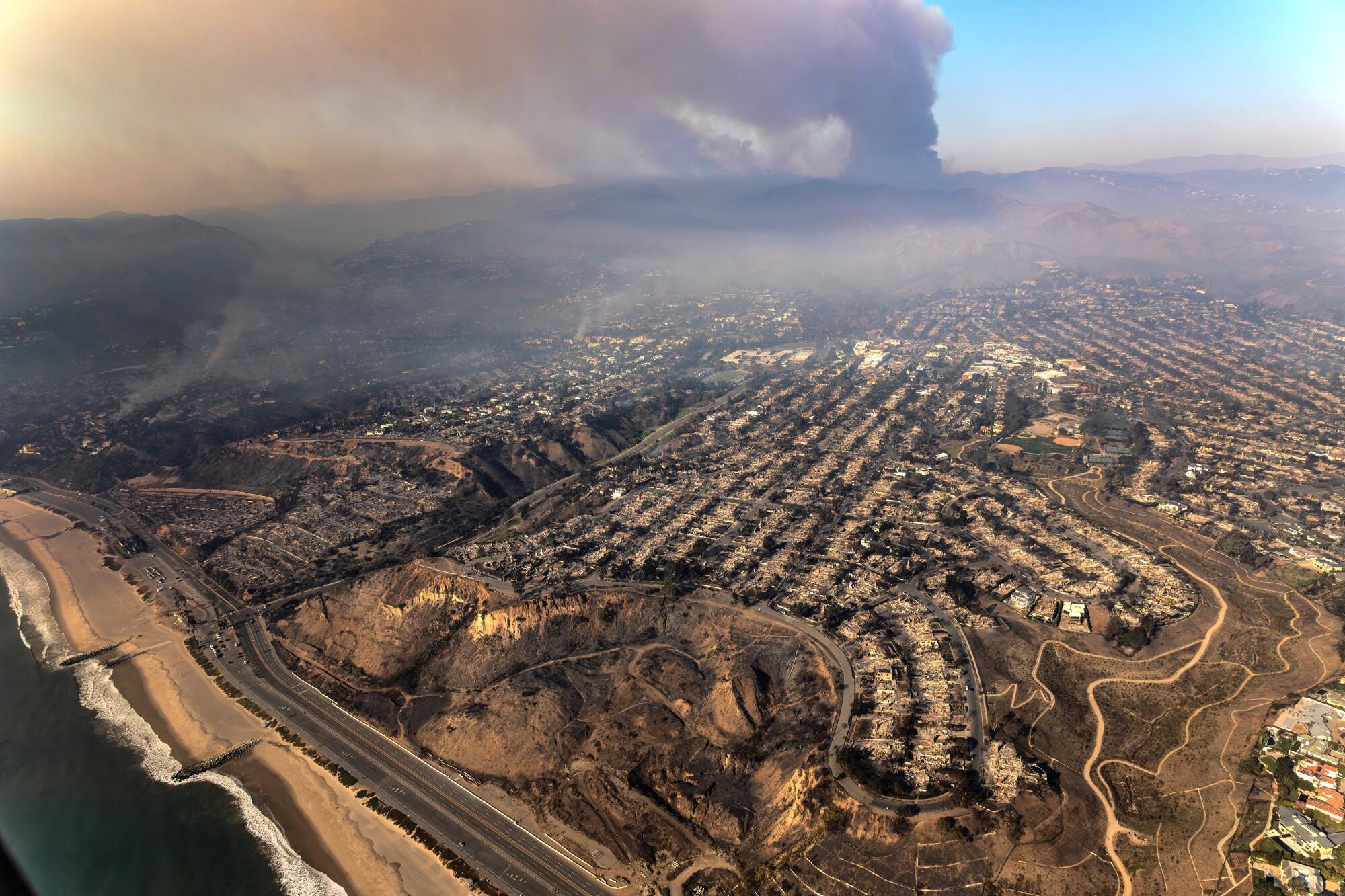
Nearly a year ago at time of writing, on January 7, 2025, while the Palisades Fire tore through one of Los Angeles’s wealthiest neighborhoods, more than 100 of the LAFD’s 183 fire trucks sat in the maintenance yard. Over half the fleet was out of service. LAFD Chief Kristin Crowley cited the equipment shortage as one reason the fires were so difficult to contain, according to reporting from Firehouse.com. The cause: fire truck prices have roughly tripled over the past decade. Pumper trucks rose to around $1 million; ladder trucks to $2 million. Delivery times stretched from under a year to two to four years. The department simply couldn’t replace its aging fleet.
Six months later, Governor Gavin Newsom issued Executive Order N-32-25, granting local governments authority to suspend SB 9 (California’s 2021 law allowing duplexes and lot splits in single-family zones) in fire-affected areas. Mayor Karen Bass immediately prohibited SB 9 applications in the Palisades burn area. The stated rationale: fire safety.
The gap between problem and response is telling. Officials responded to a disaster marked by concrete equipment failures and infrastructure collapse (half the fire trucks sidelined, two exit roads for an entire community, evacuation orders issued after homes were already burning) by suspending a housing law over speculative concerns about future evacuation density. If this were about fire safety, the policy response would address suppression capacity, road infrastructure, notification systems, and building codes. Instead, it targets how many units can be built on residential parcels.
YIMBY Law, a pro-housing litigation organization, has filed suit challenging the executive order. We are going to examine the dispute across four dimensions: the human stakes for fire survivors, the empirical claims about evacuation and fire safety, the historical context of exclusionary zoning in California, and the legal question of emergency powers. YIMBY Law’s position is well-supported (and the correct one). The Governor’s order represents exclusionary zoning dressed in safety language rather than what works in fire prevention.
But we want to go further than a simple YIMBY-versus-NIMBY framing. The survivors’ crisis has causes that run deeper than neighborhood politics. The Governor’s order is wrong not just because it’s exclusionary, but because it ignores a cascade of structural failures in insurance markets, construction supply chains, and public safety capacity, while performing responsiveness to a wealthy constituency. Understanding those failures strengthens the case against the order.
The Survivors
Before examining whether the safety claims hold up, we should be clear about what’s at stake for the people this order purports to protect.
Research from CU Boulder found that 74 percent of homeowners who lost homes in the 2021 Marshall Fire were underinsured. Of those, 36 percent were severely underinsured, covered for less than 75 percent of replacement costs. If it costs $1 million to rebuild, that’s $250,000 people have to come up with. Most households don’t have ready access to those resources.
The pattern is repeating in Los Angeles. NY1 reported that six months after the fires, 75 percent of Eaton fire survivors say they were underinsured. One Altadena resident faced a $1.2 million gap in insurance. The San Francisco Chronicle documented that underinsurance is systemic: seven years after California’s deadliest wildfire, which killed 85 people and destroyed about 11,000 homes in Paradise, more than 3,000 single-family homes and 600 multi-family units have been rebuilt; still far short of what was lost. Insurance Business America reported that nine months after the January 2025 fires, Los Angeles County had issued only seven rebuilding permits by mid-May.
These numbers reflect individual tragedies, but the causes are structural. We’ll return to that. For now, the immediate question is what tools survivors have, and what the Governor just took away.
For underinsured homeowners, SB 9 provides critical flexibility. An owner with a large lot can split it and sell half to generate funds for rebuilding. An owner can build a duplex and use rental income to service construction debt. Multiple generations can share a rebuilt property with separate units. As YIMBY Law explains, SB 9 allows homeowners (many of whom were underinsured and have only the value of their land to put toward rebuilding) to split their lots and sell unused land, or build ADUs and duplexes that generate rental income or support intergenerational living. Without these options, it will be nearly impossible for low-income and working-class people to return to these communities.
Andrew Post’s parents lost their Altadena home in the Eaton fire. With limited income in retirement and a modest insurance payout, they’re designing their new home to fit on half their lot so they can sell the other half if they need the money to afford the rebuild or for long-term medical care. Post told Politico: “There’s a great many scenarios where my parents would never set foot again in Altadena if not for SB 9.”
Victoria Knapp, chair of the Altadena Town Council, stated the distributional stakes plainly: “Without the payouts we’re legally owed, only the wealthiest will be able to rebuild.”
Banning SB 9 ensures that outcome. It benefits homeowners wealthy enough to rebuild a single-family home on a full lot without financial assistance; they get to return to a neighborhood that remains exclusively single-family and exclusively expensive. It harms middle-class and lower-income survivors who need flexibility. Without lot-split or rental income options, many will be forced to sell their land and leave.
That’s what the order does. Now let’s examine whether the safety rationale justifies it.
The Safety Claim, Exposed
The opponents’ central argument is that adding duplexes will make future evacuations more dangerous. This deserves scrutiny. It doesn’t survive it.
What Happened on January 7th
According to the Associated Press investigation, the first evacuation order covering neighborhoods closest to the Palisades fire didn’t come until about 40 minutes after some of those homes were already burning. By the time officials issued the order at 12:07 p.m., traffic was already gridlocked because residents had fled on their own.
The fundamental constraint was infrastructure. Just two paved roads connect the Highlands to the rest of Los Angeles: the four-lane Palisades Drive and a narrow two-lane road named Fire Drive. The latter is an emergency route, but flames quickly overran it. This was a pre-existing problem. The AP reported that in 2020, the Pacific Palisades Community Council wrote to Los Angeles City Council members complaining that in recent wildfire evacuations, traffic backups endangered the public. During the January evacuation, some roads became gridlocked and residents were seen fleeing their vehicles along the Pacific Coast Highway and taking refuge in the ocean.
The road network, designed decades ago for a single-family community (and not all of them at once), was the binding constraint. The neighborhood was single-family before the fire. It had congested evacuations before the fire. Adding a duplex to an existing parcel doesn’t change the road network.
What Actually Protects Structures
If the concern is fire safety, the research literature points in a completely different direction (including actually improving the road network).
A study published in Nature Communications in August 2025 analyzed five major California fires using machine learning. The findings: structure survivability can be predicted to 82 percent accuracy based on structure spacing, fire exposure, building hardening, and defensible space. A hypothetical 52 percent reduction in losses could be achieved through hardening and defensible space alone.
The Insurance Institute’s summary of this research confirmed that clearing vegetation and flammable materials within 1.5 meters of a structure (Zone 0) is one of the most effective actions a homeowner can take. When this is paired with home-hardening features like non-combustible siding, enclosed eaves, and vent screens, predicted losses dropped by as much as 48 percent.
The California Office of the State Fire Marshal is explicit: large wildfires are inevitable, but the disastrous house loss associated with wildland-urban interface fires can be prevented by reducing hazardous conditions at and immediately around buildings before the fires start.
Let’s Talk About Suppression Capacity
The LAFD’s sidelined fleet on January 7th wasn’t an anomaly. It was the predictable result of two policy failures: a consolidated industry extracting rents from municipalities, and an outdated equipment paradigm that costs more while delivering less.
The Private Equity Problem
Basel Musharbash documented on BIG by Matt Stoller (later confirmed by the New York Times) the fire truck crisis stems a large part from a private equity roll-up. American Industrial Partners acquired multiple manufacturers over the past decade (E-ONE, KME (a major California supplier), Ferrara, Spartan, Smeal, Ladder Tower) and consolidated them into REV Group.
REV Group now controls roughly a third of the $3 billion annual market. Together with Oshkosh (25%) and Rosenbauer (8%), three firms control two-thirds of national sales. In addition to Basel and the NYT, one industry executive told Firehouse Magazine: “There are now times when all vendors at a bid table, each with a ‘different’ product, are all owned and managed by the same parent company.”
The result: REV shut down KME’s plants even as demand surged 50% from 2020 to 2022. Backlogs hit $4.2 billion. Delivery times stretched to four years. “Floating” price clauses let manufacturers raise prices after contracts are signed. Seattle, Houston, and Atlanta face the same crisis: aging fleets, years-long waiting lists.
The FTC sued Welsh Carson for a similar roll-up of Texas anesthesiology practices. State attorneys general could force divestitures here. They just need to act.
The Bigger Truck Problem
Even if prices normalized, American departments would still be buying the wrong equipment. A 2018 NACTO/Volpe Center report found that European and Asian aerial ladders reach the same heights as American models despite being two-thirds as long with half the turn radius. Pumpers can be 30% smaller. Japanese trucks navigate 13-foot streets while American codes require 20-foot minimums, yet, Japan’s fire death rate is lower than America’s.
The differences are systemic. Europe uses crash-tested commercial chassis; America insists on expensive custom builds. Japan deploys numerous specialized trucks working in combination; America deploys fewer “generalist” behemoths. As Fire Apparatus Magazine reported, European compartments “look like California Closets, where they use every inch.”
Three barriers lock in the paradigm: NFPA standards written around large vehicles, ISO ratings designed for traditional apparatus, and fire department political power over street design. When San Francisco tried to narrow streets for pedestrian safety, the fire department initially demanded roads 30% wider than code minimums.
But change is possible. LA can take a page from San Francisco’s book and purchase “Vision Zero” engines; 10 inches shorter, 24% smaller turn radius, same pumping capacity. Nashville added squad response vehicles costing 83% less than aerial trucks. The NACTO/Volpe report concluded that if cities banded together, they could entice manufacturers to produce smaller models.
What Else Serious Fire Policy Would Address
Beyond suppression capacity, another genuine safety response would tackle evacuation infrastructure and building standards.
The evacuation problem is road capacity: add egress routes where terrain permits, widen existing roads, create designated temporary refuge areas, improve traffic signal coordination during emergencies. NIST’s ESCAPE guidance provides a framework: training, public education, mutual aid coordination, labeled Temporary Fire Refuge Areas, drills, and cross-jurisdictional integration.
Serious policy would require all rebuilds (regardless of unit count) to meet modern Chapter 7A fire-resistant standards. It would mandate defensible space, with noncombustible materials within 5 feet of structures and vegetation management within 100 feet. It would improve notification systems. And it would create mechanisms for coordinated fire hardening at the community scale.
If learning lessons is what the governor serious about ,especially for fire safety. You would think he champion procurement reform, encourage antitrust action, etc etc. Think whatever it takes to get smaller and efficient fire trucks (that you don’t need to be on a waitlist for), better road networks, a more modernized fire code base on what works in Europe and Japan, and so on. None of these require banning duplexes. All of them would actually reduce fire risk. Banning duplexes addresses none of the factors that research identifies as determinative.
The Pattern
Safety and traffic rationales have been deployed to justify exclusionary zoning since its inception. The Pacific Palisades dispute fits this pattern.
The White House Council of Economic Advisers documented that the origins of such laws date back to the nineteenth century, when many cities were concerned about fire hazards and light-and-air regulations. The foundational 1926 Euclid v. Ambler decision upholding zoning quoted characterizations of apartment buildings as “mere parasites” that bring “disturbing noises incident to increased traffic and business.”
The Century Foundation’s analysis puts it plainly: exclusionary zoning is a legal practice used for decades to keep lower-income people (disproportionately racial minorities) out of wealthy and middle-class neighborhoods.
Why do these arguments persist even when evidence doesn’t support them? In part because fire safety is politically unassailable. Safety claims don’t need to be empirically grounded to be politically effective; they need only invoke the specter of harm.
City Councilwoman Traci Park’s statement is revealing: “After what this community just lived through, the idea of forcing more density into a high-fire-severity zone demonstrates this isn’t about sound housing policy, but ideological extremism.” But SB 9 doesn’t force density anywhere. It gives property owners the option to build duplexes or split lots, options many underinsured survivors desperately need. Calling property rights ideological extremism while defending mandatory single-family zoning inverts the historical relationship between exclusion and ideology.
Failures Keep on Getting Deeper
The Palisades residents make easy villains. But if we’re honest about the crisis facing fire survivors, the causes run deeper than neighborhood politics, and understanding them strengthens the case against the Governor’s order.
The Insurance Collapse
We noted earlier that 75 percent of LA fire survivors were underinsured. That wasn’t just bad luck or individual miscalculation. It reflects a systemic failure in insurance markets that state policy has done little to address.
Over the past decade, major insurers have been fleeing California’s wildfire zones. State Farm, Allstate, and others stopped writing new homeowner policies in high-risk areas. The carriers that remain have either raised premiums to levels many homeowners can’t afford or tightened coverage limits and exclusions that leave policyholders exposed. California’s FAIR Plan (the insurer of last resort) is financially strained and offers inferior coverage. When fires hit, homeowners discover that their “guaranteed replacement cost” policies have caps, their coverage hasn’t kept pace with construction cost inflation, and the insurer they’ve paid premiums to for decades has exited the market. Some would say this is a blue state issue, however Floridians keep finding out the same issues almost every Hurricane season.
The Construction Bottleneck
Even with insurance proceeds and lot-split revenue, survivors face another structural barrier: the cost of actually building.
Construction costs have risen sharply in recent years, even before Trump’s supply chain breaking tariffs. Some of this reflects labor market tightness and pandemic-era supply chain disruptions. But some of it reflects consolidation in building materials. Lumber, gypsum, roofing materials, and concrete are all industries that have seen significant concentration. When a handful of firms control supply, prices stay elevated even after input costs normalize.
The fire truck industry is just a tip of a (clichéd) iceberg. As detailed above, private equity rolled up manufacturers, shut down plants, and let backlogs grow while prices tripled. Similar dynamics play out across critical supply chains. The LAFD’s sidelined fleet on January 7th was one consequence; the inflated cost of rebuilding a home is another.
What This Means for the SB 9 Debate
This isn’t either/or. California needs both supply-side reforms like SB 9 and action on the structural failures in insurance, construction, fire trucks, and public capacity. The tools work at different levels. Zoning reform removes legal barriers; addressing market concentration removes economic barriers; rebuilding public capacity removes institutional barriers. Survivors need all of them.
The Governor’s order is particularly perverse for this reason: these structural barriers meant SB 9 wasn’t producing a flood of new housing even before the fire. Insurance costs, construction prices, and permitting delays kept the law’s theoretical flexibility from translating into massive density increases. The safety concern about evacuation-complicating density was largely hypothetical because the housing wasn’t getting built anyway.
And now the Governor has banned the tool while ignoring the structural barriers that constrained it. He hasn’t fixed the insurance market. He hasn’t addressed the fire truck oligopoly or the oversized-apparatus paradigm. He hasn’t reduced construction costs. He hasn’t added road capacity or improved notification systems or mandated defensible space. He’s removed one option survivors have (the flexibility to split lots or build rental income) while leaving every barrier to actually using that option intact.
The Law
With the substantive case made (the safety rationale is weak, the evidence points elsewhere, the historical pattern is familiar, and the structural failures go unaddressed), we turn to the legal question. Here we should be more cautious. Emergency powers jurisprudence is contested, courts grant executives significant deference during declared emergencies, and the line between “crisis response” and “prospective policymaking” is blurrier than advocates on either side acknowledge.
That said, YIMBY Law has a plausible argument, perhaps the better one.
California’s Emergency Services Act grants governors broad authority during declared emergencies, including power to suspend statutes where “strict compliance would in any way prevent, hinder, or delay the mitigation of the effects of the emergency.” But this authority is not unlimited.
The California Legislative Analyst’s Office has documented that emergency powers are designed for crisis response, not permanent policy realignment.
The central problem: the order doesn’t suspend SB 9 to facilitate debris removal or emergency housing (activities that clearly mitigate the ongoing emergency). It suspends SB 9 to prevent hypothetical future evacuations in rebuilt neighborhoods from being complicated by additional dwelling units. That’s prospective policymaking dressed as emergency response.
The Legislature already addressed fire safety when it passed SB 9. Referencing Government Code § 65913.4(a)(6)(D), SB 9 projects in high or very high fire hazard severity zones must either implement fire hazard mitigation measures pursuant to existing building standards or be excluded from SB 9 eligibility.
The Legislature made a considered policy choice: allow SB 9 in fire zones with mitigation, or exclude projects that can’t meet safety standards. The Governor’s order substitutes his judgment for the Legislature’s.
The Assessment
YIMBY Law is right. The courts should restore SB 9.
Their track record is strong: nine of ten lawsuits won since 2019, including multiple victories against Los Angeles. But our support doesn’t rest on their litigation record. It rests on the evidence.
We’ve argued that the full policy response should go beyond what any lawsuit can achieve. Survivors need insurance reform, action on construction concentration, and rebuilt public capacity. The YIMBY movement’s supply-side agenda is necessary but not sufficient, just like a foundation for the house isn’t the entire house. And yet: the Governor’s order doesn’t advance any of these goals. It removes one tool survivors have while leaving every structural barrier intact. Between an order that does active harm and a lawsuit that preserves survivor flexibility, the choice is clear.
The political process failed here. It often does on housing. Whether litigation is a healthy substitute is debatable, but it beats allowing wealthy neighborhoods to exempt themselves from state law whenever a convenient justification arises.
Andrew Post’s parents are trying to figure out how to go home. They should be allowed to.