


F. Ichiro Gifford had an emergency peak-load program drowning in seven sign-off emails. It was bad. He sat down with a blank Excel, walked the procedure end to end, tagged every step, and cut the thing nearly in half. No reorg, no new headcount, no dashboard. A chart and an afternoon.
That is not a new trick. It is a very old one we forgot.
In 1942 the Bureau of the Budget had the same set of problems everyone has: too much work, not enough people, procedures nobody had read in years. It did not freeze hiring, talent was scarce in wartime, and it did not redraw the org chart. It taught a handful of managers to find the wasted motion in their own offices and cut it out. Workshops, manuals, and a run of good propaganda posters. While that program and others like it were running, public trust in government sat near 80 percent. We are not claiming the one produced the other. We are claiming they kept company.
A few writers besides us, Kevin Hawickhorst at State Capacitance and F. Ichiro Gifford at Energy Crystals, have written about the uncomfortable version of this history. Government workers back then were not more talented or harder-working. They were managed better. Reforms shipped as pilots before they scaled. Then the corporate management fashions of the 1960s and 70s came in and undid it. Kevin put it best: “Politicians had better dashboards in the era of punch cards than we have in the era of AI.”
So why not bring it back?
The method, in a nutshell
Each tool asks a few blunt questions.
The Process Chart asks what the steps really are. You walk a procedure end to end and tag every step: operation, move, inspection, delay, storage. Laid out in order, the waste shows itself. The four approvals that should be one. The form keyed in twice. The wait nobody owns. This is what Ichiro ran against Peak Shredder, and his line is the one the whole thing is built on: “Operational staff don’t need dictums. We need tools.”
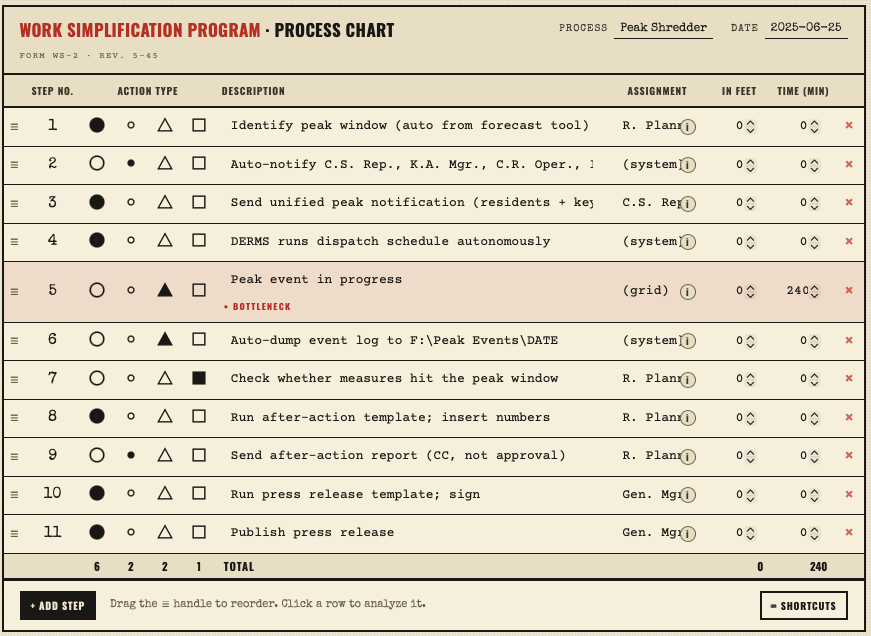
The Work Distribution Chart asks who does what, and for how long. People across the top, work down the side, hours in the cells. It does not flatter anyone. It is how you catch the director still reviewing rebates by hand while the strategy goes unwritten. Ichiro thinks this is a great way to sniff out “ex-analyst syndrome,” the affliction of managers who didn’t give up their old job when they got promoted.
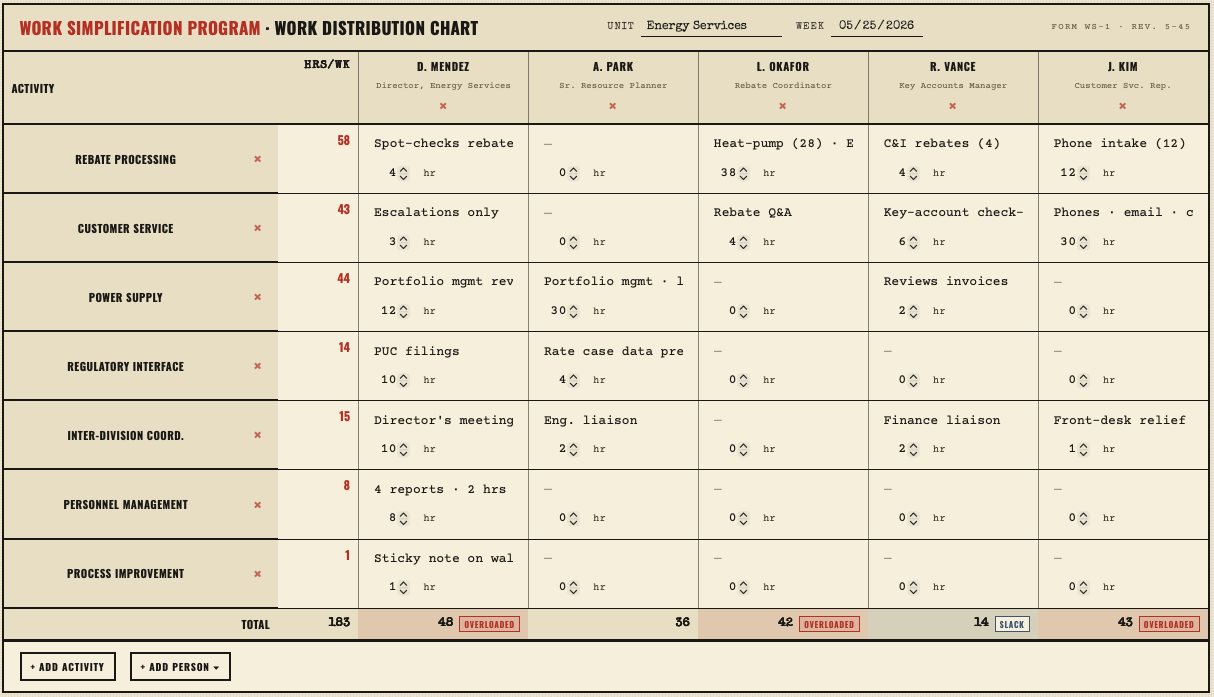
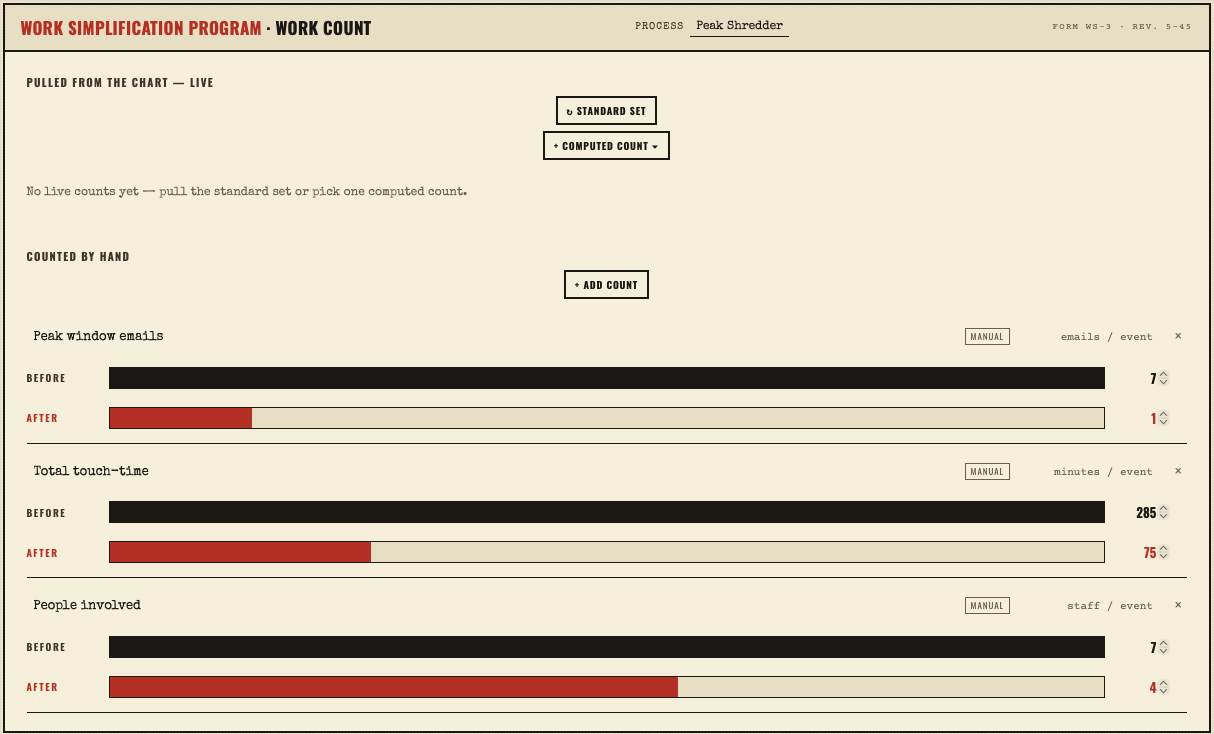
The Work Count asks whether the volume justifies the machinery. It is the numbers under the process, and they are usually smaller than the apparatus built to handle them.
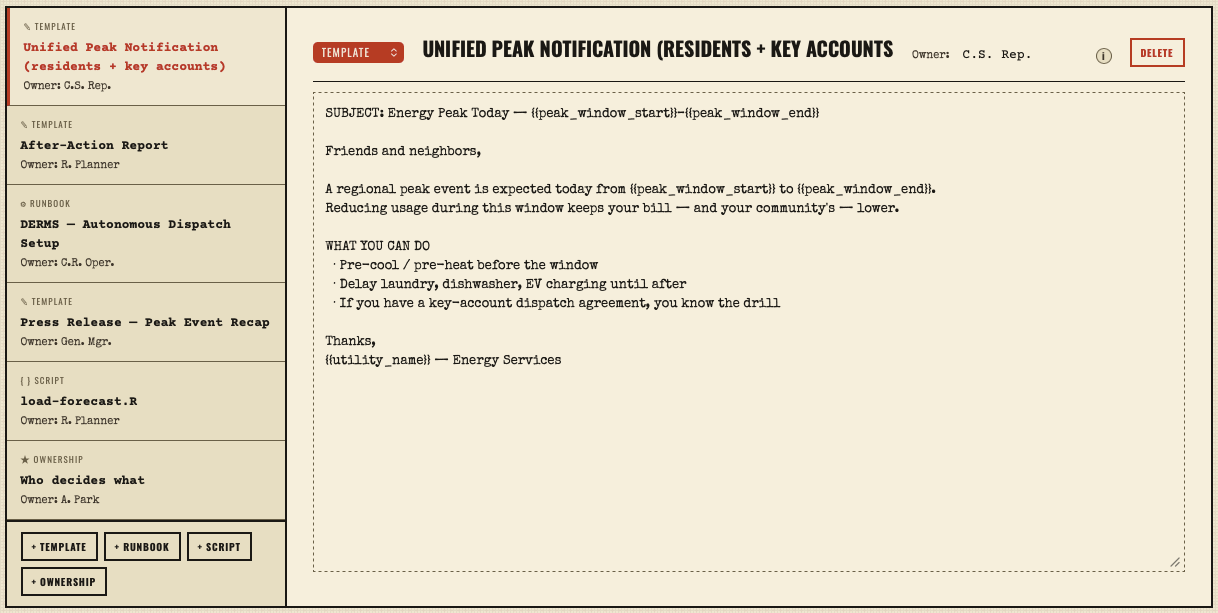
Behind the three is the Functional File, the one place the forms, scripts, and templates actually live. The Bureau got so good at this that private businesses asked the federal government to teach them the same approach.
Nobody trains the people who run things
Activist movements train organizers and judges. MBAs lean on organizational strategy, which is more glamorous but not relevant to improving domain-specific processes. And many managers were pressed into service without even a seminar. Nobody trains the official who has to make the city run: the one who geotags every bus stop so the next storm does not kill anyone, or who counts the six thousand small-business rules that piled up while no one was looking. The craft is teachable, and almost no one teaches it. You cannot have an imagination for what a system feels like from inside it if you have never been inside one.
Luckily (for you, not us), Kevin, Ichiro, and I have done our time inside the machine. So we built something to put the craft back in reach, and to get people into the same room to learn it in person.
What we built
Work Simplification is a free, installable web app. It is the 1945 toolkit on your computer, nothing more.
A Process Chart with the operation, move, inspect, delay, and store symbols, severity stamps, bottleneck flags, and a Before/After view, so the cut you are proposing sits next to what it replaces. A Work Distribution Chart mapping people against steps, with friction marked. A Work Count for the derived numbers, and a Functional File for the paperwork a process runs on. A Field Manual that explains each move in plain English, and a Team view for the people doing the work.
It opens on a pack chooser. Pick a world to start in, or take an empty desk. One of the worlds is recreation of the utility energy services desk F. Ichiro Gifford cut his teeth in, so you can take the tools apart on a real process before you point them at your own.
Two choices were deliberate. It looks like a 1945 government pamphlet, stencil type and rubber-stamp verdicts included, a reminder that this is recovered craft and not a “productivity app” wearing a hat. And it is offline by construction. Install it once and it runs in its own window. No network, no account, no telemetry, your data in your own browser. If you are charting a touchy internal process with an IT department that thinks Gmail is security risk, that is the only honest setting.
What’s next
We put it on Product Hunt next week. The response decides the direction, and we have a real fork in front of us. It could grow into a fuller SaaS with teams and AI built in. It could go the other way, a native standalone app (talking about native Swift and C# here, not another Javascript wrapper) closer to something like Office, or perhaps a template in Notion or Obsidian. We would rather watch how people actually use the first version than guess now. One thing is fixed either way: the in-person training, courses and events, run the way the Bureau ran them.
A tool, not a dictum
Many government offices manage services that are 1) too complex for a single human to comprehend and 2) impossible for normal people to opt out of: monetary policy, electric service, public health. In these contexts, normal people should be able to trust the People in Charge to handle things off-screen. But when inflation spikes, or the power goes out, or the world locks down, normal people are forced to contend with leviathans they cannot predict, much less protect their loved ones from.
People don’t want advice on bear-market investing, or time-of-use electric rates, or mRNA vaccine safety. They want to hear:
Hi, you’re talking to a Person in Charge. I know what you’re going through, and I take it seriously. I cannot promise everything, but I know what I’m doing, and I’m on your side.
The problem is that many government offices cannot make that promise—some are corrupt, many do the wrong thing by design, and the majority are shot through with incompetence and complacency about that incompetence. The public is right to distrust government, but they don’t have alternatives. The only alternative to bad bureaucracy is better bureaucracy.
But you do not fix a bureaucracy by yelling at it or starving it. You fix it from the inside, one charted process at a time, with someone who has been inside holding the pen.
So open it, chart something small, and cut a step.
Love the retro look, and perhaps certain orgs might gamify their otherwise boring work tracking so that important info actually gets input into a searchable system. In my data science/ analytics client projects, the input data gathering and processing had always been a struggle, and I suspect in some cases, gamification could improve (at least the adoption rate).