


Key Points
Nature already cools the planet through aerosols. Penguin guano, seabird colonies, phytoplankton, and forest terpenes all produce particles that seed clouds and reflect sunlight. The physics of solar radiation management isn’t theoretical; it’s been running for millennia.
Ships ran an accidental century-long geoengineering experiment, then we stopped it overnight. High-sulfur bunker fuel brightened marine clouds globally. IMO 2020 cut ship sulfur emissions 80%+, unmasking an estimated +0.14 to +0.2 W/m² of warming nobody had planned for, likely contributing to the 2023 ocean heat anomaly.
The governance vacuum rewards rogue actors and punishes serious research. Make Sunsets launched 147 sulfur balloons and sold 128,000 cooling credits with no oversight for years. Meanwhile, Alameda shut down a university salt-spray test too small to affect any clouds. Without credible institutions, the taboo on research hasn’t produced caution; it’s produced ignorance.
The bottleneck is industrial capacity, not science. Marine cloud brightening sprayers, drone-seeded mangroves, and reef substrates all exist as prototypes. Scaling them requires manufacturing infrastructure, sustained funding, and supply chains that no country has built, while the production capacity that does exist is concentrated in China, which has no SRM governance framework.
Sixty thousand Adélie penguins are changing the weather in Antarctica. Not on purpose, of course. They’re just pooping.
In May 2025, a team led by atmospheric scientist Matthew Boyer of the University of Helsinki published a study in Communications Earth & Environment documenting something remarkable: ammonia gas wafting off penguin guano at a coastal Antarctic site reacted with sulfur compounds from marine phytoplankton to create aerosol particles that seed clouds. When winds blew from the colony, ammonia concentrations surged to 13.5 parts per billion, more than a thousand times the baseline. The guano-derived particles boosted cloud formation rates by up to four orders of magnitude. Even after the penguins migrated away, their abandoned guano kept emitting ammonia at levels a hundred times above background for over a month. The researchers observed fog rolling in as aerosol counts spiked: clouds conjured, in essence, from bird excrement.
In Frank Herbert’s Dune, the sandworms of Arrakis are treated as obstacles or resources, creatures that produce spice and threaten harvesters. But they are also the planet’s climate engineers. Their lifecycle sequesters water, produces oxygen, and maintains the desert conditions that define Arrakis’s entire ecosystem. Kill the worms and the planet transforms. The Fremen understood this; the Imperium, fixated on spice extraction, did not. The penguins are biological organisms whose metabolic byproducts engineer atmospheric conditions at regional scale, operating in plain sight while the people arguing about climate intervention barely glance at them.

Aerosols (sulfate droplets, sea salt crystals, soot, ammonia compounds, volcanic ash) are the invisible scaffolding on which clouds form. Change the aerosol population and you change the clouds: their brightness, their lifetime, their extent, and therefore how much sunlight they reflect back to space. The best estimate from the IPCC’s Sixth Assessment Report is that anthropogenic aerosols have offset roughly a quarter to a third of greenhouse gas warming since the industrial revolution, though the uncertainty range is enormous. Nature built the prototypes for aerosol-driven climate regulation millions of years ago: seabird colonies, phytoplankton blooms, volcanic eruptions. We accidentally industrialized one version when cargo ships burning high-sulfur bunker fuel pumped sulfate particles into clean marine air for a century, brightening clouds across every major shipping corridor. Then in 2020, we regulated the sulfur out of ship fuel, an unambiguous win for public health, without seriously reckoning with the fact that all that pollution was also cooling the planet.
The deliberate manipulation of aerosols to cool the planet, generally called solar radiation management (SRM), is now the most discussed (to put it kindly) idea in climate policy. But the conversation is not really about whether it works. Penguins demonstrate that it works. Ships demonstrated it for a hundred years. The conversation is about whether we can do it deliberately and responsibly, when our track record so far is a series of accidents and belated reckonings.
Nature’s aerosol laboratory
Seabird colonies and the biology of cloud-making
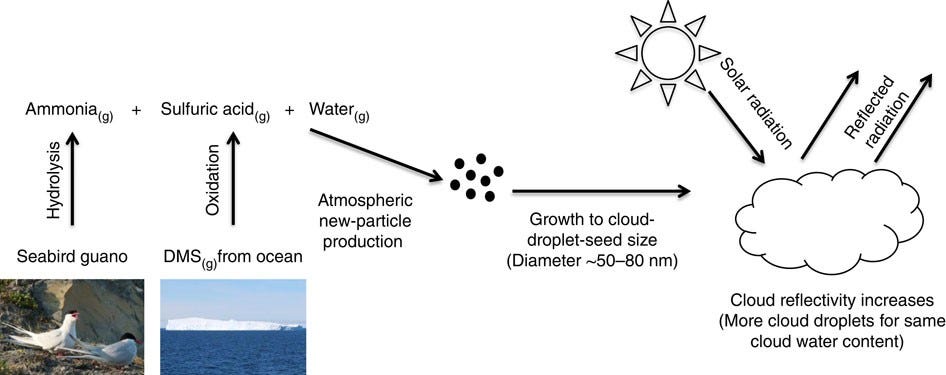
In 2016, Betty Croft and colleagues published a study in Nature Communications showing that ammonia from Arctic seabird colonies at Alert, Nunavut, was a key driver of summertime new-particle-formation bursts. Their chemical transport model indicated that seabird-influenced particles could grow large enough to act as cloud condensation nuclei across much of the Arctic. The calculated cooling tendency was substantial: roughly −0.5 W m⁻² as a pan-Arctic mean, exceeding −1 W m⁻² near the largest colonies. Total anthropogenic aerosol forcing is estimated at roughly −1.0 to −1.5 W m⁻², so seabirds are producing a non-trivial fraction of that signal in the cleanest part of the planet.
What makes these systems so powerful is the pristine baseline. In polluted continental atmospheres, adding more aerosol particles does comparatively little; there are already plenty of cloud condensation nuclei. But over the remote Southern Ocean or the high Arctic, aerosol populations are so sparse that biological emissions shift the cloud regime entirely. These colonies emit aerosol precursors into clean marine air, the particles grow into cloud condensation nuclei, the clouds brighten, and the surface cools. They have been running this process, unsupervised and unmonitored, for millennia. When MCB researchers in Australia build sprayers that generate hundreds of trillions of sea salt nanoparticles per second, they are engineering a controlled version of what a colony of 400,000 Arctic terns does with ammonia and guano.
The CLAW hypothesis and marine DMS
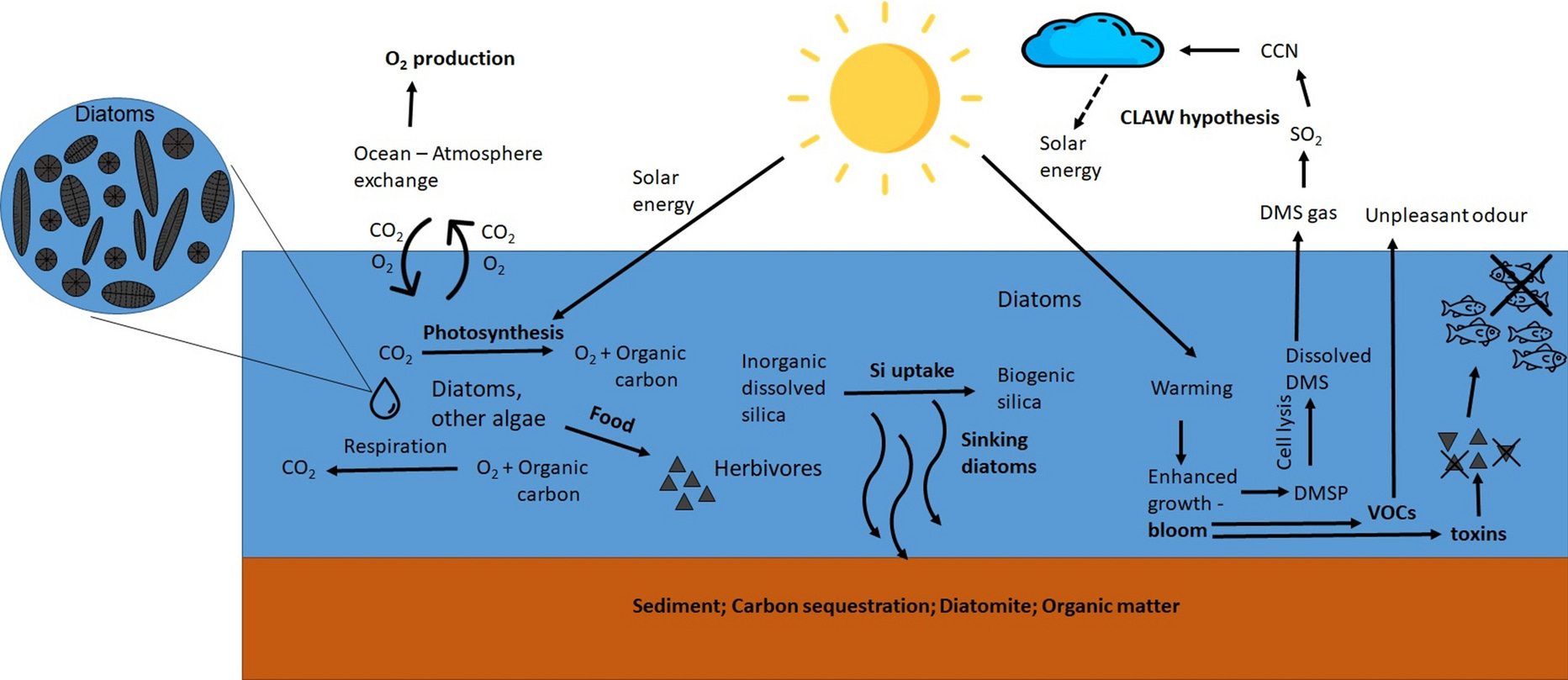
In 1987, Robert Charlson, James Lovelock, Meinrat Andreae, and Stephen Warren proposed what became known as the CLAW hypothesis (from their initials): that marine phytoplankton regulate Earth’s climate through a feedback loop. Certain algae produce dimethylsulfoniopropionate (DMSP), which breaks down into dimethyl sulfide (DMS). DMS escapes to the atmosphere, oxidizes into sulfate aerosol, seeds clouds, and increases their reflectivity, cooling the ocean surface and completing the loop.
It proved difficult to confirm. In 2011, Quinn and Bates published a critical synthesis in Nature arguing that after two decades of research, none of the critical links in the CLAW chain had been firmly established. The relationship between DMS emissions and cloud condensation nuclei was far more complex than a simple feedback loop, involving organic compounds, sea spray, and microphysical processes that resisted tidy summation. More recent modeling with detailed aerosol microphysics has suggested the DMS-cloud feedback, while real, is probably weak at the global scale.
Still, CLAW forced climate scientists to take seriously the idea that biology, aerosols, and clouds form coupled systems, and that intervening in one component ripples through the others. The neat feedback loop didn’t hold, but the underlying observation survived: biology has been doing atmospheric geoengineering longer than we’ve been studying atmospheres. The penguin guano research is CLAW’s spiritual (yet smelly) descendant, confirmation that biological emissions shape cloud properties in specific, measurable ways.
Volcanoes: nature’s SAI experiments
The June 1991 eruption of Mount Pinatubo in the Philippines injected roughly 17 megatons of SO₂ into the stratosphere, the largest stratospheric aerosol perturbation since Krakatau in 1883. The resulting sulfate aerosol veil produced globally averaged optical depths of 0.1 to 0.15 for two years, and global mean surface temperatures dropped by 0.3 to 0.5°C. The cooling was powerful enough to temporarily overwhelm both the concurrent El Niño and the background greenhouse warming trend. Midlatitude ozone concentrations reached record lows. Pinatubo remains the canonical natural analogue for stratospheric aerosol injection: proof, in real time and at scale, that sulfate aerosols in the stratosphere can cool the planet. It also demonstrated the side effects: ozone depletion, altered precipitation patterns, reduced direct sunlight reaching the surface.
The January 2022 eruption of Hunga Tonga–Hunga Ha’apai offered a different lesson. It injected similar quantities of sulfur, but 95% was washed back out by the extraordinarily water-rich explosion. What reached the stratosphere instead was an unprecedented quantity of water vapor, roughly 150 megatons, which persisted for years. The surface temperature impact was negligible, less than 0.04°C. The sulfur-to-water ratio, injection altitude, and particle size distribution determine whether an eruption cools or warms, and these details become critical when contemplating deliberate interventions.
The world’s longest unintentional experiment
Cargo vessels burning sulfur-heavy bunker fuel emit plumes of sulfate particles that, in clean marine air, dramatically increase the number of cloud droplets in low-level stratocumulus clouds. The result is visible from space: bright, linear “ship tracks” trailing behind vessels, each one a demonstration of the Twomey effect (more droplets means a brighter cloud). Ship tracks have been studied since the 1960s and are among the most robust observations in aerosol-cloud science. NASA documented a significant decline in ship track occurrence following the IMO 2020 regulation, providing a before-and-after natural experiment at global scale.
IMO 2020: an accidental termination shock
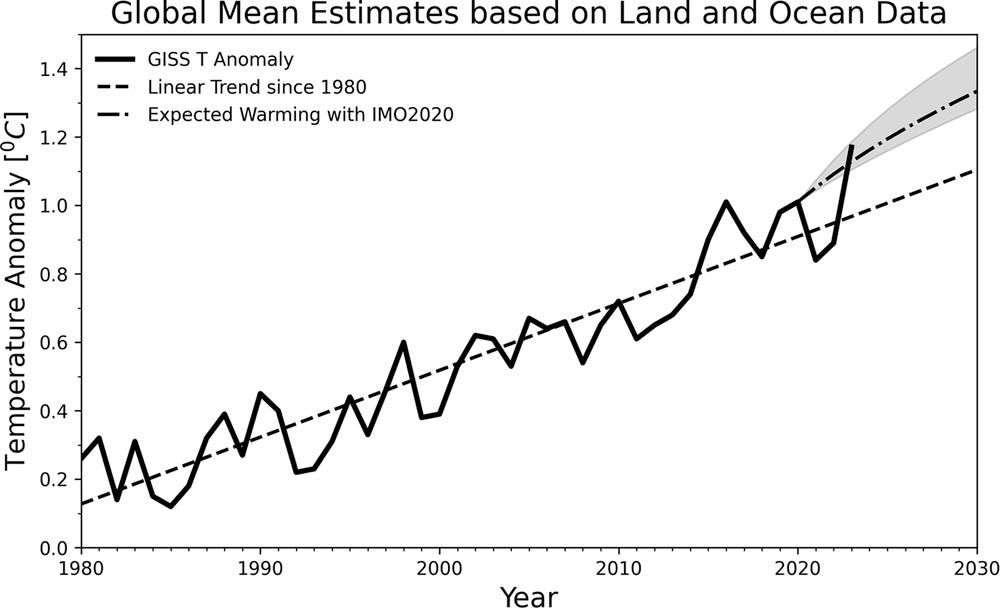
On January 1, 2020, the International Maritime Organization’s new fuel sulfur regulation took effect, slashing the maximum sulfur content of marine fuel from 3.5% to 0.5%. Sulfur oxide emissions from shipping fell by more than 80%. It was a public health victory (sulfate aerosol from ships has long been linked to respiratory illness and premature death) but also an inadvertent termination shock: the abrupt cessation of a decades-long, unintentional marine cloud brightening experiment.
The climate consequences have been hotly debated. Three major studies frame the disagreement:
Yuan et al. (2024), published in Communications Earth & Environment, estimated a radiative forcing of +0.2 ± 0.11 W m⁻² over the global ocean, enough to potentially double the rate of warming during the 2020s compared to the post-1980 trend. Yuan’s team characterized the regulation as a “termination shock” for inadvertent geoengineering and argued the warming signal was consistent with the anomalous ocean heat observed in 2023.
Jordan et al. (2024), using the UK Earth System Model (UKESM1), estimated a forcing of +0.139 ± 0.019 W m⁻² and concluded that IMO 2020 had accelerated global warming by approximately two to three years. They found the dominant driver was changes to cloud reflectivity (the Twomey effect), not direct aerosol scattering, and that the effect was concentrated over the North Atlantic and North Pacific shipping corridors.
Quaglia and Visioni (2024), published in Earth System Dynamics, found a more modest effect: +0.14 ± 0.07 W m⁻² and 0.08 ± 0.03 K of warming. They confirmed the signal was real but their estimate implies a smaller share of the anomalous warmth.
The studies disagree on magnitude but not direction: removing ship-emitted sulfate aerosols produced warming. As Cornell’s Daniele Visioni observed: “There was no attempt to say we should have all eyes on the shipping corridor. In hindsight, it would have been great to study that four years ago before the problem manifested itself.” That missed opportunity speaks to a broader governance failure we will return to.
Intentional interventions
Marine cloud brightening: the most tangible approach
If ship tracks demonstrate that aerosol injection brightens marine clouds, marine cloud brightening (MCB) proposes to do it deliberately and more efficiently. The concept, first articulated by British physicist John Latham in 1990, envisions fleets of ships spraying fine sea salt particles into low-lying marine stratocumulus clouds, increasing droplet number and boosting reflectivity. Sea salt is benign, abundant, and short-lived in the atmosphere (days, not years), making MCB among the most reversible forms of SRM.
The design logic is straightforward: study what natural aerosol sources (seabird colonies, wave-generated sea spray, phytoplankton DMS) do to cloud microphysics in clean marine environments, identify the functional mechanism, then engineer a device that does it more efficiently with a controlled particle size. MCB is the most explicitly biomimetic approach to climate intervention. Every other SRM proposal is modeled on geological or atmospheric phenomena. MCB is modeled on biology.
The field has seen two significant lines of outdoor work:
Australia’s Great Barrier Reef trials. Since 2020, researchers led by Daniel Harrison of Southern Cross University have conducted MCB field experiments over the Great Barrier Reef as part of the Reef Restoration and Adaptation Program (RRAP), a government-funded collaboration between CSIRO, the Australian Institute of Marine Science, and several universities. The approach is explicitly regional and defensive: brighten clouds during marine heat waves to shade corals and reduce bleaching stress. The researchers have developed sprayers capable of generating hundreds of trillions of nano-sized sea salt crystals per second, and modeling suggests MCB could delay expected declines in coral cover, though only if paired with deep emissions cuts.
The Alameda controversy. In March 2024, the University of Washington’s Marine Cloud Brightening Program set up a test facility on the deck of the decommissioned USS Hornet in Alameda, California. It was a small-scale aerosol study, too limited to alter any clouds, testing whether their spray device could produce particles of the right size and track their dispersion. Independent environmental consultants found no safety concerns, but the Alameda City Council unanimously voted to shut it down in June 2024 after press coverage drew public anxiety. A salt spray test producing less sea salt than natural wave action along the nearby coast was killed because it had the word “geoengineering” attached to it.
Stratospheric aerosol injection: the big lever
Stratospheric aerosol injection (SAI) is the most studied and most consequential SRM proposal, and the least biomimetic. Where MCB takes its design cues from biological aerosol systems tuned by evolution over geological time, SAI is modeled on catastrophic geological events: volcanoes. Inject reflective particles (most commonly sulfate aerosol, formed from SO₂) into the stratosphere at altitudes of 20–25 km, where they scatter incoming sunlight and persist for one to two years before settling out.
The physics favor sulfate particles in a specific size range. Particles too small scatter light inefficiently; particles too large settle out quickly and absorb longwave radiation, potentially warming the stratosphere and accelerating ozone depletion. Optimal particle diameters are generally estimated at 0.2–0.5 micrometers. Delivery would likely require high-altitude aircraft or, in some proposals, tethered balloons or naval guns, all speculative at operational scale.
The 2021 NASEM report Reflecting Sunlight remains the most authoritative institutional assessment. It concluded that a “strategic investment in research is needed,” recommended a transdisciplinary research program coordinated by the U.S. Global Change Research Program, and called for robust governance. It explicitly covered SAI, MCB, and cirrus cloud thinning, and warned that SRM research was “ad hoc and fragmented, with substantial knowledge gaps.”
The known risks are serious. Sulfate injection would deplete stratospheric ozone. Models consistently show that SAI would reduce global mean precipitation, even as it lowers temperatures, because it reduces the energy driving the hydrological cycle. Regional effects are highly uneven: SAI deployed primarily in the Northern Hemisphere could shift tropical rainfall belts, potentially weakening the South Asian monsoon, with severe consequences for billions of people. And because the cooling disappears within a few years if injection stops, SAI creates a termination shock risk: any interruption (from war, economic collapse, or political reversal) would produce rapid rebound warming.
Cirrus cloud thinning: the longwave complement
Where SAI and MCB target incoming shortwave (solar) radiation and work best during daytime, at low latitudes, cirrus cloud thinning (CCT) targets the other side of the radiation budget. Cirrus clouds, thin ice clouds at high altitudes, have a net warming effect: they trap outgoing longwave (infrared) radiation more efficiently than they reflect incoming sunlight. CCT proposes to seed these clouds with efficient ice nucleating particles, causing ice crystals to grow larger, fall out faster, and reduce the clouds’ optical thickness, allowing more heat to escape to space.
A combined SAI/CCT approach could, in principle, achieve more uniform cooling across latitudes and day/night cycles. The supporting models are promising: Storelvmo et al. (2013) estimated a potential cooling effect of up to 2.5 W m⁻², Muri et al. (2014) found a global temperature reduction of nearly 1 K from idealized seeding, and Lawrence et al. (2018) estimated a potential forcing of 2 to 3.5 W m⁻².
But CCT has an obvious problem: overseeding. If too many ice nuclei are introduced, the result is more numerous, smaller ice crystals, which increases the warming effect rather than reducing it. The margin between beneficial thinning and counterproductive thickening appears narrow and highly sensitive to background conditions. The NASEM report noted that CCT’s “efficacy is currently unknown due to very limited understanding of cirrus cloud properties.” This remains firmly in the domain of modeling, not experimentation.
Rogue actors and the governance vacuum
Make Sunsets: the startup that launched first
In late 2022, Luke Iseman, a serial entrepreneur and former Y Combinator hardware director, launched weather balloons containing a few grams of sulfur dioxide from sites in Baja California, Mexico, without notifying the Mexican government or consulting local communities. His startup, Make Sunsets, was already selling “$10 cooling credits” on its website, claiming each gram of SO₂ released would offset the warming effect of one ton of CO₂ for one year.
The quantities involved were climatically meaningless: a few grams versus Pinatubo’s 17 megatons. But the provocation was effective. Mexico’s Ministry of Environment announced plans to ban solar geoengineering experiments within the country in January 2023, explicitly citing the unauthorized launches. Iseman moved operations to Nevada and continued, eventually conducting over 147 balloon deployments and selling some 128,000 cooling credits.
In April 2025, the U.S. Environmental Protection Agency issued a formal demand for information to Make Sunsets, noting that SO₂ is a regulated criteria pollutant under the Clean Air Act. EPA Administrator Lee Zeldin, who had overseen the largest deregulatory rollback in the agency’s history, was now pursuing a two-person startup whose total SO₂ emissions were smaller than those of a single cross-country flight.
Make Sunsets matters not because of its climate impact (which is zero) but because of what it reveals about the governance gap. A motivated individual with a few thousand dollars can release regulated pollutants into the stratosphere, sell credits against them, and operate for years without regulatory intervention. No study of natural analogues. No particle size optimization. No monitoring of atmospheric response. If the biomimetic approach says “study what nature does, then engineer a controlled version,” Make Sunsets is the anti-biomimetic approach: skip the study, skip the engineering, skip the controls.
Blue Dot Change: iron, chlorine, and the methane question
Blue Dot Change, a Palo Alto startup, wants to spray iron chloride particles into the exhaust streams of commercial ships. The iron salt aerosol hypothesis holds that sunlight irradiating these particles produces chlorine radicals that accelerate the destruction of atmospheric methane, converting it to CO₂ (a far less potent greenhouse gas). Lab experiments at the University of Copenhagen and Utrecht University have shown that adding iron to seawater spray can boost production of chlorine and hydroxyl radicals.
But the uncertainties are large. The dark iron-rich particles could exert a warming effect. Iron deposition could fertilize oceans and trigger phytoplankton blooms in unpredictable ways. The particles could brighten marine clouds, dragging the venture into solar geoengineering territory whether or not that is the intent. As MIT Technology Review reported, some researchers are not even sure whether the net effect on methane would be positive or negative. Another startup, gM-Engineering, abandoned plans for iron salt aerosol field trials in Australia’s Bass Strait, citing concerns that attributing observed changes to the intervention would be impossible and that “the overall political governance framework is not ready.”
The governance void
The rogue actors are not the cause of the governance crisis. They are the product of it. Every year that passes without a competent institutional framework for SRM research, the people acting without permission gain legitimacy by default.
The most commonly cited governance instrument is a 2010 decision by the Conference of Parties to the Convention on Biological Diversity (CBD), often described as a “moratorium” on geoengineering. That characterization is imprecise: the decision is non-binding, applies only to activities that “may affect biodiversity,” includes exemptions for small-scale scientific research, and has not been ratified by the United States. National-level actions have been reactive rather than anticipatory. Mexico’s ban was triggered by Make Sunsets. Several U.S. states have introduced legislation restricting “geoengineering,” though most target the chemtrail conspiracy theory rather than actual SRM research. The NASEM report called for a national research program with a code of conduct, a public registry, and permitting for outdoor experiments. As of this writing, no such program has been established.
The EPA pursued Make Sunsets under Clean Air Act authority designed for smokestacks, not stratospheric balloons. Congress has no staff, no office, and no body capable of assessing MCB field trials or SAI research proposals. The Office of Technology Assessment, which might have provided that capacity, was defunded in 1995 and never replaced. The Alameda experiment was shut down not by a regulatory body with the expertise to evaluate it, but by a city council that couldn’t distinguish a salt spray test from an environmental threat. When governments cannot tell the difference between serious research and stunts, and cannot build systems to permit one and constrain the other, they forfeit their authority to set the rules when the real decisions arrive.
There is a serious counterargument, and it deserves honest engagement. A significant faction of climate scholars, including the signatories of the Solar Geoengineering Non-Use Agreement and researchers like Jennie Stephens, argue that building SRM research infrastructure is itself the danger. In this view, institutionalization is normalization: create a permitting system and you create a political constituency for deployment. Fund a research program and you create careers that depend on the technology advancing. The correct strategy, in this framing, is to keep SRM marginal, underfunded, and taboo, so it cannot become an escape valve that slows decarbonization. This is not a fringe position. It is the dominant position in much of the climate policy world.
But the premise no longer holds. The physical process of aerosol-cloud interaction is not a speculative future technology that can be kept in a box by withholding institutional support. It is an observed, ongoing, measurable feature of the Earth system. Seabird colonies, phytoplankton, and forests do it. The global shipping fleet did it industrially for a century. The taboo applies only to the deliberate version, which is the only version that could be designed, monitored, and controlled.
The taboo has also empirically failed for deliberate efforts. Make Sunsets launched 147 balloons and sold 128,000 cooling credits. Blue Dot Change is developing iron salt aerosol spray systems. Australia’s RRAP is running MCB field trials. The Simons Foundation is funding SRM research grants. A startup selling unverifiable credits does more to cheapen and normalize SRM than any publicly funded, peer-reviewed research program would. Without credible institutional science to establish actual risks, the public discourse gets shaped by whoever is loudest and least constrained. The taboo did not produce caution. It produced ignorance. And ignorance in a warming world is the fastest path to reckless deployment.
Voices from the Global South expose who actually bears the cost of the “keep it taboo” strategy. Countries in the tropics and subtropics stand to experience the largest consequences of SAI, both positive (reduced warming) and negative (monsoon disruption, precipitation changes), yet have the least representation in research programs and governance discussions. Keeping SRM marginal is viable mainly for wealthy nations with strong adaptive capacity. If you are the Netherlands, you can afford to wait. If you are Bangladesh, or a Pacific island state, or the Indian subcontinent facing monsoon disruption from both unmitigated warming and potential unilateral SAI by another country, the calculus is different. The pattern is familiar from Arrakis: the people who live with the system and understand its local dynamics are excluded from decisions about planetary-scale intervention by those who don’t. The Carnegie Climate Governance Initiative (C2G) and networks like SRM360 have worked to expand participation, but the structural asymmetry remains stark.
Nothing governs the deliberate introduction of reflective aerosols into the atmosphere at scale. The Montreal Protocol governs ozone-depleting substances; the Paris Agreement governs greenhouse gas emissions. The Oxford Principles, the AGU’s ethical framework, and various academic governance proposals exist, but they are voluntary codes, not enforceable rules. And unlike AI, unlike biotech, unlike every other domain where regulation can follow deployment and products can be recalled, you cannot recall sulfate aerosol from the stratosphere. Once a nation or well-funded actor begins injection at scale, the leverage to impose rules collapses, because stopping them means accepting the termination shock. Governance delayed is governance forfeited.
From prototypes to deployment
Governance is necessary but not sufficient. Even with a perfect institutional framework, the question remains: can we actually build this?
MCB researchers in Australia have built sprayers that produce hundreds of trillions of sea salt nanoparticles per second. But moving from prototype to climate-relevant deployment is an industrial capacity problem, not just a research problem. A fleet of MCB sprayer ships traversing ocean basins requires manufacturing nozzles that produce 200nm particles at industrial volume, building and maintaining the vessels, powering operations with decarbonized energy, and sustaining all of this for decades. None of that infrastructure currently exists.
And MCB is the easy case. Aerosol-cloud interactions are just the atmospheric layer of a broader portfolio of biological climate infrastructure that nature has already prototyped. Mangrove forests dampen storm surges while sequestering five times more carbon per unit area than tropical forests. Oyster reefs attenuate waves while filtering water. Beaver dams create stepped water tables that buffer both floods and droughts. The Amazon rainforest triggers its own rainy season through transpiration and biogenic aerosol emissions: trees releasing terpenes that oxidize into cloud condensation nuclei, essentially manufacturing weather through chemical signaling. CERN’s CLOUD chamber experiments have confirmed that these biogenic particles can seed clouds efficiently even at extremely low concentrations, and that as anthropogenic SO₂ declines from pollution controls, forest-derived aerosols become relatively more important to the cloud budget. The “nature already does this” evidence base includes forests that make their own rain.
All of these systems share the same scaling bottleneck: industrial throughput. Drone-seeding 27 million mangroves (as Dendra Systems is attempting in the UAE) requires manufacturing infrastructure. Deploying tens of thousands of oyster reef substrates requires fabrication facilities. Building automated kelp farm platforms requires energy, materials, and supply chains. The limiting factor for biological geoengineering is not the biology. It’s the industrial base.
The numbers are sobering. California pays roughly $0.24/kWh for industrial electricity; China’s Pearl River Delta pays $0.09/kWh. Manufacturing MCB nozzles, sprayer vessels, reef components, or seeding drones at 2.7 times the energy cost makes projects economically unviable before they start. China deployed more industrial robots in 2023 than the rest of the world combined, with robot density per manufacturing worker increasing fivefold between 2017 and 2023. Over the same period, America’s robot density grew less than half that rate for a shrinking manufacturing workforce. The production capacity to build biological climate infrastructure at scale exists, but it exists primarily in a country that is not party to the CBD, has no SRM governance framework, and is simultaneously the world’s largest emitter. This is not a comfortable observation, but ignoring it makes any deployment timeline fictional.
There is also a temporal problem. Successful programs get defunded. The U.S. interstate highway system enabled trillions in economic activity and now crumbles from deferred maintenance because functional infrastructure generates no political urgency. Wageningen University, widely regarded as the world’s leading agricultural research institution, returning an estimated €4.20 in societal value per €1 invested, announced €80 million in cuts in 2024. The institution that enabled the Netherlands to become the world’s second-largest agricultural exporter faces budget reductions because successful infrastructure becomes invisible.
If MCB successfully protects the Great Barrier Reef from bleaching, will Australia maintain funding twenty years later? Or will successful reef protection be taken for granted, making the program an easy target during the next fiscal crisis? The Alameda shutdown is the premature version of this pattern: a research program killed not because it failed but because it was working quietly enough to be politically expendable. This argues for embedding climate intervention capacity in physical capital and industrial infrastructure, not just institutional structures. A functioning MCB sprayer fleet with invested capital, trained crews, established supply chains, and maintenance contracts is harder to defund than a university research program. Manufacturing capacity has political economy advantages over knowledge institutions: it employs workers who vote, generates visible output, involves private capital that resists expropriation, and creates constituencies for its own continuation. The spice must flow, and what flows must have infrastructure behind it.
This leaves three paths. Build domestic industrial capacity for biological and aerosol climate intervention: expensive, slow, but autonomous. Leverage existing manufacturing capacity where it exists (primarily China): cheaper, faster, but strategically dependent. Or accept that neither governance nor industrial capacity will be built in time, and watch the field default toward riskier, cruder interventions by actors who face no constraints at all. Current trajectories point toward the third option by default. Not because anyone chose it, but because nobody chose either of the first two.
What the aerosol landscape tells us

This is not a story about missing knowledge. It is a story about missing integration, and missing industrial seriousness about what integration requires.
By the 1970s, atmospheric scientists understood sulfur dioxide chemistry in extraordinary detail, because acid rain was destroying forests and lakes across the Northern Hemisphere. The U.S. Clean Air Act amendments of 1990 created a cap-and-trade system for power plant SO₂ emissions that became a textbook case of successful environmental regulation. Meanwhile, the shipping industry kept burning high-sulfur bunker fuel, and we had all the information (the Twomey effect was described in 1977) to anticipate that removing ship sulfur emissions would unmask warming. We did not study it. The IMO 2020 regulation took effect, the ship tracks faded, ocean temperatures spiked, and researchers scrambled to quantify a warming signal they could have been measuring in advance.
In Horizon Zero Dawn, the engineers who designed GAIA, an AI system tasked with restoring Earth’s biosphere after collapse, understood both halves of this problem. They didn’t just design the science. They built the manufacturing base. GAIA was an integrated system of subfunctions, each modeled on natural processes, and the machines it deployed were biomimetic, shaped like birds and grazers and predators, because the engineers recognized that the natural systems they were replacing had already solved the design problems. The Stormbirds didn’t just look like birds. They did what birds do, at scale, by design. But the fictional engineers also built the Cauldrons: the automated factories that manufactured the biomimetic machines. They understood that prototypes without production capacity are museum exhibits, not planetary infrastructure.
We are in the odd position of having the birds already. The penguins and seabirds are producing aerosol particles that seed clouds across the cleanest atmospheres on Earth. Phytoplankton are emitting DMS. Forests are releasing terpenes that nucleate cloud condensation particles. We had a global fleet of ships running an unintentional MCB program for a hundred years. What we lack is what GAIA had: the integrated framework, the governance architecture, the manufacturing base, and the institutional will to connect them before something else breaks.
The strongest case for caution remains real. SAI does not remove CO₂; it masks warming. Stop the injections and temperatures snap back like a rubber band. MCB is more forgiving (sea salt washes out in days), but at scale it too creates a regime the climate system adjusts to. In a world where decarbonization is already agonizingly slow (despite how cheap green energy is becoming), offering a cheaper and faster alternative to cutting emissions is a strategic complication.
But caution without research is not prudence, and research without industrial capacity is theater. I think the evidence supports a vigorous, publicly funded, internationally coordinated research and deployment program, as the NASEM report partially recommended in 2021 and as no government has come close to implementing. The alternative is not the absence of activity. It is what we have now: startups launching balloons, nations imposing reactive bans, researchers scrambling for private funding, manufacturing capacity concentrating in countries with no governance framework, and the global community flying blind as pollution controls continue to unmask aerosol cooling we never accounted for.
The penguins will keep producing ammonia. The forests will keep emitting terpenes. The question is whether we will keep treating each piece of this system as someone else’s problem, or whether we will finally do what the fictional engineers of GAIA understood was necessary: build the integrated system, build the factories to manufacture it, model both on what nature already does, and actually watch what happens before we pull the next lever. Unlike, those fictional engineers, I prefer being alive to see it happened.
Kudos, Sean! GREAAAT article!
May the light be with you.
What I really like about your post Sean is you write about a natural cooling that we are losing in the lessening of biogenic aerosols. Nobody is an expert on clouds, ccns, and all their aerosol effects but we do know cloud cover is lessening, Earth is dimming, less sulfur is polluting the air, and natural forests are getting decimated. Wish this were studied more seriously 40 years ago.