


The desire gap is the opportunity. People already want more children than they’re having. The job isn’t persuasion; exposure to kids alone increases fertility ideals, it’s building environments where existing desires can be acted on. Moralizing about young men needing to shape up or young women not having the right values doesn’t close the gap and won’t close the gap.
Build the coalition and infrastructure subnationally Local governments can move completed family sizes; national governments control entry into parenthood. Stop waiting for national reform. Build working ecosystems at the municipal and provincial level now, capture the gains available there, and assemble the political coalition of places that have actually delivered.
This is a product/service delivery problem, not a culture war Every place that sustained above-average fertility built an integrated system, held it across administrations, and made it visible in everyday life. They didn’t change anyone’s values. They built an environment where existing values could be executed on. Integration and constancy of purpose are the product. Everything else is downstream.
The mothers in Nagi who arrive with plans for one child and leave with plans for two aren’t being persuaded of anything. They wanted more children before they got there. The previous environment didn’t let them have them. Nagi did. The wanting was already there. The system finally caught up to it.
Hold that in mind. It’s the shape of the argument.
When Steve Jobs walked on stage in January 2007 and introduced the iPhone, he wasn’t selling a device. He was selling a proposition: that the Mac would still work with it, that the App Store would be stocked next year, and that whatever Apple announced in 2012 would still run on the thing you bought in 2007. And then there was always “one more thing.” The phrase was pure theater, but it worked because there was always actually one more thing, and the one more thing always connected to every other thing he’d already shown. The showmanship and the system were the same act. But the showmanship only sold because underneath it was an obsessively integrated system. Hardware talked to software talked to services talked to retail, and every seam was somebody’s job. The phone was worth more because the App Store was stocked. The App Store was worth more because the phone was in your pocket. The Mac was worth more because both synced to it. None of the components did much alone; together they produced something that felt like magic to the customer, and the magic was real because the machinery underneath it was real. People who didn’t know they wanted a smartphone discovered they wanted one because the environment made smartphones feel like a thing to have, and concentration of early adopters changed what the next wave of customers could imagine.
Apple is the one widely understood case of what an ecosystem does. The ecosystem isn’t the Mac, the App Store, the iPhone, or the repair network. It’s the way each piece makes the others more valuable. It requires both: the razzle & the dazzle that makes people want to enter the system, and the tick-tick-tick of a system that actually delivers once they’re inside.
Fertility policy has almost no equivalent. It has components: baby bonuses, parental leave, childcare subsidies, housing grants. Most countries spend real money on some of them. The aggregate numbers keep falling. But here’s the thing: the components mostly work. Korean baby bonuses produce babies. German parental leave reforms produce conceptions. Italian childcare expansions, above a threshold, produce births. Evaluated individually, the programs do what they’re designed to do, with some doing much better than others. Evaluated as a system, they produce the world’s lowest fertility rates. The reason is that nobody designed the system.
A baby bonus that lands in a city with affordable family housing, available childcare, and neighbors who used the same bonus last year is not the same intervention as a baby bonus that lands in a city without those things. Same check. Same amount. Completely different product. The check didn’t change. The environment it landed in changed everything about what the check could do. That’s the alchemy, and it’s the same alchemy Apple was selling: the pieces make each other work, and the felt experience of the pieces working together is the thing that actually shifts decisions.
But alchemy that works has machinery underneath it. The baby bonus lands right because someone built the housing, someone staffed the childcare, someone made sure the programs talked to each other instead of each department optimizing its own line item while the family fell through the gaps between them. The central government runs cash transfers. The province runs its own programs. The city runs still others, with funding from local taxes. No one is responsible for whether they cohere. Each layer optimizes its own components. The family doesn’t experience the components. The family experiences the gaps.
On top of this, the whole arrangement has to survive an election, and a new mayor/governor/president/PM, and a budget cycle, and the moralist on the op-ed page who thinks the problem is that young people have the wrong values (oftentimes the right accusing women, the center/left accusing men, and sometimes the inverse), and the minister who wants to announce something visible before the next vote rather than sustain something invisible that compounds over fifteen years. The alchemy requires the machinery. The machinery requires the politics. A few places have figured out how to hold all three within the layer they control, and the difference shows up in fertility numbers that sit two to five times apart under identical national laws.
Same country, same laws, five times the children. Why?
Two young Korean women, same age, same income, same education, same national fertility policy. One lives in Yeonggwang County. One lives in Busan’s Jung District. Yeonggwang’s fertility rate is 1.71. Busan Jung’s is 0.32. Economic models don’t predict this. Cultural models don’t predict it. Ideological and religious models don’t predict it. What’s the variable nobody is measuring?
In 2009, a research group put childless women in fMRI scanners and showed them photographs of infant faces. The women’s reward circuitry (the nucleus accumbens, the part of the brain that fires when someone you love walks into the room or when you eat a perfect peach) lit up before they consciously processed the image. Later work using EEG clocked the response at roughly 140 milliseconds. The women didn’t decide to find the babies cute. The brain had already responded by the time the deciding part woke up. The response was graded: more infantile features produced stronger responses, in women who had never been pregnant, who weren’t thinking about pregnancy, who in some cases didn’t want to be pregnant. Something in them was keeping score of how many babies they had encountered. They didn’t know they were keeping score.
The women didn’t decide (she did, but you get the point). That’s the part I keep coming back to. The empathy response is decision-making before the deliberation, the part that runs on perception before the reasoning wakes up. It’s hard to build policy around a 140-millisecond response. It’s also hard to build policy while pretending it isn’t happening.
And the 140-millisecond response doesn’t stop at desire. It reaches all the way into marriage. In Japan, somewhere between 30 and 39 percent of never-married adults in their 20s and 30s say they are uncertain whether they want children. Not opposed; uncertain. Stephanie H. Murray brought my attention to Fumiya Uchikoshi and colleagues at Harvard, Princeton, Tokyo, and Gakushuin’s paper. They tracked what those uncertain adults did over the following years, in a paper published this year in Population and Development Review. Controlling for whether they wanted to marry (which in conventional models would be the variable doing the work), they found that uncertainty about fertility cuts the annual marriage transition rate by 30 to 50 percent. People who don’t know whether they want children marry later, or don’t marry.
The arrow runs the other way. Marriage doesn’t cause children; the prospect of children causes marriage. They call it child-driven marriage, and the reframes where the causation you assumed was backward tend to be where the actual leverage lives.
So the woman in Yeonggwang and the woman in Busan aren’t just in different policy environments. They’re in different neurological environments. The woman in Yeonggwang walks past children in playgrounds, parents pushing strollers, neighbors visibly managing two and three kids. Her brain is accumulating 140-millisecond responses before she deliberates anything, and the accumulation shapes her fertility desires, and the desires shape whether and when she marries. The woman in Busan walks past convenience stores and study cafés. Same brain. Same circuitry. Different inputs. The variable nobody is measuring is the density of the environment the circuitry is responding to.
What if TFR isn’t really one number?
The density is measurable, but the measurement most people use throws the signal away. When Stephen Shaw decomposed the Total Fertility Rate across 314 million mothers in 33 countries, he found that what looks like one number is actually two numbers multiplied together, and the two don’t move together. He checked it three ways (breakpoint co-occurrence, wavelet coherence, mutual information) and confirmed statistical independence. The share of women who become mothers at all (call it TMR, the Total Maternal Rate) drops in sharp shocks and doesn’t recover between them. The average family size among mothers (CPM, Children per Mother) stays roughly flat for decades. TFR averages them together and throws away 49% of the information in the process. A single TFR value of 1.5 corresponds, on average, to thirteen distinct combinations of the two underlying numbers. The thing every fertility paper for sixty years has been measuring is half a measurement, and the half that’s missing is the half that tells a mayor what to do.
Here’s the simplest way to hold it: TFR is an average of two different decisions made by two different people at two different life stages. The 27-year-old deciding whether to become a mother at all is deciding TMR. The 33-year-old mother of one deciding whether to have a second is deciding CPM. Policies that work for one often don’t work for the other. Forces that move one often don’t move the other. Sixty years of policy has been optimizing against an aggregate that hid both failure modes.
Shaw’s shock pattern has the right time signature for an environmental mechanism, with a wrinkle the smooth-decline reading misses. TMR doesn’t drift downward; it drops in discrete shocks and ratchets down. Italy, Japan, and the UK all show sharp TMR falls around 1974. The US shows the same shock pattern in 1971 and again in 2008. Shaw’s prefecture-level analysis of Japan is the cleanest single piece of evidence: TMR fell in all 47 Japanese prefectures simultaneously between 1974 and 1975, with a probability under the null of less than 0.0001, as improbable as flipping a coin 47 times and getting heads every time. The breakpoint cluster in monthly birth data begins in October 1974 and peaks in November, which, accounting for conception and gestation, lines up almost exactly with the Japanese Oil Shock of October 1973. CPM stayed roughly flat across the same period. The shock altered who became a mother at all. It barely touched how many children mothers ended up having.
This gives the transmission mechanism its time signature. A shock (economic crisis, labor-market upheaval) disrupts fertility-desire formation in the cohort experiencing it. That cohort’s lowered birth rate depletes the next decade’s ambient infant exposure. The empathy channel runs at lower amplitude on the following cohort. Their fertility desires form against a thinner environment. Their TMR ratchets down again at the next shock and doesn’t recover between shocks because the environment never refills. CPM stays stable because it’s a different decision, made by people already inside parenthood, responding to local rather than national conditions. The smoothness of the aggregate decline was an artifact of TFR aggregation.
Put Shaw’s ratchet together with Uchikoshi’s child-driven marriage, and East Asia’s marriage collapse stops being mysterious. Atoh’s work and recent estimates by Tan, Cui, and Uchikoshi attribute 40 to 70 percent of TFR decline in Japan, Korea, Taiwan, and Singapore to falling marriage rates. The conventional reading is that fewer people are marrying, so fewer children are born. The better reading is that an earlier generation’s TMR shock depleted the ambient infant environment of the next cohort, which produced uncertain fertility desires in unmarried young adults, which depressed their marriage rates, which produced still fewer children (the next TMR step down), which further depleted the environment for the cohort after that. The marriage collapse is downstream of a fertility-desire collapse, which is downstream of a depleted environment, which is downstream of TMR shocks the previous generation absorbed and never recovered from. The trap closes itself.
Is the whole problem just economics?
None of this is to say the empathy channel is the only thing going on. Rising education costs, women’s labor-market opportunities, contraception, the genuine economic burden of raising children: all do real work in the fertility decline. Galiani and Sosa are explicit that the empathy channel is one mechanism among several, additive to economic pressures rather than replacing them. Shaw is similarly careful that his shock-and-ratchet pattern shows association rather than definitive causation. What the combination makes visible, and what sixty years of TFR-anchored policy never had to confront, is that one of the actual drivers of the decline has an environmental leverage point that fiscal instruments cannot reach. The economic factors still matter. They are not the whole picture, and the part they don’t cover is the part where felt environment compounds over generations.
TMR and CPM respond to different forces and require different interventions. In most developed countries both have been declining, meaning the aggregate decline reflects two different decisions made by different people at different life stages. The 27-year-old deciding whether to enter parenthood at all is a different customer from the 33-year-old mother of one deciding whether to have a second. Any policy portfolio that works has to work for both, and most don’t. Most serve the existing-parent customer through benefits that escalate with each child. The prospective-parent customer, who doesn’t yet have a child to trigger any of them, is served by cash she hasn’t yet decided to earn.
Who can actually reach any of this?
The two customers’ frictions live at different scales, and this matters for what work can be done now. The split is rough. Most frictions sit at one layer, but individual frictions cross between them. TMR’s binding constraints are mostly national, and Shaw’s shock pattern shows why: TMR moves with national-scale disruptions that hit cohorts simultaneously, and the disruptions ratchet rather than reverse. Whether a 25-year-old can form the fertility desires that drive her marriage decision depends on whether she has stable employment, whether her education will complete on a reasonable timeline, whether her labor market will penalize her 66 percent in maternal earnings, whether her employer will force her to sign an illegal contract promising to resign if she becomes pregnant. No mayor can fix any of these. CPM’s frictions are mostly local, consistent with Shaw’s finding that CPM stays flat across periods of national turbulence; it’s not insulated from the national environment, but it’s tracking something more local. Whether a mother of one has a second depends on whether local childcare works, whether her neighborhood contains other families managing two or three children in ways that shift what a livable family size feels like. A mayor can absolutely reach these.
Housing is the clearest friction that refuses the split. A young couple that wants to marry and start a family can’t if there’s nowhere in the city they can afford a family-sized unit. That’s a TMR friction, and the lever is overwhelmingly municipal: zoning, parking minimums, permitting timelines, all decided at the city and sometimes state level. The federal government has essentially no direct authority over what gets built where. Housing is also a CPM friction at the same layer (the mother of one in a two-bedroom can’t have a second if the three-bedroom doesn’t exist because zoning prevents it from being built) and it’s the substrate the empathy channel runs on (a neighborhood of family-sized units near transit puts families in walkable range of each other; a neighborhood of studios above retail doesn’t). Three jobs, one lever, one layer. The political coalition for this already exists in YIMBY organizing across the English-speaking world, which has proven that cross-ideological housing coalitions are buildable at the municipal and state level in a way that almost no other pronatalist intervention can claim. Pronatalists who aren’t already in that coalition should be.
The local cases below do most of their measurable work on CPM (higher concentrations of families with children raising completed family sizes among residents who were going to become mothers somewhere) while also producing TMR effect through two channels: concentration raising ambient infant exposure for residents who weren’t already fertility-minded, and housing-stock decisions directly enabling household formation for couples who currently can’t start one. But the bulk of the TMR problem is national and isn’t being reached by any of the local work.
Yeonggwang. What the young couple sees walking through their county is most of this argument in concrete form. Children in the playgrounds, parents pushing strollers, neighbors who took the same marriage incentive the county offers, used the same baby care package, claimed the same child-raising subsidy. Six consecutive years as Korea’s highest fertility rate, more than double the national average, in a rural county with no subway, no university, and no tech industry. Busan Jung-gu, three hundred kilometers away under the same national framework, has none of the visible design and none of the children. Same country, same laws, more than five times the children per woman in Yeonggwang. Section I returns to what Yeonggwang actually does.
A skeptical reader will say: much of this is selection. Fertility-minded families move to Yeonggwang. Haenam County, also in South Jeolla, once held Korea’s top TFR and then lost it. (Section I returns to Haenam as the anti-case.) The critique is real and applies in varying degrees to most cases below. It’s also less damaging than it looks once the chain is in hand. Families moving into Yeonggwang aren’t reshuffling a fixed stock of fertility; they’re concentrating in a place where they are visible to each other and to everyone else who lives there. Concentration does CPM work directly, by raising completed family sizes among residents who were going to become mothers somewhere, and it does some TMR work indirectly, by raising infant exposure for residents who weren’t already fertility-minded and letting the empathy channel run on them before the child-driven marriage mechanism shifts their decisions. Concentration is one of the channels through which production happens.
What the local cases are showing
Don’t people already want more children?
The Nagi pattern, wanting already present and the system finally catching up, is the shape of the problem almost everywhere. Korean women, surveyed across multiple cohorts, say their ideal is between 1.8 and 2.16 children. They produce 0.72. Italian women say their ideal is around 2; under “ideal living conditions” they say 2.3. They produce 1.18. Across 27 EU member states, 87% of women say two or more children is their personal ideal, and a third of women aged 40 to 54 report having fewer children than they wanted. The desired-actual gap is enormous and it is not closing on its own. People want children. The system isn’t delivering on the wants people already have.
This is the first-order claim, and it belongs in front of every other one. Most of the available fertility recovery in the next decade lives inside this gap. Closing the gap doesn’t require convincing anyone of anything. It requires building the environment in which the children people already say they want become plannable. Cash transfers, ecosystems, and moral exhortations all bid for the same job. They are not equally good at it, and the reasons they differ matter.
What makes this more than a one-time transfer is what happens after the gap closes. Children produced by gap closure don’t just exist. They occupy the environment: playgrounds, sidewalks, train platforms, supermarket aisles. The 22-year-old commuter who hasn’t formed a family preference yet now lives in a denser child environment than her older sister did. Her brain is keeping score in 140-millisecond increments, before she consciously deliberates anything at all. By the time she’s deciding, she’s deciding on top of accumulated unconscious priors that were shaped by the previous round’s gap closure. Her ideal number of children, when she’s surveyed, will be slightly higher than her sister’s was at the same age, because the environment that formed it was slightly denser.
This is what Sebastian Galiani and Raul Sosa formalize as the empathy channel in their April 2026 NBER paper. Each child in an environment generates a positive externality on the desired fertility of surrounding adults, mediated by the reward circuitry that fires before conscious processing. Konrad Lorenz identified the underlying baby schema in 1943; Glocker and colleagues confirmed in 2009 that infant faces with high baby-schema intensity activate the nucleus accumbens in women who have never been pregnant. Kringelbach’s group established that the response runs within roughly 140 milliseconds. Ruth Feldman’s research showed that oxytocin tracks infant contact regardless of whose child it is, in fathers and alloparents and unrelated adults. The channel is dormant when fertility is high, where additional infants barely move the signal, and steeply active when fertility is low, where each additional infant (or its absence) shifts the operating point. Galiani and Sosa calibrate the channel at between 3 and 33% of the fertility decline, with 13.4% at baseline.
The implication is that gap closure compounds. Closing the desired-actual gap for the current cohort puts more children into the environment, which lifts desired fertility in the cohort behind them, which means the next round of gap closure operates on higher desires, which puts still more children into the environment. The same loop ran in reverse for fifty years and produced the trap. Fewer children meant less exposure meant lower desired fertility meant fewer children. The local ecosystems that work are running the loop forward.
This is the difference between a cash transfer and an ecosystem, and it explains why Korea’s modest cash-transfer gains don’t compound. Cash arrives at the moment of birth in a household already inside parenthood. It does some gap-closure work for that household, but it doesn’t densify the environment in concentrated, visible ways. The 22-year-old commuter sees nothing she didn’t see before. The next cohort’s desired fertility is unmoved. Each year’s transfers do roughly the same work as the previous year’s, and the base doesn’t grow. Local ecosystems concentrate. Yeonggwang’s higher fertility produces a denser child environment, which lifts desires in residents who weren’t already family-oriented, which produces still more children, which densifies the environment further. Same gap-closure intent. Very different long-run trajectory.
Whose preferences have to change?
Two recent thought leaders clarify why the frame matters by getting it wrong. Helen Andrews, on the right, argues that the “girlboss lifestyle would not exist if it were not massively subsidized” and treats the removal of women’s economic options as the implicit pronatalist program. Something that doesn’t match the research on the topic, especially with a greater correlation of income and CPM.


Matthew Yglesias, from the center-left, identifies that the binding constraint on marriage formation is on the male side (educated women marry at higher rates than working-class women, and the men who aren’t getting college degrees are the weak link). He then concludes that “someone needs to tell them to either stay in school or else take some other conscientiousness-demonstrating path.”
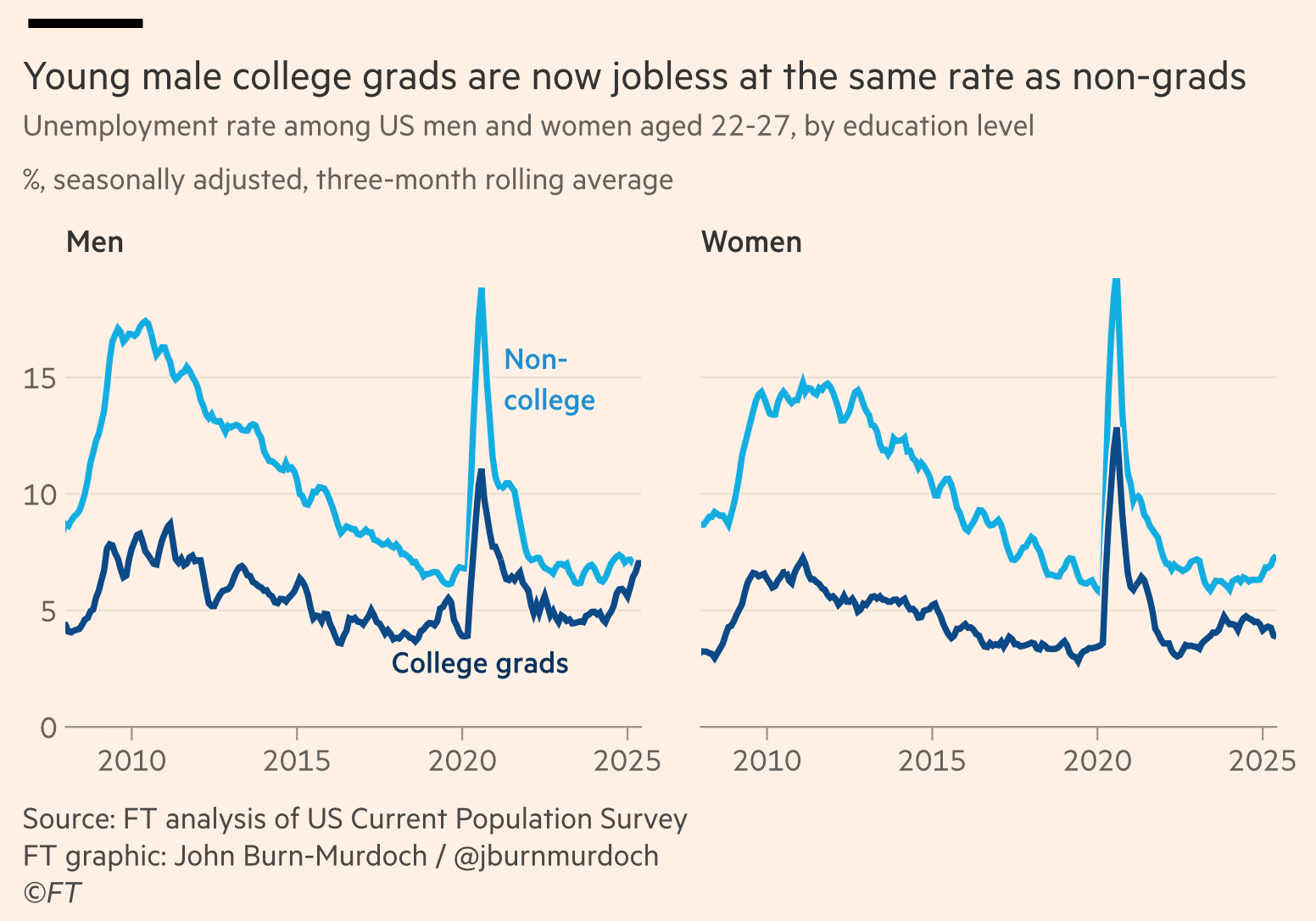
At time of Ygelsasis’s writing, the unemployment rate for college graduated young men and non college grades are at the same, alongside the fact that post 2008. Men saw persistently higher unemployment rates than women. On top of that, learn to plumb is a dismal failure as blue collar job market collapse.
Tell who, with what mechanism, through what institution, on what timeline that matches the demographic clock. The prescription doesn’t survive contact with the question of who would deliver it.
I find both arguments frustrating (well, disgusting and repulsive) in similar ways. Both are about whose preferences need to change. The data says preferences don’t need to change for the first-order gain. The preferences are already there, in the form of a desired-actual gap that no amount of moralizing will close, as if moralizing haven’t been tried. Andrews wants women to revise downward what they want from their lives so they will accept what the current system delivers. Yglesias wants working-class men to revise upward what they expect of themselves so they will become deliverable to women whose preferences would then be met, regardless of current economic realities.
Neither asks what environment would let the preferences people currently hold actually be executed on, or what the same environment would do to the next cohort’s preferences as a compounding effect. Andrews is comfortable making women bear the cost of a transition she isn’t responsible for designing. Yglesias is comfortable making working-class men bear the diagnosis without offering them anything that resembles a path. Both treat the people whose lives are at stake as objects to be hectored or modified, rather than as people responding rationally to an environment that someone built and someone could rebuild.
Research like Han and Uchikoshi that Yglesias gestures at without naming deserves direct treatment, because the talk about economics being the reason why men are the binding constraint. Among Korean men aged 25 to 29, the share neither working nor seeking work nearly tripled between the mid-1990s and the early 2020s, from roughly 10% to 30%; in the same Japanese age group, the rate barely moved.
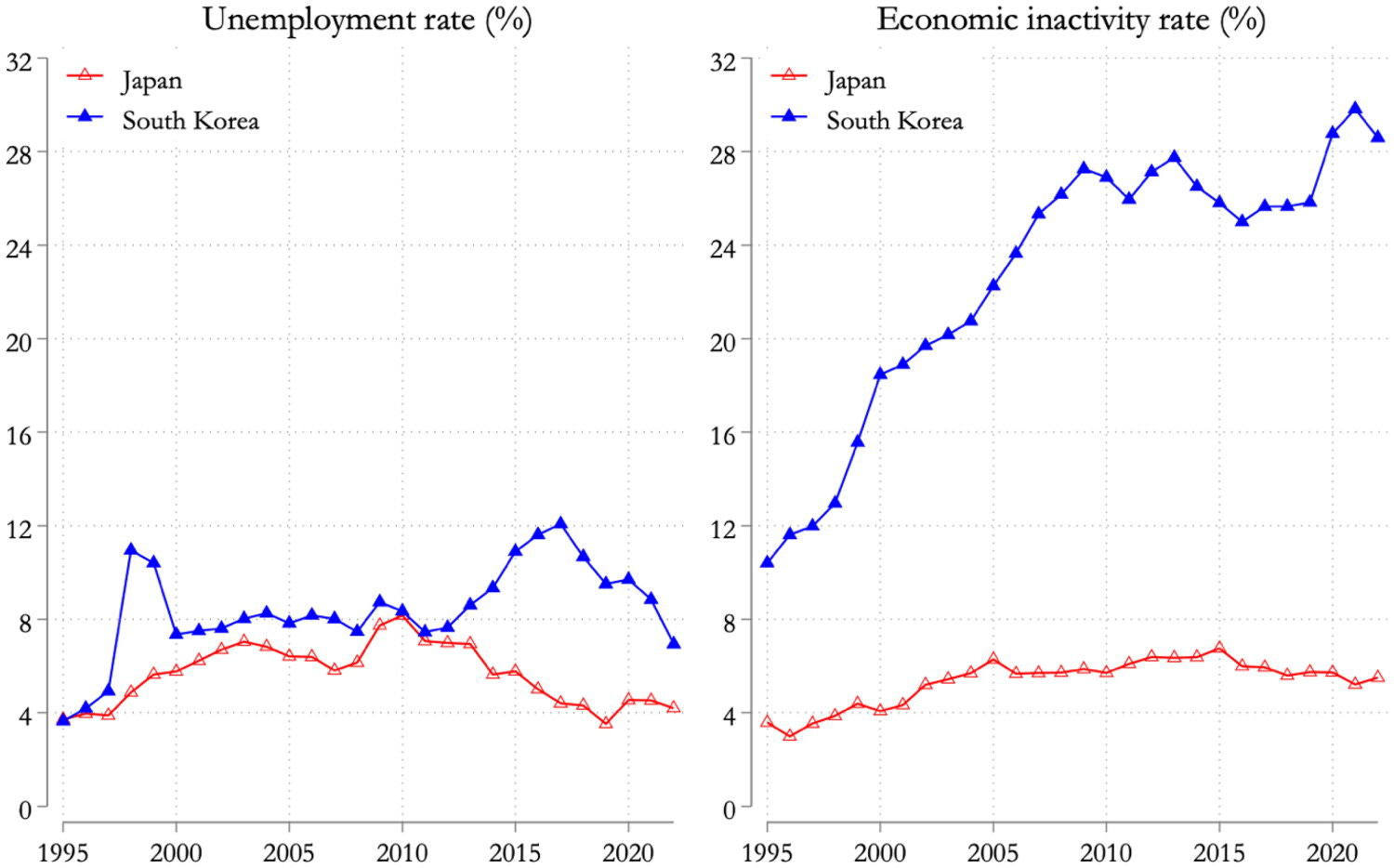
The study attributes about a third of Korea’s fertility decline in this age group to that rise. Male economic inactivity is a national-scale TMR friction that excludes the inactive from the marriage market almost entirely, and no mayor can fix it. Naming it doesn’t change who can act on it. It does change what a thinkpiece is supposed to do.
Where can we see the chain working?
Sarah Hrdy’s cooperative-breeding research adds the historical dimension: girls in traditional societies arrived at first pregnancy with hands-on experience caring for younger siblings and neighbors’ children, which exposed the neurobiological systems that generate maternal desire to the stimulus they evolved for. Modern societies dismantled that apprenticeship by age-segregating residential life and privatizing childcare. Local ecosystems that concentrate children in visible public space are partly rebuilding what age segregation took apart.
The population-level test is clean. A quasi-experimental study of Italian municipal childcare expansion found that municipalities starting with childcare coverage above 20 percent and expanding further showed measurable fertility gains over four years. Municipalities starting below 10 percent and expanding just as aggressively showed nothing. The authors attribute this to a minimum cultural threshold for using educational services; below it, expansion doesn’t register as a meaningful option for couples making family decisions. The shape is exactly what the compounding loop predicts. Visibility has to cross a threshold before additional supply registers in decisions, because what registers isn’t the supply but the normalization of using it. Same population, same selection, different births.
How do you build an ecosystem in a rural county?

Yeonggwang. What the young couple sees walking through their county is most of this argument in concrete form. Six consecutive years as Korea’s highest fertility rate, reaching 1.71 in 2024 against a national 0.75, in a rural county of 52,000 people with no subway, no university, and no tech industry. What Yeonggwang has is a dedicated Population and Jobs Policy Office (인구일자리정책실) established in 2019 as the first such department at Korea’s basic-local-government level, and more than 80 lifecycle support programs running across marriage, pregnancy, birth, childcare, and youth retention. The county frames itself as a saenghwal-miljakhyeong dolbom dosi, a “life-embedded care city,” and uses the older Korean phrase “from cradle to grave” (요람에서 무덤까지) to describe the setup: every child is enrolled in the support network from birth and the services follow them through school, marriage, and eventually their own children.
The individual programs are unremarkable as components. A ₩5 million marriage grant, rent-interest support for newlyweds, a ₩30 million transportation card for expecting mothers, neonatal support scaling from ₩5 million for a first child up to ₩35 million for a sixth, fertility-treatment subsidies, and a monthly birth allowance of ₩200,000 payable for 216 months until age 18 (₩43.2 million in total). More unusual is the father’s parental leave subsidy (아빠 육아휴직 장려금), which pays men who take leave and which the county frames as a tool for both gender equality and paternal bonding. Most unusual is the adjacent infrastructure: e-mobility manufacturing at Daema Industrial Complex, Hanbit Nuclear Power Plant employment, and Neulpum Village young-professional housing that makes Yeonggwang a place a young person can both move to and stay. Marriages jumped 40 percent between 2023 and 2024 (from 177 to 248), which will feed the TMR of the next cohort. Mayor Jang Se-il describes the sequence directly: youth support, marriage, birth, child-rearing, in that order, as the chain the county is trying to operate on. The design is the ecosystem. The specific programs are the visible pieces.

Sejong, Korea’s purpose-built administrative capital established in 2012, operates on a different principle. Sejong held Korea’s highest TFR at the metropolitan level for seven consecutive years starting 2015, peaking at 1.89 and still at 1.03 in 2024 even as the national figure fell to 0.75. Sejong didn’t layer subsidies. It assembled three things at once: stable public-sector employment as central ministries relocated from Seoul, relatively affordable new housing (a local policy choice enabled by Sejong’s being built without legacy zoning politics), and public kindergartens accounting for 93 percent of early-childhood provision against a national figure closer to a quarter. The housing did TMR work directly: it was what let young government workers form households. The childcare did CPM work: it was what let those households have second children. The employment anchored both. Concentration raised infant exposure for everyone else who lived there. The empathy channel activated. Fertility desires formed.
“We need to approach fertility from the perspective of the youth life course, independence, employment, housing, family formation, child-rearing, rather than through fertility-boosting subsidy programs.”
When the first three work, the fourth and fifth can happen. Sejong’s advantage is narrowing as neighboring Daejeon competes for the same newlyweds with its own ₩300,000-per-month subsidy, which illustrates how fragile municipal success is when the national framework doesn’t recognize and protect what works.
When does a train-station daycare beat a cash bonus?

Nagareyama, a Tokyo commuter town that elected Yoshiharu Izaki mayor in 2003, ran a formal SWOT analysis of the city before taking office, picked dual-employed households with children as the target customer, and built infrastructure around them. The headline intervention was train-station childcare: at Nagareyama-Otakanomori and Minami-Nagareyama stations, parents drop children between 7 and 9 a.m., staff bus them to participating daycares across the city, and the buses return them by 6 p.m., at 100 yen per day. The logistical problem it solved was real. The less obvious thing it did was put parents and children together in the most visible public space in the city twice a day, for years. Nagareyama reached a fertility rate of 1.50 in 2022 against a national 1.26, and was Japan’s fastest-growing city for six consecutive years.

Matsudo runs a similar model with different instruments. The city has won or placed in the top three of Nikkei’s dual-career-friendly cities ranking every year since 2018, and has achieved 10 consecutive years of zero waitlist by building 121 small-scale childcare facilities positioned at all 23 train stations in the city. Matsudo treats the commuter-parent as the customer: every station has childcare within walking distance of the fare gates. The insight travels within a prefecture willing to organize around it.

Akashi, in Hyogo Prefecture, demonstrates what happens when a city government chooses what it is. Mayor Fusaho Izumi raised the child-policy budget from 125 billion yen to 297 billion yen while the overall budget stayed flat, and tripled the staff on child policy, recruited lawyers and welfare specialists onto the municipal payroll, consolidated kindergartens and libraries under a new Children’s Future Department, and moved authority over preschool policy from the school board to the mayor’s office. The visible “five free things” for children rested on organizational restructuring that took years and that no one outside city hall noticed. The reorganization was the intervention; the free services were its downstream expression. Akashi hit a TFR of 1.7 in 2018 against a national 1.42 and ran nine consecutive years of population growth. Critics point out that much of the gain is in-migration from Hyogo municipalities that didn’t match the policy. Right, and it matters less than they think. In-migration concentrates families in an environment where they’re visible to Akashi’s existing residents, and concentration activates the chain.

Two smaller cases extend the pattern. Hinode-machi in western Tokyo produced the largest TFR improvement of any Japanese municipality in Nikkei’s survey, +0.57 from 1.02 to 1.59, through coupons and allowances. Furubira-cho in Hokkaido raised its TFR by 0.47 to 1.62 on a retention logic its mayor stated plainly: “Childcare support has a defensive aspect against out-migration. It’s worth the cost.”
What happens when you get the numbers without the ecosystem?

Haenam County, in the same South Jeolla province as Yeonggwang, is the story of success that wasn’t. Haenam held Korea’s top TFR for seven years running, peaking at 2.46 in 2015. In 2017 it became the only Korean region to exceed 2.00 since Korean below-replacement fertility set in. The county received a Presidential Award on Population Day in 2016. It was the global poster child for municipal fertility success, until it wasn’t. By 2022, Haenam’s TFR had fallen to 1.04. Annual births fell from 839 in 2015 to 295 in 2021. The Korean press coined a term for what had happened: 먹튀 출산, “eat-and-run birth.”
There’s something bleak about a town winning a Presidential Award for something it wasn’t actually doing. Neighboring counties started offering bigger cash subsidies. Fertility-minded families moved for the subsidies, collected them, and moved on. The design Haenam had was transactional, not ecological. There was nothing to stay for after the cash arrived. A 2023 analysis by the Korea Institute for Health and Social Affairs showed the deeper mechanism: Haenam’s “high fertility” years corresponded to a low share of women aged 15 to 49 in the population (28 to 35 percent), compared to 44 to 54 percent in genuinely growing high-fertility places like Jinju, Asan, and Dangjin. Haenam had a small denominator that cash could inflate temporarily. It did not have an ecosystem that shifted desires in the next cohort. When the cash moved elsewhere, so did the numbers.
Is there a single variable that matters most?

Kasuga, a Fukuoka commuter town of roughly 115,000, is the exemplar of the scale-of-commitment principle. Kasuga allocates approximately 41 percent of its municipal budget to child welfare spending (児童福祉費), roughly triple what comparable Japanese municipalities allocate. The town positions itself as family-friendly for Hakata-area commuters, operates six train stations connecting to Fukuoka’s center, and pushed its child-focused investment at a level that a recent analysis of all 1,741 Japanese municipalities by Kawasaki and Morimoto identified as the single most powerful municipal-level predictor of desired birth rates, with a coefficient of 0.47 that dwarfs density, transit access, income, facility counts, and commute patterns. The point isn’t that every municipality should allocate 41 percent. The point is that the share of the budget going to children is the most consequential variable any municipality controls, and most municipalities don’t know this because nobody has told them.
Can a province do what a country can’t?
Bolzano, Trentino, and Vorarlberg sustain fertility meaningfully above their national averages over decades at the provincial scale, and they do it through three different designs.

Bolzano (Alto Adige / Südtirol) is the consumer-facing brand. Italy’s national fertility has fallen to 1.13 in 2025; Bolzano holds 1.55 and is the only Italian province whose fertility rate actually rose between 2024 and 2025. The province runs an 8.7-billion-euro annual budget, with roughly 200 million euros going to family policies specifically, split across direct transfers, the 0-to-3 childcare network, and employer incentives for work-family conciliation. The visible elements are the Family+ card giving retail discounts to families with three or more children, retailer partnerships, trilingual welcome backpacks for newborns, and the Tagesmütter system of certified home-based childcare that covers rural valleys where centralized daycare would be uneconomic.
The institutional elements are more load-bearing than the visible ones. A single unified Department for Family has coordinated the work since 2013, an Agency for the Family acts as the policy interface with municipalities and employers, a Consulta per la Famiglia of 19 members shapes direction, and every municipality and district community has a family-referent in its executive council. This is the organizations-don’t-optimize-separately principle in action: the province broke down the barriers between departments that would otherwise each run their own family program badly. The housing component is equally important and usually overlooked: Bolzano builds more housing per capita than Milan or Rome (roughly 0.22 square meters per capita in 2022 against 0.14 in Milan, and 0.31 against 0.11 pre-Covid), which means a young couple can actually find a family-sized apartment. And the Audit certification for family-friendly workplaces now covers 55 certified companies, bringing the employer into the ecosystem rather than leaving the conciliation problem to households alone.

Trentino, just south, runs a more institutional setup. Provincial Law No. 1 of 2011 established an integrated family system with a dedicated agency run by Luciano Malfer since its founding. The province runs a Family Audit certification for employers, a “Comune Amico della Famiglia” designation for municipalities, a network of Distretti Famiglia (family districts), and 93.4 percent municipal coverage of early-childhood services. Regional TFR for Trentino-Alto Adige combined is 1.39 against the national 1.18, with Trentino’s own number somewhat below Bolzano’s but well above the Italian baseline. The contrast with Bolzano is instructive: Bolzano does consumer-facing branding backed by services; Trentino does institutional structure backed by a provincial statute. Different instruments, same outcome.

Vorarlberg, Austria’s westernmost Land, runs a third model with almost no centralized brand. Vorarlberg’s 2023 TFR was 1.50 against Austria’s 1.32. The province offers a Familienpass that every Vorarlberg family automatically receives, good for discounts at over 200 partner businesses and reduced public transit fares, renewing automatically until children turn 18. On top of this sit the familieplus program recognizing family-friendly municipalities, and Vorarlberg lässt kein Kind zurück (”Vorarlberg leaves no child behind”), a comprehensive child-welfare framework coordinating federal and provincial supports. Municipalities administer most services; the province provides the shared infrastructure; the brand is almost invisible compared to Bolzano’s. This matters because Vorarlberg demonstrates that the specific visibility design is substitutable. What isn’t substitutable is sustained institutional commitment to families as the unit around which other provincial decisions orient themselves. (Vorarlberg’s trajectory is fragile: the regional family association reports a 9.4 percent birth-rate decline between 2021 and 2023, reflecting Austria-wide housing and cost-of-living pressures. Even strong provincial ecosystems don’t insulate against national-scale shocks.)
Malfer puts the shared principle in his own words:
“Money isn’t what counts. In these policies the winning card is a management model that conceives of the family as a resource for society.”
The management model is the product. Everything visible downstream is just the management model becoming visible. Michela Morandini, Bolzano’s director of Social Cohesion, Family, Elderly, and Cooperatives, says the same thing from the other province:
“There is broad consensus across all local parties on maintaining these policies, which have lasted for years and are not continually changed like national ones.”
A family pulling out the Family+ card today has reasonable confidence it will mean the same thing in ten years. That confidence is the product. The card is its visible manifestation.
What does twenty years of commitment actually buy?

Nagi, a rural town of roughly 5,700 people in Okayama Prefecture, is the closer on commitment. Nagi’s TFR climbed from 1.41 in 2005 to 2.81 in 2014, then to a peak of 2.95 in 2019, which the town built and sustained for more than two decades through ordinary interventions any municipality could copy: cuts to its own council seats and staff to free up child-policy budget, volunteer aiiku-iin delivering personal gifts to newborn families, and a suite of supports sustained long enough that residents learned to plan around them. Eighty-five percent of Nagi’s child-rearing households have two or more children; 48 percent have three or more. That’s a CPM distribution: completed family sizes shifted upward by an environment that made second and third children plannable.
A young couple in Nagi believes the support will still be there in five years because it has been there for twenty. That belief is part of the product, and it can’t be manufactured through a single visible intervention. It’s the cumulative output of a town that kept doing the same thing long enough that the doing became part of what the town is. Call it constancy of purpose. Institutions that change direction every administration cannot build the trust that lets families plan around them, which is the failure mode every municipality trying the visible interventions without the underlying commitment eventually demonstrates: a mayor announces, the press covers, fertility ticks up, the next administration arrives with different priorities, the budget tightens, the program disappears. The customer base that had started to believe the city was committing learns that institutional commitments cannot be trusted.
What the municipal cases share isn’t generosity. None of them spent dramatically more than comparable places. What they share is the alchemy and the machinery held together long enough that the compounding started, and the politics to keep it running across administrations. Visibility shapes desires, which shape marriage decisions, which shape fertility. Each link is now empirically established.
Why the national conversation is stuck
What if the French exception isn’t fading evenly?
France is the case Shaw’s framework reframes most sharply. The conventional reading is that France’s century-long fertility exception is fading: French fertility is closer to European averages than a decade ago and falling. The decomposition says something more specific. Between 2013 and 2023, France’s CPM remained stable between 2.3 and 2.4 children, while TMR fell from 85.0% to 72.8%.
French mothers are still having French-sized families. What’s collapsing is entry into motherhood at all. This matters because French policy has been organized for a century around the CPM side: generous family allowances that scale with parity, school and childcare systems that make two and three children manageable for existing mothers, tax incentives (the quotient familial) that lower the marginal cost of additional children inside a family. These instruments still work for the population they reach, which is why CPM held flat through a decade when most of Europe saw it slipping. None of them do anything for the 27-year-old who hasn’t started. Whether she enters motherhood depends on whether she can form a household, whether the labor market will penalize her for doing it, whether the housing she can afford has room for a child.
The CPM-supporting ecosystem, the part that works locally on existing parents, is doing roughly what it always did. The TMR-supporting national conditions are deteriorating. The French exception isn’t fading in some general sense; it’s fading in one component while the other holds, and the failing component is the one that sits before any local ecosystem can reach.
This is the diagnostic payoff of the decomposition. A country can spend more, sustain the spending longer, build the most institutionally continuous family policy in the developed world, and still watch the aggregate number slip, because the aggregate hides which half is slipping. If you can’t see that France’s TMR is falling while its CPM is stable, you can’t see that French policy needs a different kind of intervention now than the one it has historically delivered well.
Why do cash transfers keep hitting ceilings?
Poland’s 500+ program raised fertility from 1.29 to 1.45 within two years through a near-universal cash transfer; Polish fertility has since fallen back. Germany’s 2007 parental allowance reform produced a measurable increase concentrated among highly educated women, but current German fertility is where it was before. Targeted components can move TMR for the segment they target. They don’t compound without an ecosystem around them. Lyman Stone said it in 2020 with more directness than most pro-natal literature allows:
Cash at the moment of childbirth arrives after most of the consequential choices have been made.
What does x% percent of a national budget buy when the system is broken?
Korea is the anti-case, and Korea’s decline is heavily TMR. Korean marital fertility has been stable; the collapse is in whether people marry at all, which means the binding constraints are all the national conditions shaping whether young Koreans form fertility desires in the decade before marriage. The country spends roughly 6 percent of its government budget on fertility policy and has the world’s lowest national rate, which is what spending looks like when it’s flowing through a system that doesn’t work.
Korean policies, evaluated rigorously, have measurable effects in their domains. Kim’s analysis of Korea’s regional baby bonus variation finds Korean TFR would have been 4.7 percent lower without the transfers, equivalent to roughly 562,000 fewer children over the lifecycle of the 2015 female cohort, with elasticities from 0.34 to 0.58 depending on birth order. The same program dropped the third-child sex ratio from a counterfactual 124.7 boys per 100 girls to 105.3, cash reshaping a deeply embedded cultural preference. A 2011 reform expanding childcare leave subsidies for higher-earning mothers produced a 2.3 to 2.5 percentage point increase in conception rates with no significant effect on employment. These are real findings. Korean policies work in the places where they can reach; they do modest CPM work on families who were already going to have at least one child. What they don’t do is reach the TMR frictions producing the aggregate decline, because those frictions sit before any component-level policy can touch them. No marriage bonus reaches a 25-year-old whose employer will force her to sign an illegal contract promising to resign if she becomes pregnant, whose housing is unaffordable on non-regular employment, whose education ran six years past the age her mother was when she married, and whose ten-year earnings penalty for motherhood is seven times what a Swedish mother faces.
The vertical fragmentation makes this worse. Korea runs national cash transfers, metropolitan housing rules, ward-level childcare allocation, and a private hagwon market that none of those layers regulates. Each layer optimizes its own component. Nobody is responsible for whether they fit together for the family trying to use them. The principle that organizations fail when departments optimize separately applies equally across levels of government. The central, provincial, and municipal layers are running independent strategies on the same families.
The Korea Institute of Public Administration said substantively the same thing in 2023: current regional support policy “lacks long-term performance indicators and performance management systems; insufficient project identification and evaluation systems for the regional extinction response mission; and insufficient awareness and capacity at the local government level”. The country’s successful municipal outliers get no structural recognition: as National Assembly member Lee Gae-ho noted in August 2025, Yeonggwang has produced six consecutive years of top-ranking fertility and measurable net in-migration, yet “actual fiscal support is lacking” because the central government has no incentive system that rewards municipalities that succeed. The center can’t see what its own municipalities have built, which means it can’t amplify what works or replicate it elsewhere.
The scale of the TMR frictions deserves naming because the numbers are staggering. Korean workers put in 1,865 hours a year against 1,431 in Sweden. Raising a child to 18 costs $275,000, or 7.8 times GDP per capita, against 4.1 times in the US. Eighty percent of Korean children attend a hagwon, and Koreans spent $19 billion on shadow education in 2023. None of this is reachable by any subsidy a mayor can offer. This is what the environment looks like when the chain has been running in the wrong direction for a generation. The TMR shocks that drove the chain into this position arrived discretely and ratcheted down. Each ratchet depleted the next cohort’s exposure environment further.
Doesn’t Korea’s recent rebound change the picture?
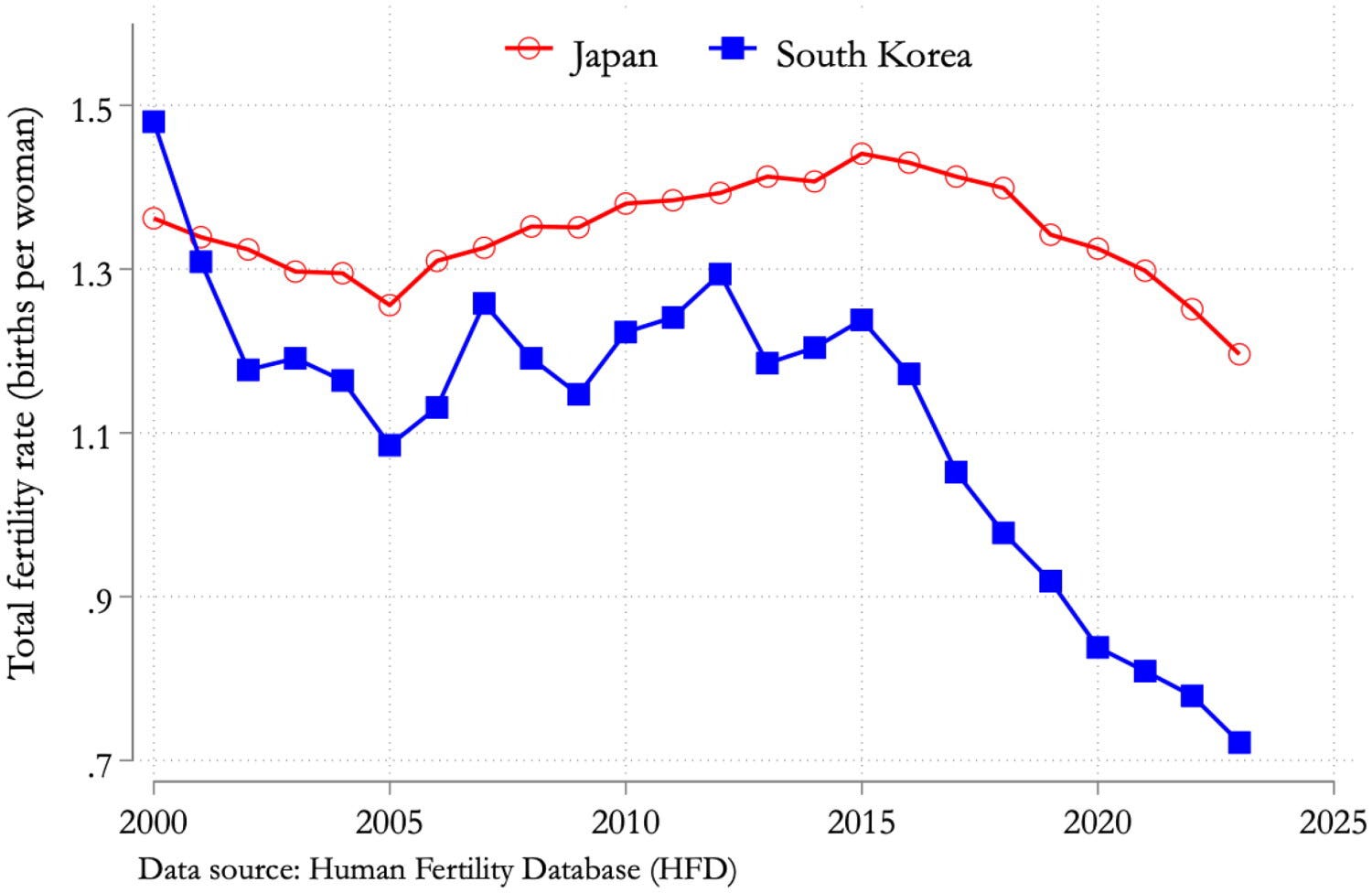
Korean TFR rose slightly in 2024 and 2025: 0.72 in 2023, 0.75 in 2024, an estimated 0.80 in 2025, the first sustained increase in a decade. The rebound is structural timing. The echo-boom generation born in the early 1990s is entering peak childbearing age, and pandemic-deferred marriages are happening with the usual two-year lag before births. None of the structural conditions has changed. The aggregate moved without the environment moving, which is exactly the failure mode the decomposition was built to expose: TFR can rise on cohort timing while the underlying ratchet stays where it was, and the next cohort will discover the gain didn’t compound.
National-scale policy is mostly stuck. Multiple ministries with separate budgets, short electoral cycles, slow demographic feedback, and structural reforms that are politically contentious in ways component-level programs aren’t. France stayed the course for a century because institutional continuity held, and even France is now showing the TMR component slipping while the CPM component holds, which is what slipping looks like before the aggregate number tells you it’s slipping. Korea and Germany and Italy haven’t, and there’s no credible mechanism in their current political economies for them to start.
The local work is the infrastructure
What can’t a mayor reach?
The bulk of the fertility problem in most developed countries is TMR (fewer young adults entering the parenthood pathway at all), and the bulk of TMR’s binding constraints are national. No mayor can reach them. Housing is the major exception, and its politics are moving. Most of the others are not. Energy policy shapes the real cost of running a household and therefore the economics of forming one. Industrial policy determines whether the labor market absorbs young men at stable wages, which determines whether they become marriageable on the timeline their biology and their desires suggest. Education finance shapes both the direct cost of raising a child and the timeline on which a young adult finishes training and enters the family-formation window.
Each of these deserves careful work, close attention to political economy, and mapping of the coalitions that could move them. None of it exists yet in the form pronatalists need. Someone has to do it. This essay is not that essay. This essay is about what to do in the meantime. Shaw's ratchet pattern makes the stakes legible: the 1970s oil shock didn't just raise prices, it triggered the economic disruption that stamped an entire cohort's TMR down permanently and never let it recover. Energy and industrial policy are pronatalist policy, whether pronatalists treat them that way or not. That essay still needs writing.
The claim here is that while the national conversation remains stuck, useful subnational work should proceed now. The municipal and provincial cases do most of the achievable work on CPM (completed family sizes among women who were going to become mothers), direct TMR work on the frictions local authority can reach (housing the main one), and additional TMR work through local concentration raising ambient infant exposure for residents who weren’t already fertility-minded. None of this solves the national TMR problem. But together these build the infrastructure national TMR reform will need to land on if and when it arrives, and they’re the work doable inside the political constraints mayors and provincial administrators actually face.
What are mayors actually doing when they succeed?
A mayor building Nagareyama’s station childcare or Akashi’s Children’s Future Department isn’t building a scale model of what a prime minister should do. She’s doing two things at once: building CPM infrastructure, and working around the missing vertical coherence her national government won’t supply. The mayor can’t make the central government cohere with the city, but she can at least make the city cohere with itself. Akashi consolidated kindergartens and libraries under a new Children’s Future Department and moved preschool authority from the school board to the mayor’s office. Trentino passed Provincial Law No. 1 of 2011 to put a single agency in charge. Nagi cut its own council seats to free up child-policy budget. These are vertical integration moves inside the layer the actor controls.
The empathy channel runs in an environment. Environments are built locally, by entities small enough to act and sustained enough to hold. A country with no local ecosystems is a country where, even if national TMR reform eventually arrives, the young mothers it produces stop at one child because the local environment doesn’t make a second or third livable. A country with a hundred Nagareyamas is a country where national TMR reform, when it comes, has CPM infrastructure to land on. The local work complements national reform; it doesn’t substitute for it.
Yeonggwang and Sejong and Nagareyama and Akashi and the Alpine provinces aren’t demonstrations of what Korea or Italy or Japan should do at the center. They show what mayors and provincial administrators can do now, inside the political constraints they face. Every one of these places shifted ambient exposure, then desires, then marriage and fertility decisions, at the scale where they had authority to act. The aggregate numbers for their countries didn’t move much, because most other cities and provinces didn’t do the same thing and because the national TMR frictions continued to depress entry to parenthood across the full cohort. Building the ecosystem in your jurisdiction makes the national number movable when the center eventually turns, and captures the CPM gains available at your scale regardless of what the center does.
The Uchikoshi findings sharpen this in a specific way, and Shaw’s decomposition sharpens it further. If fertility desires shape marriage decisions rather than the other way around, and if marriage decisions drive fertility in East Asia, then the TMR leverage point is the environment shaping fertility desires in unmarried young adults. The bulk of that environment is national. But some of it is local: the ambient infant exposure a 25-year-old experiences in her actual neighborhood is a municipal-scale variable, and local ecosystems that sustain high exposure do activate the empathy channel for residents who weren’t already fertility-minded. This is the TMR work local ecosystems can do. It’s real but limited. What it isn’t limited on is CPM: the same local environments that produce some TMR activation are also the environments where existing mothers decide whether to have second and third children, and that decision is almost entirely a local question. National cash transfers, by contrast, deliver modest CPM effects and essentially no TMR effects because they don’t touch the binding national constraints that shape young adults’ fertility-desires environment. Uchikoshi’s own policy conclusion lands here, where the operational decision gets made: “policy efforts that increase fertility desires among young people contemplating family formation by reducing uncertainty around childbearing may also contribute to higher fertility via their positive effect on marriage.” Reducing uncertainty around childbearing is exactly what a local ecosystem does. It makes the environment clear enough that a young adult can see what her thirty-five-year-old self might plausibly live, and the empathy channel takes care of the rest.
One caveat. Some fraction of the fertility-desires shift is autonomous, genuine preference change that ecosystems cannot reach. A 25-year-old who has thought it through and concluded she doesn’t want a life that includes children isn’t going to be empathy-channeled back into wanting one. That fraction exists, and the ecosystem argument makes no claim on it. What the ecosystem argument claims is the fraction shaped by environment, which Shaw’s reading of the Fertility Gap puts at the center of the problem: the gap between desired and actual fertility stems less from mothers having fewer children than desired, and more from a growing share of women who hope to become parents but ultimately remain childless. That’s a TMR phenomenon, women who wanted to become mothers and didn’t, and it’s exactly the territory where ecosystems do work, because the fraction of TMR loss attributable to depleted environment rather than autonomous preference change is large, and it’s largest in places where the ratchet has been running longest.
So what should pronatalists actually do?
The pronatalist response to national policy stagnation shouldn’t be despair. It should be aggression at every layer below national, because that’s where the work that compounds is actually getting done. I am still going to write essays on why energy and industrial policy is pronatalist policy and vice versa at the end of the day, because no pronatalist policy is immune from oil shocks, as Shaw’s paper makes perfectly clear. Pronatalists need to think about this stuff, but we are still limited by the political economy.
Build the ecosystem where you have authority. Capture the CPM gains available at your scale. Start with housing, the YIMBY coalition already exists, the municipal authority is real, and the intervention does TMR, CPM, and empathy-channel work simultaneously.
The local work also builds the political capital and institutional expertise that pronatalists will need for national reform. A country with a hundred Akashis has a bench. A country with zero has a press release.
Jobs didn’t convince anyone they wanted a phone. He built the system, and the system delivered, and the delivering changed what the next wave of people could imagine wanting. The demographic version is harder and slower, but it’s the same thing: alchemy on top, machinery underneath, and the politics to keep both running long enough that the compounding kicks in. The jurisdictions that have figured out how to hold all three together are municipalities and provinces. The countries that end the next four decades with that infrastructure in place will be in a different position from the countries that don’t.
Fascinating! Really enjoyed the breakdown of the two metrics and why it matters to count them separately.
Great Article!
But I have one important caveat. Your data on Korea doesn't appear correct:
"South Korea invests roughly 1% of its annual GDP in fertility incentives, totaling over $270 billion since 2006. These funds support cash subsidies, housing assistance for newlyweds, infertility treatment support, and childrearing services aimed at boosting the nation's record-low fertility rate."
Other sources put it a little higher but still below average for the OECD.
https://webfs.oecd.org/els-com/Family_Database/PF1_1_Public_spending_on_family_benefits.pdf
I know some of the flaws in determining what is a "family benefit" (Israel for instance is higher in reality then that chart), but I'm pretty confident Korea isn't spending 6% of GDP and certainly not on cash transfers.
People like bandying about big numbers like $X at birth, but that's all headline little substance. Kids take 18 (or more) years to raise and a one year bonus divided by that much isn't worth much.
I think the message "money doesn't work" is a terrible one.
First, money does work. We see it work wherever it's tried. The main problem is that it isn't tried hard enough (10% of GDP, which would solve the problem).
Second, money works better than most alternatives. Subsidies and make work schemes all have a ton of deadweight loss and bad incentives compared to cash. Hungary spent a lot of money on micro-managed subsidy schemes and badly incentivized payments and got a lot less then it should get for its money (Israel by contrast spends its family support money very well).
Third, it's pretty clear that the message behind "money doesn't work" is "we don't want to give you the money." It's cheap and selfish. "Culture" or government scam programs are offered as an alternative so that people don't have to open their wallets to provide for those raising their future social security funding.
The message should be:
1) Money works
2) We need more of it, lots more, now
Everything else is a distraction at best and harmful at worst. You can still pursue housing abundance or whatever while still giving money, but please give money and not housing vouchers.