

Key points
The fertility gap between Korea and Japan comes down to one age group. Korea’s TFR fell 51% from 2000 to 2023 versus Japan’s 12%, and nearly all that divergence traces to women aged 25–29. Korean births in this group collapsed 87%; Japan’s fell 35%. Other age brackets looked similar in both countries.
Male economic inactivity is the key. Among Korean men 25–29, the share neither working nor seeking work nearly tripled, from ~10% in the mid-1990s to 30% by the early 2020s. In Japan it barely moved. The study attributes about a third of Korea’s fertility decline in this age group to that rise.
Male inactivity and female employment suppress fertility different ways by birth order. For first births, predictors are male inactivity and unemployment; female labor force participation isn’t significant. For second-plus births, female participation becomes strongly negative (−0.811, p<0.001), alongside male inactivity, but male unemployment drops out. This pattern is consistent with research showing that workplace inflexibility and childcare burdens make it difficult for working mothers to have additional children.
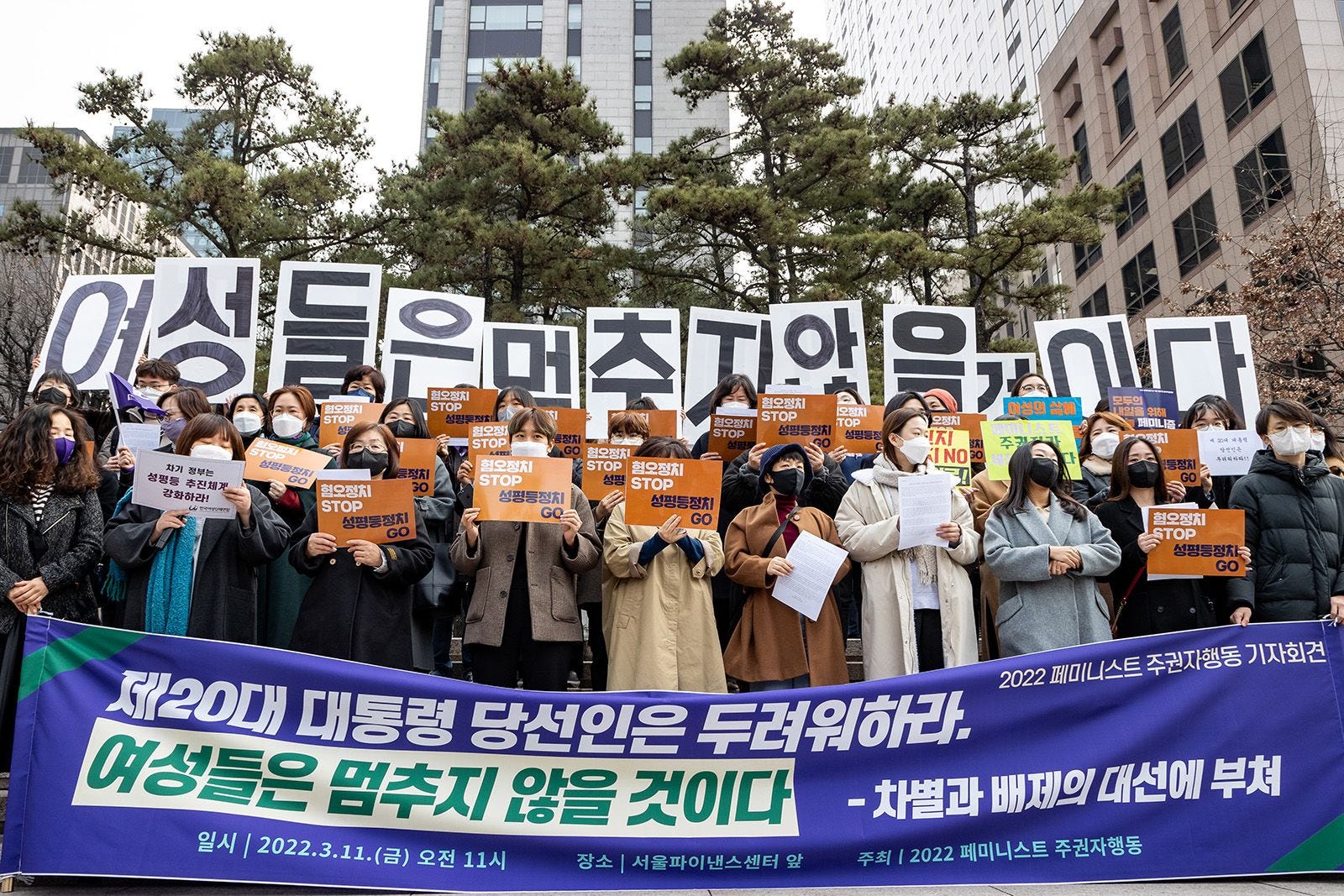
If you’ve read anything about South Korea’s collapsing birth rate in the past few years, you’ve almost certainly encountered the 4B movement. The name comes from four Korean words beginning with bi (meaning “no”): no marriage, no childbirth, no dating, no sex with men. It emerged from Korean feminist circles around 2017 to 2019, born of fury over gender-based violence, digital sex crimes, and a society where the word “feminist” is treated as a slur. Western media ran with it.
The narrative has been adopted with equal enthusiasm by people who agree on almost nothing else. First Things, the conservative religious journal, declared flatly that the movement is “both a consequence of South Korea’s fertility crisis and a cause.” From the other direction, progressive commentators frame 4B as effective resistance, a successful “birth strike” that has brought the patriarchal Korean state to its knees. One widely shared article in The International Affairs Review stated, without qualification, that the decline in Korea’s fertility rate “results from the 4B Movement.”
Here is what everyone discussing 4B seems to have missed: the movement has approximately 3,400 members on Naver, South Korea’s largest online platform, and claimed about 4,000 at its peak in 2019. As Ju Hui Judy Han, a gender studies scholar at UCLA, has noted, the vast majority of Korean feminists do not subscribe to 4B’s tenets, and the movement has actually lost momentum in recent years. More importantly, the timeline doesn’t work. South Korea’s birth rate fell below the replacement level of 2.1 in 1983. It crossed the “lowest-low” threshold of 1.3 in 2001. It dropped below 1.0 in 2018. The 4B movement emerged, at the earliest, in 2016 or 2017. The fertility collapse was well underway for decades before the first Korean feminist typed bihon into a Twitter post. Attributing Korea’s demographic crisis to 4B is like attributing a house fire to someone who showed up after the roof had already caved in and took a photograph.
So what is driving it?
A recent study by Sinn Won Han of Yonsei University and Fumiya Uchikoshi of Harvard, published in the Chinese Sociological Review, offers an answer that cuts against both framings. The mechanism is not ideological refusal or a "birth strike." It is more consequential: a large and growing share of young Korean men have become detached from the labor force entirely, limiting the options of women who do want to marry. Male employment (Korea, Japan, America, and almost everywhere) is effectively a prerequisite for marriage, and marriage is effectively a prerequisite for childbearing, that detachment cascades into a demographic crisis.
The story is not about women who won’t marry. It’s about men who can’t.
The natural experiment that nobody noticed
Japan and South Korea are, to a first approximation, the same country when it comes to the structural conditions that suppress fertility. Both have punishing work hours and expensive urban housing. Both are gripped by an education arms race in which parents pour enormous sums into private tutoring. Both maintain dual labor markets that punish women who step off the career track to raise children. And both have been grappling with low fertility for decades.
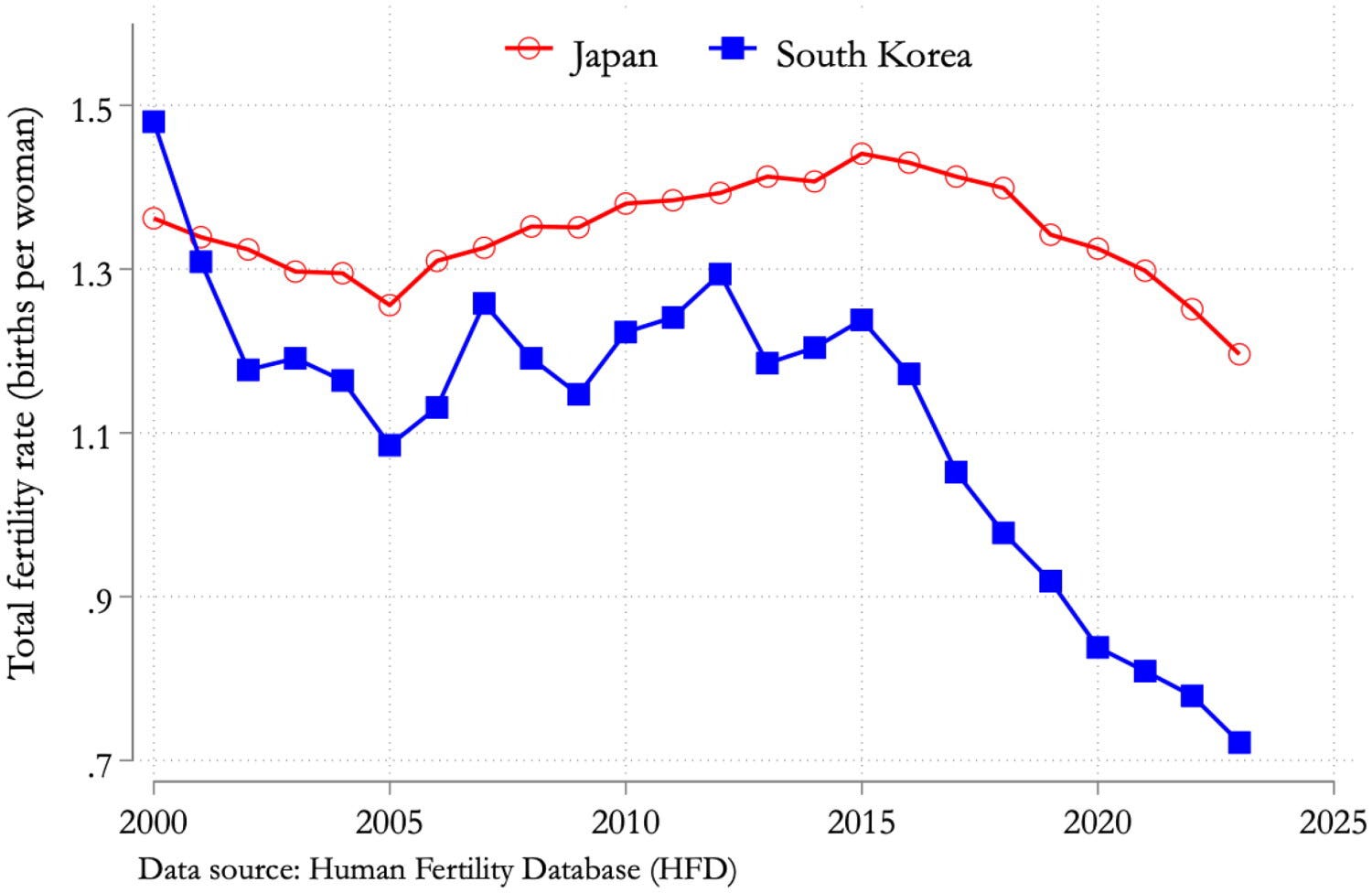
And yet. Korea’s total fertility rate has plummeted to 0.72 births per woman. Japan’s sits at 1.20. Between 2000 and 2023, Korea’s TFR fell by 51%. Japan’s fell by 12%.
If the standard explanations (gender inequality, housing costs, education expenditures, family-unfriendly workplaces) were sufficient, these two countries should look roughly the same. They don’t. And 4B cannot explain the gap either, since Japan has no comparable movement and its fertility has been far more stable.
Where the divergence lives
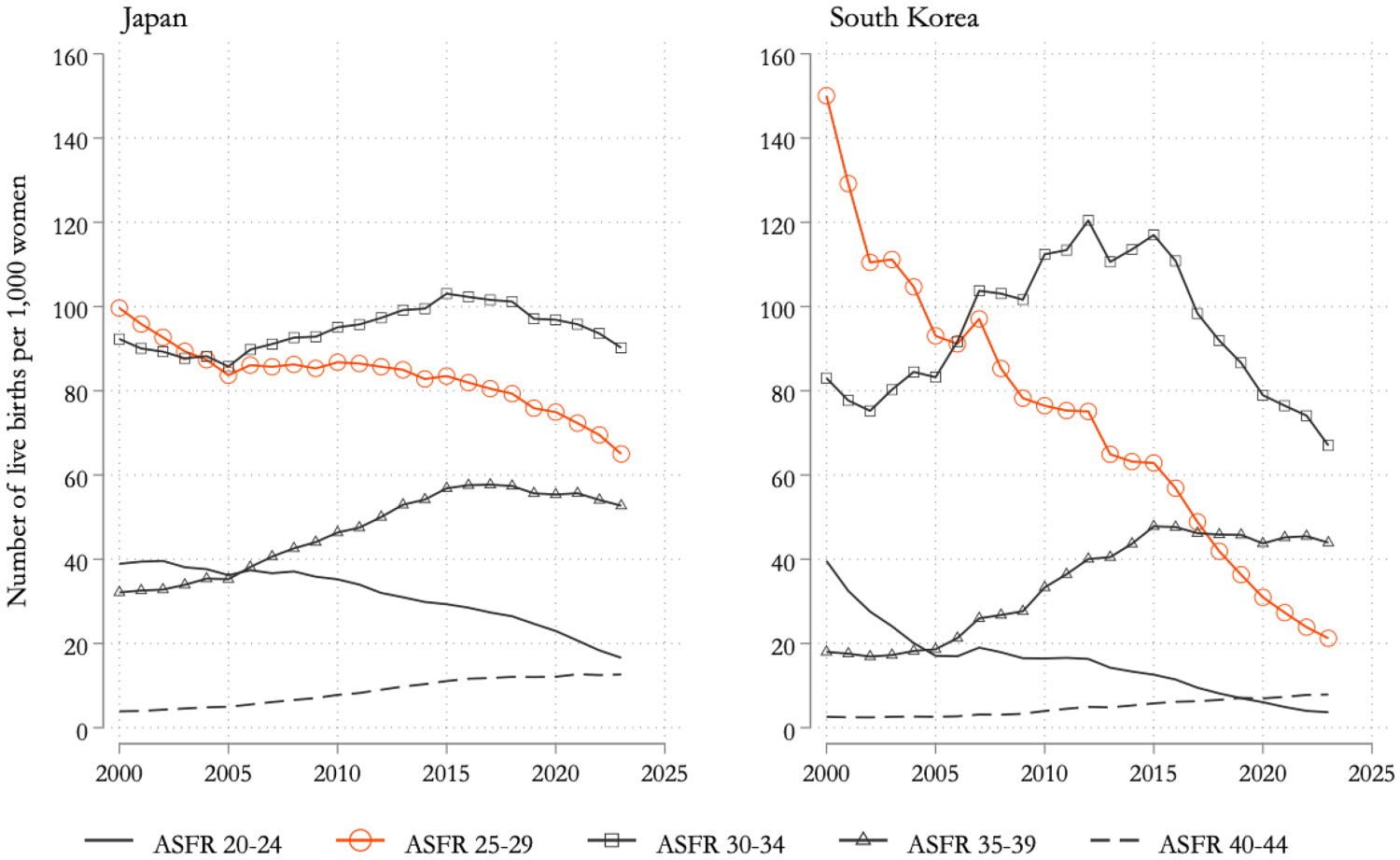
Han and Uchikoshi begin by decomposing the fertility decline by age group. The entire Korea-Japan divergence is concentrated in one demographic: women aged 25 to 29. In Korea, the birth rate for this age group collapsed from 150 live births per 1,000 women in 2000 to just 20 in 2023, an 87% decline. In Japan, the same age group fell 35% over the same period, from 100 to 65 births per 1,000.
Every other age bracket tells a broadly similar story in both countries. The 30 to 34 age group in Korea saw a temporary increase between 2005 and 2012 as some women who delayed childbearing had children a few years later, but that recuperation stalled and reversed. What initially looked like postponement has increasingly become abandonment.
If we want to explain the Korea-Japan divergence, we need to explain what changed for people in their late twenties.
Watching the wrong gauge
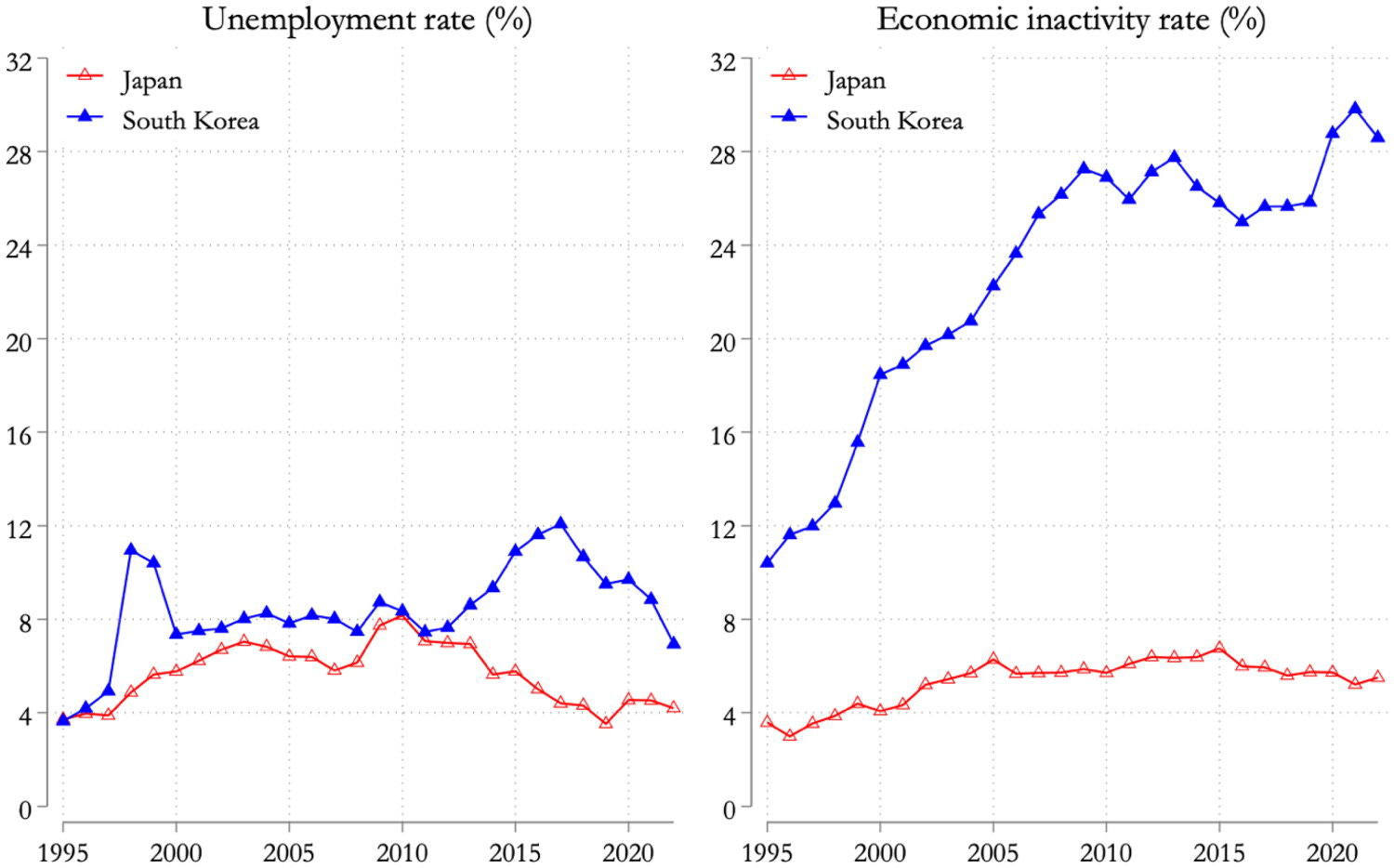
Most research on labor markets and fertility tracks the unemployment rate. Han and Uchikoshi argue it is the wrong indicator, at least for Korea. Unemployment among Korean men aged 25 to 29 has spiked during recessions (1997, 2008) but recovered each time. It has not trended dramatically upward.
The economic inactivity rate tells a different story. Inactivity captures individuals who are neither employed nor actively seeking work. Among Korean men aged 25 to 29, the rate has nearly tripled over three decades, rising from roughly 10% in the mid-1990s to 30% by the early 2020s. Among Japanese men in the same age group, the rate has barely moved: from 3.6% in 1995 to 5.5% in 2022.
This divergence has opened up steadily and structurally, not in response to any single recession. Unemployment is cyclical. Inactivity is secular. If you’re only watching unemployment, you’re watching a gauge that oscillates around a roughly stable mean while the real pressure builds somewhere your instruments aren’t pointed.
What economic inactivity looks like
Korea’s inactivity is different from what the term typically connotes in Western Europe, where it tends to reflect welfare dependency or health-related withdrawal and where associations with fertility are weak. In Korea, it is driven in large part by competitive preparation: young men spending months or years studying for civil service entrance exams, company hiring tests, or professional certifications. This is not withdrawal in the psychological sense. It is a rational, if individually costly, response to a labor market in which the gap between regular and non-regular employment is vast in wages, benefits, job security, and social status, and in which the entry points to regular employment are intensely competitive and narrowly gated.
But the composition of the inactive population has shifted. Among economically inactive Korean men aged 25 to 29, the share who are not students rose from 49% in 2000 to 67% by 2022. When inactivity reflects enrollment in a graduate program, it has a clear endpoint and a plausible payoff. When two-thirds of inactive young men are not enrolled in any educational program, when they are instead preparing for exams they may never pass, cycling through informal training, or simply stuck, the story changes.
And when they do eventually enter the labor market, they pay a lasting penalty. Those who experience prolonged inactivity or NEET status tend to be channeled into non-regular, temporary, or part-time positions with lower long-term wages and fewer protections. The preparation, in other words, often doesn’t work.
Numbers
The paper's country-level regression analysis puts numbers to the intuition. After controlling for seven other variables (male unemployment, female LFP, real house price index, paid leave, public spending on family benefits, GNI per capita, and Gender Inequality Index), the male economic inactivity rate for ages 25 to 29 is negatively and significantly associated with the age-specific fertility rate for women in the same age group. The coefficient is −2.488: each percentage-point increase in male inactivity is associated with a decline of roughly 2.5 births per 1,000 women aged 25 to 29.
Separating first births from second-and-higher births matters. Male inactivity suppresses both, but the mechanisms are different. For first births, male inactivity and male unemployment are the significant predictors; female labor force participation is not. For second and higher births, female labor force participation becomes strongly significant alongside male inactivity. The implication is that male economic exclusion blocks entry into parenthood altogether. Female employment, by contrast, constrains expansion of family size once a couple has already started. The first problem is about clearing the path to marriage; the second is about making it possible for working mothers to have more than one child.
Korea’s male inactivity rate increased by approximately 17 percentage points between the late 1990s and the early 2020s. Multiply 17 by 2.488 and you get a predicted decline of about 43 births per 1,000 women. The actual observed decline in the 25 to 29 birth rate over this period was roughly 130 births per 1,000 women. The rise in male inactivity thus accounts for approximately 33% of the total decline. For Japan, the same coefficient applied to a 1.3-percentage-point increase in inactivity predicts a decline of only 3.3 births per 1,000 women, about 10% of Japan’s (much smaller) observed decline.
The other variables in the model moved similarly in both countries. Male inactivity didn’t, and it explains a third of the divergence.
The panel regression draws on 48 country-year observations across two countries. That’s thin. But the results survive two important robustness checks, re-estimation using only pre-pandemic data (2000 to 2019) and an alternative lag structure, and they are corroborated by two entirely independent analyses using individual-level data. Triangulation across macro regressions, vital statistics, and survey data is the real evidential strength here, not any single regression table.
Marriage Markets
Among marriages involving men aged 25 to 29, the share in which the groom was unemployed or inactive at the time of registration was 7.7% in 2000 and fell below 5% by 2022.
This seems to cut against the paper’s argument. But the reading is exactly backward. The declining share tells us not that inactive men are marrying at reasonable rates, but that they are being excluded from the marriage market almost entirely. The total number of marriages among men aged 25 to 29 fell by approximately 89% between 2000 and 2022, from roughly 121,000 to about 14,000. The marriages that still occur are overwhelmingly between employed men and their partners. The inactive men aren’t marrying at a discount. They’re not marrying at all.
The standard 4B framing places women’s refusal at the center of the fertility decline, but the marriage market is shrinking in large part because a growing share of men lack the economic standing that social norms treat as a prerequisite for marriage, not just in Korea but also in most of the developed world. If you don’t marry, you almost certainly don’t have children.
What inactive men believe about their own futures
The paper’s final analysis draws on survey data from the Korean Labor and Income Panel Study. Compared to employed peers, economically inactive non-students report significantly lower confidence across every dimension of the life-course sequence Korean society expects young men to complete: securing a desired job, obtaining housing, dating and marriage, having and raising children. These are not men who have rejected the aspiration. They want what their parents had. They just don’t believe they can get it.
The popular discourse frames Korea’s fertility crisis in terms of choice: young people choosing careers over families, freedom over obligation, protest over conformity. The attitudinal data suggests something different for a large share of the population. Not choice but exclusion. Not what people want but what they believe is possible.
Why Korea and not Japan?
If the mechanism is correct, then the Korea-Japan divergence resolves into a prior question: why did male inactivity rise so dramatically in Korea and not in Japan?
The paper points to several structural factors. The retirement of Japan’s large baby boomer cohort (born 1947 to 1949) created labor market vacancies that younger workers could fill. Korea’s demographic structure offered no comparable opening. Japan’s post-2010 stimulus policies also improved youth employment.
Beyond the study’s analysis, the structural environment facing a young Korean man compounds the labor market gap.
Housing is one example. Monthly rents in Seoul are actually somewhat cheaper than in Tokyo, but that comparison is misleading. Korea’s housing market operates on jeonse, a system in which tenants pay a lump-sum deposit of 60 to 80% of a property’s market value in exchange for living rent-free for two years. For a modest apartment in Seoul, that deposit can easily reach $75,000 or more. The deposit is theoretically refundable, but jeonse fraud, where landlords cannot or will not return deposits, has become a serious and growing problem. For a young man who is economically inactive or precariously employed, accumulating a jeonse deposit is functionally impossible, and the alternative (monthly rent, known as wolse) is rising as the jeonse system frays. Seoul apartment prices have roughly doubled in five years, with a price-to-income ratio of approximately 10 to 1, three to four times that of comparable economies. Tokyo’s upfront deposit requirements are far lower.
Then labor market conditions. Japan’s acute labor shortage, driven by boomer retirements and a shrinking working-age population, has created something approaching a seller’s market for young job seekers. The ratio of job openings to applicants has hovered well above 1.0 for most of the past decade. Korea offers no such tailwind. Korean wages have actually surpassed Japan’s in recent years (about 4 million won monthly at firms with 10+ employees in 2022, versus 3.8 million won at Japanese equivalents), but these wages accrue to those who have made it through the gate. Those who haven’t face temporary, part-time, and precarious positions that pay far less.
It is almost like aggregate wage statistics hide a mind-boggling amount of variation between workers, and the best way forward is to eliminate slack in the labor market. Fancy that.
One factor the paper does not discuss: mandatory military service. Korean men serve approximately 18 months, typically between ages 18 and 21. Japanese men face no such obligation. Military service does not explain the trend (it is a constant, not a variable) but it does explain why Korea’s system is structurally more fragile. An 18-month delay compresses the window between completing education and the late twenties into an extremely tight band. When the post-service pathway was straightforward, this was manageable. As the pathway has gotten longer and more uncertain, the fixed delay leaves less and less margin.
The right problem
The implications cut against both sides of the culture war around Korea’s fertility decline.
To conservatives who blame feminism: the data shows that Korea’s fertility collapse is driven by men who cannot enter the labor market, cannot enter marriage, and cannot have children. Blaming 4B for a demographic transformation driven by the economic exclusion of hundreds of thousands of young men is a distraction from the structural reforms that might actually help.
To progressives who celebrate 4B as effective resistance: Korean women face genuine grievances about gender inequality, violence, and the unequal division of domestic labor. But framing the fertility decline as a successful “birth strike” misidentifies the mechanism and risks obscuring the labor market crisis trapping a generation of young men in economic limbo. It doesn’t take much thought to realize just how bad of an idea that is.
Not to mention, if the goal is to maximize fertility rates, based on this paper (and others) the goal is an extremely tight job market for all genders. Gender conflict and labor market exclusion are not competing explanations. They are compounding ones. But we cannot fix what we refuse to see.
So, the point being?
Korea may not be an outlier. It may be a leading indicator. China’s youth unemployment rate hit record levels in 2023, high enough that the government temporarily stopped publishing the data. The structural conditions that produce male economic inactivity in Korea (intense credentialism, dual labor markets, limited entry points to stable employment, strong male-breadwinner norms) are present across the region in varying degrees.
If male labor market detachment is a significant driver of fertility decline and that detachment is intensifying across East Asia’s high-pressure economies, then the policy conversation needs to shift. The question is not only how to make it easier for employed, married couples to have children. It is how to ensure that young men can enter the labor force at all, early enough, and with enough stability, to contemplate family formation.
Related to your point about retiring workers, one of the places I disagree with most people a lot is over raising the retirement age.
It's not that I like resources being transferred from young to old, I'd love to cut benefits and lower taxes on young people.
It's that I can't think of a less effective change. There are two people working in their late 60s:
1) Some poor bastard doing something physical his body can't do anymore because he doesn't have a choice.
2) Some disinterested and/or out of touch older manager squating on an office job and keeping a younger more dynamic person from moving up and making the economy more dynamic.
I get that raising the retirement age pencils out as saving money, but I feel like the actual positive impact on the economy is far less.
Finally, people can actually enjoy the early part of their old age. They can travel, have hobbies, play with their grandkids, know who they are and where they are.
It's the end of life that gets way over subsidized. Olds need to go on a few less cruises, downsize their houses, and die more gracefully. In exchange let them enjoy the best part of their retirement.
Feminism destroys everything it touches.